SpaceX Stock Faces Technical Breakdown as AI Spending Hits $15.8 Billion
Key Takeaways
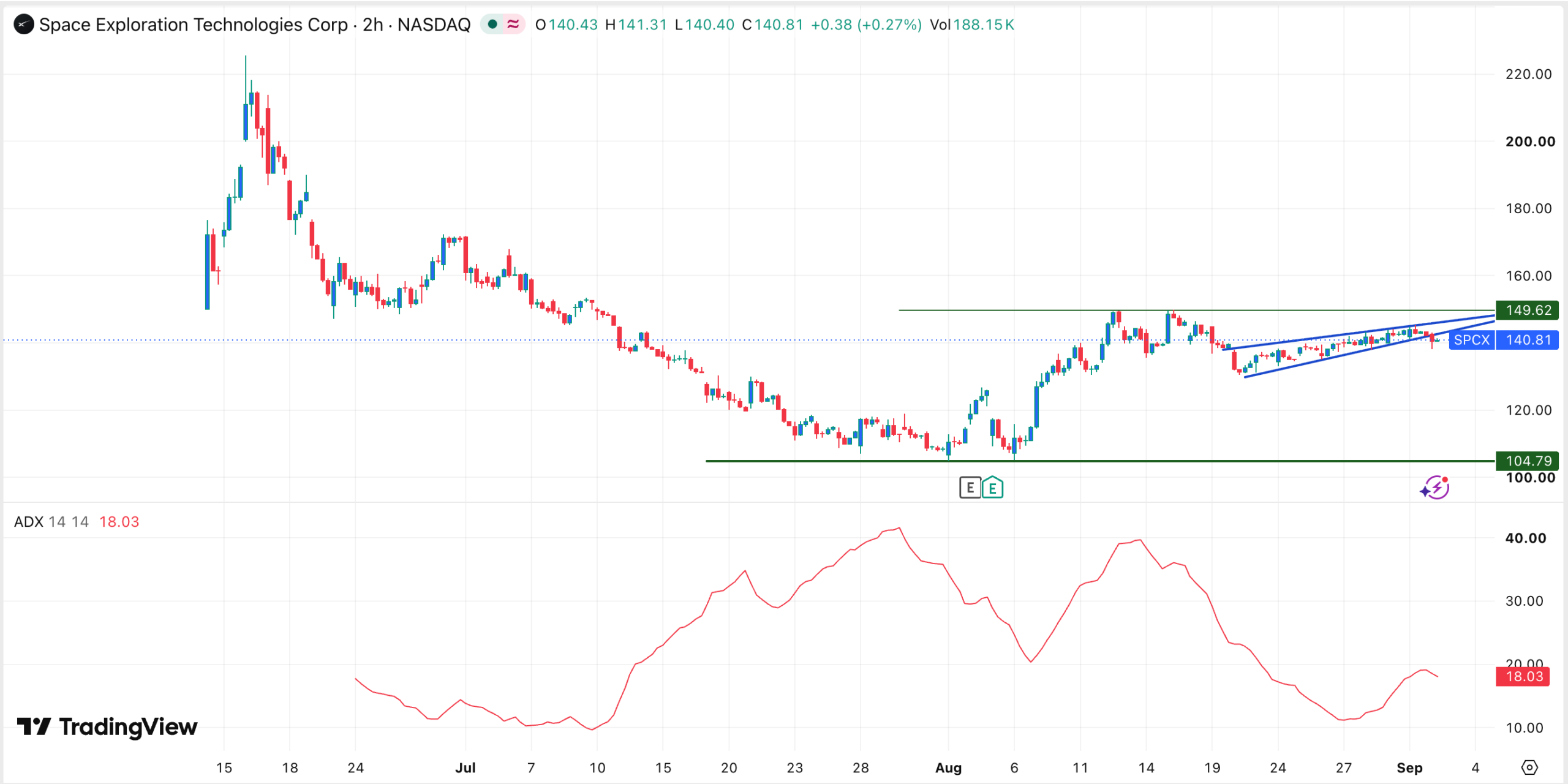
- •SpaceX stock broke below the lower boundary of a rising wedge pattern and trades below key resistance near $149.62, with falling RSI, PPO, and ADX signaling weakening momentum.
- •The company's AI capital expenditure jumped to roughly $15 billion in Q2 from $7.7 billion a year earlier, contributing to negative free cash flow for the quarter.
- •Q2 revenue nearly doubled year over year to $7.8 billion, with Starlink—now surpassing 12 million users—as the largest contributor.
- •SpaceX's Grok chatbot holds under 10% market share against rivals like Google Gemini, Claude, ChatGPT, and cheaper models from Meta and Chinese firms.
- •Despite quarterly losses, SpaceX carries a market capitalization near $1.9 trillion, with a Wall Street consensus price target of $220, about 57% above current levels.
Key Insights
SpaceX stock has broken below the lower boundary of a rising wedge on the supplied chart, weakening its short-term technical structure.
SpaceX spent $15.83 billion on its AI segment during Q2, while total quarterly capital expenditures reached $18.37 billion.
SpaceX carries a market capitalization near $1.9 trillion, creating valuation risk despite rapid revenue growth and bullish Wall Street targets.
SpaceX stock is facing renewed downside risk after breaking below the lower boundary of a rising wedge on the supplied daily chart. SPCX recently traded in the $139–$142 range, having rebounded sharply from its Aug. 3 low of $104.83. The stock climbed to an August high of $149.80 before losing momentum near the $150 resistance area.
The technical weakness emerges as investors weigh SpaceX's rapidly expanding artificial-intelligence spending following its acquisition of xAI. That spending pattern is part of a broader industry trend: major technology and AI companies across the sector have been ramping up capital expenditures on data centers, chips, and infrastructure to compete in AI, and investors have increasingly scrutinized whether that spending is matched by returns. Q2 results showed strong revenue growth, but AI capital expenditure increased dramatically and the company remained unprofitable.
SpaceX Stock Is Facing Technical Risks
SPCX has bounced back over the past few weeks, rising from an August record low of $104.80 to a high of $149.62. Since then, the stock has encountered substantial technical challenges that could lead to a strong near-term retreat.
One of the risks is that it has formed a rising wedge pattern whose two trendlines are about to converge — and the price has now moved below the lower line of that pattern. A rising wedge is generally viewed by technical analysts as a reversal pattern that tends to resolve to the downside when the lower boundary gives way.
The stock has also remained below a key resistance level at $149.62, its highest swing point on August 12 and 17. In addition, it has formed a bearish divergence pattern, as both the Relative Strength Index (RSI) and the Percentage Price Oscillator (PPO) have continued to fall. A bearish divergence occurs when momentum indicators weaken even as prices hold near highs, which analysts read as a sign of fading buying pressure.
A further risk is that the Average Directional Index (ADX) has kept trending downward. The ADX is an indicator that gauges the strength of a trend: a trend is generally considered strong when the ADX has moved above 20 and is pointing upward.
SpaceX Is Facing Major Risks
On the positive side, SpaceX has several major catalysts, including strong revenue growth. Its recent earnings report showed revenue jumping to $7.8 billion in the second quarter from $4 billion in the same period last year. All of its businesses — space, connectivity, and AI — grew, with Starlink the largest contributor. Starlink's user base crossed the 12 million milestone, and its growth may continue for the foreseeable future.
Analysts also remain optimistic about the business, with a consensus price target of $220, about 57% above the current level. Some of the most bullish analysts come from firms including Bernstein, Morgan Stanley, Arete Research, Oppenheimer, and Wells Fargo.
Despite that optimism, the company faces major risks that could weigh on its business over the long term. One is that its booming data center business is experiencing substantial delays, and media reports suggest it is attempting to overhaul its data center team. These delays could ultimately cost the company billions of dollars over time.
The company is also contending with rising memory, GPU, storage, and construction costs. As a result, its AI capital expenditure jumped to $15 billion in the second quarter from $7.7 billion a year earlier. The metric soared from $3.3 billion in the first half of last year to $23.5 billion in the first half of this year. That level of spending explains why the company posted negative free cash flow in Q2. Sustained negative free cash flow at this scale means the company must rely on continued access to capital or further investor tolerance for losses, a balance that other capital-intensive AI players are also being asked to strike.
Other challenges are mounting as well. Notably, the AI chatbot industry is highly competitive: Grok, SpaceX's chatbot, faces rivals such as Google Gemini, Anthropic's Claude, and OpenAI's ChatGPT. Just this week, Meta Platforms announced that its AI model will be significantly cheaper than Grok and other models. At the same time, Chinese AI models such as Kimi and DeepSeek are gaining market share. Grok's market share remains below 10%. In a market where several well-funded competitors are racing to release newer and cheaper models, standing still on model quality or pricing carries competitive risk.
Most notably, SpaceX is a highly valued company, carrying a valuation of over $1.9 trillion while still losing billions of dollars each quarter. For investors, the key indicators to watch going forward include the pace of AI capital expenditure, whether free cash flow improves as data center projects come online, and Grok's ability to gain share against larger rivals.
This article is for informational purposes only and does not constitute financial advice. Equity markets can experience sharp price movements.
The post SpaceX Stock Risks Drop as AI Spending Reaches $15.8B appeared first on The Market Periodical.
