SpaceX Stock Holds Near $150 as Falcon 9 Prepares to Launch Google AI Chips Into Space
Key Takeaways
- •A SpaceX Falcon 9 rocket is scheduled to carry Google's Tensor Processing Units into orbit as part of Project Suncatcher, testing how the AI chips perform in space.
- •Google is SpaceX's largest investor with a stake worth over $82.4 billion and pays more than $925 million per month for its AI business.
- •SpaceX's AI segment revenue grew to $2.56 billion in the second quarter from $818 million a year earlier, supported by deals including a contract worth over $1.2 billion with Anthropic.
- •More than 328 million SpaceX shares become eligible for sale on October 9, followed by over 800 million shares at the six-month lockup expiry in December.
- •The stock is forming an ascending triangle pattern on the four-hour chart, with a potential breakout target of $200, while a drop below $130 would invalidate the bullish outlook.
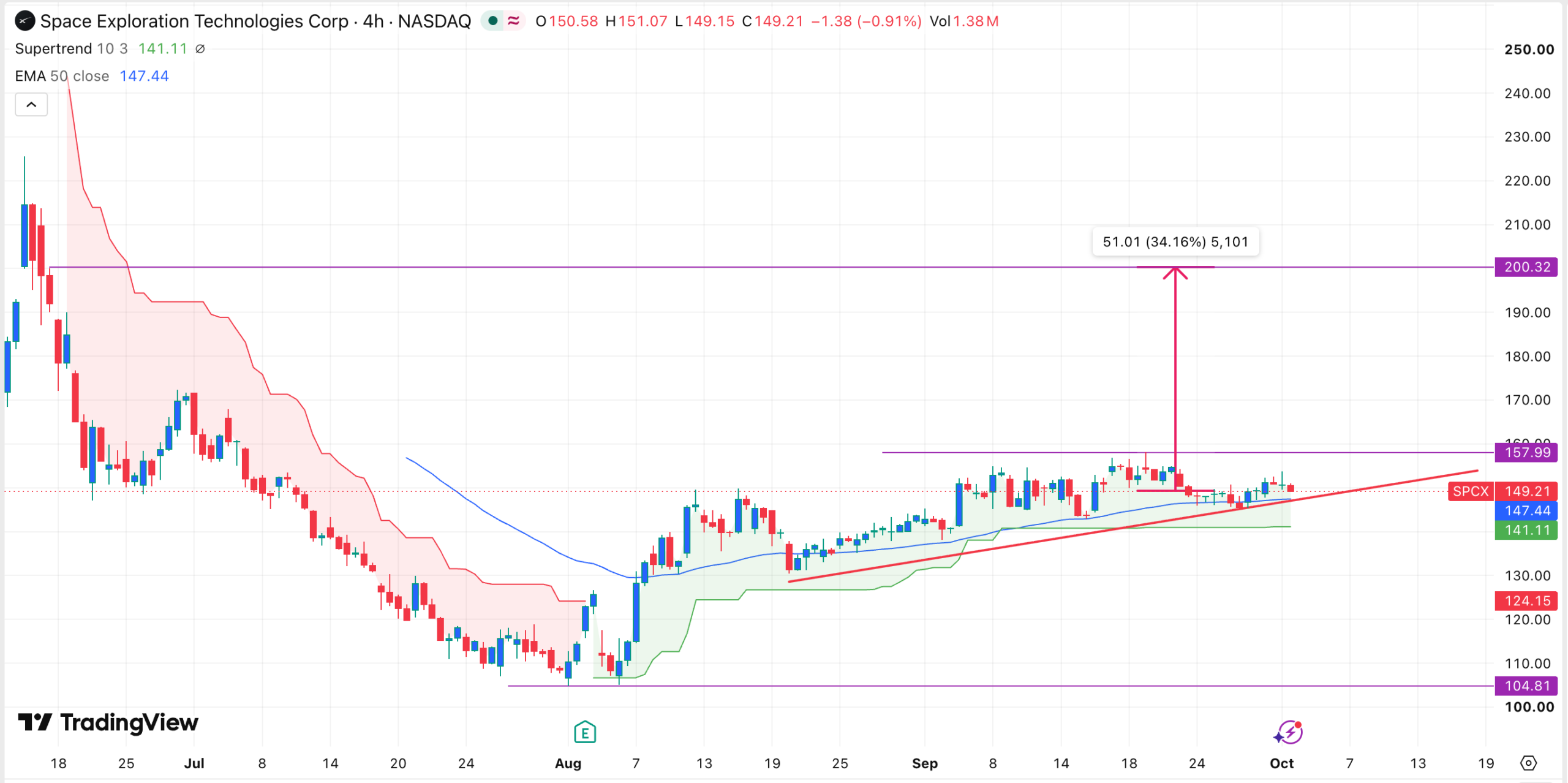
SpaceX (SPCX) stock traded around $150 on Oct. 1 as investors balanced the company's expanding role in orbital AI infrastructure against a steadily growing post-IPO share float. Shares have consolidated in a narrow band between the mid-$140s and mid-$150s since rebounding from their August lows, and remained below their recent September highs as traders awaited another scheduled share unlock.
A separate catalyst emerged from Google, whose first Project Suncatcher orbital AI experiment is riding aboard a SpaceX Falcon 9. The mission, set to carry Google's Tensor Processing Units (TPUs) into orbit, could open a new frontier for the AI industry — and it arrives just as the stock is forming a series of bullish technical patterns. TPUs are the custom chips Google designs to run AI workloads in its data centers, and Suncatcher will test how they perform in orbit.
SpaceX to Launch Google TPUs Into Space
Elon Musk's Space Exploration Technologies (SpaceX) has big ambitions, chief among them the deployment of data centers in space — a move that would make it the first company to do so. The appeal is solar power: energy is readily available in orbit and up to eight times more intense than what reaches the Earth's surface. That energy constraint is one the AI industry knows well on the ground, where securing enough electricity for rapidly expanding data centers has become a central challenge — which is why a working orbital alternative would be watched closely across the sector.
The company is now preparing to take an early step in that direction for Google, according to CNBC, with a Falcon 9 rocket slated to loft the search giant's TPUs into space. The development is significant for both SpaceX and Google, and the arrangement is mutually beneficial: Google is SpaceX's biggest investor, with a stake worth over $82.4 billion.
Google has also entered into a major deal with SpaceX, under which it is paying over $925 million per month for its AI business.
SpaceX's most recent results showed that its AI business is one of the company's fastest-growing segments, with revenue reaching $2.56 billion in the second quarter, compared with $818 million in the same period last year. The segment has signed further deals this year, including a contract with Anthropic worth over $1.2 billion and another with Reflection AI. The division is expected to underpin SpaceX's projected revenue growth: Yahoo Finance data shows the company is expected to generate more than $44.5 billion this year and $112 billion next year.
Share Unlocks Keep SPCX Range-Bound
One reason SpaceX stock has traded in a narrow range is the ongoing series of share unlocks. Since the unlock schedule began, the company has released several tranches, allowing employees to start selling their shares. Such schedules are a standard feature of large public listings: early holders are barred from selling for a set period, and their shares then reach the market in waves rather than all at once.
The unlocks will continue this quarter, with the next tranche expected on October 9, when more than 328 million shares will become eligible for sale. In addition, the six-month lockup expiry arrives in December, with over 800 million shares set to become eligible for sale. Elon Musk will be able to sell his shares starting June 12 next year. Eligibility alone does not mean the shares will be sold, but each wave enlarges the float available to trade.
Historically, companies tend to struggle when more shares come to market, as added supply can weigh on a stock unless demand keeps pace. Despite the overhang, analysts remain bullish SpaceX, citing its strong revenue growth and growing market share in the data center business. Among the most bullish are analysts at Goldman Sachs, Morgan Stanley, Royal Bank of Canada (RBC), and Deutsche Bank.
Technical Analysis: Ascending Triangle Takes Shape
The four-hour chart shows the SPCX share price has remained under pressure over the past few weeks. A closer look reveals the stock is slowly forming an ascending triangle pattern, with its two boundary lines nearing their confluence — the point where breakouts normally occur. The pattern's name describes its geometry: resistance sits near a fixed level while the lows climb steadily, which is why technicians treat the narrowing range as building pressure for a resolutionn
SpaceX has held slightly above the Supertrend indicator, a bullish signal, and has also stayed above the 50-period Exponential Moving Average (EMA). Taken together, these signs suggest the stock could be set for a strong bullish breakout in the near term. If that happens, the next target to watch would be $200, roughly 35% above the current level. A drop below the $130 support level would invalidate the bullish outlook. With the pattern's boundaries converging against an active unlock calendar, the coming sessions offer traders clear markers on both sides of the range.
This article is for informational purposes only and does not constitute financial or investment advice. Analyst targets and technical patterns do not guarantee future returns.

