SpaceX Stock Plunge Could Signal Buying Opportunity as Revenue Surges 92%
Key Takeaways
- •SpaceX reported Q2 revenue of $7.8 billion, representing a 92% year-over-year increase driven by growth across Starlink, space, and AI business segments.
- •The company's capital expenditure exceeded $18 billion in Q2, with the AI segment alone accounting for $15.2 billion of total spending.
- •Starlink reached 12 million subscribers and deployed a satellite constellation exceeding 10,000 units, generating $4.2 billion in connectivity revenue for the quarter.
- •Analysts project full-year revenue of $39.1 billion for the current year, rising to $73 billion next year, supported by major AI contracts including a $1.2 billion-per-month agreement with Anthropic.
- •The consensus analyst price target stands at $229, reflecting approximately 99% upside potential from current trading levels, with bullish ratings from Bernstein, UBS, Wells Fargo, and Piper Sandler.
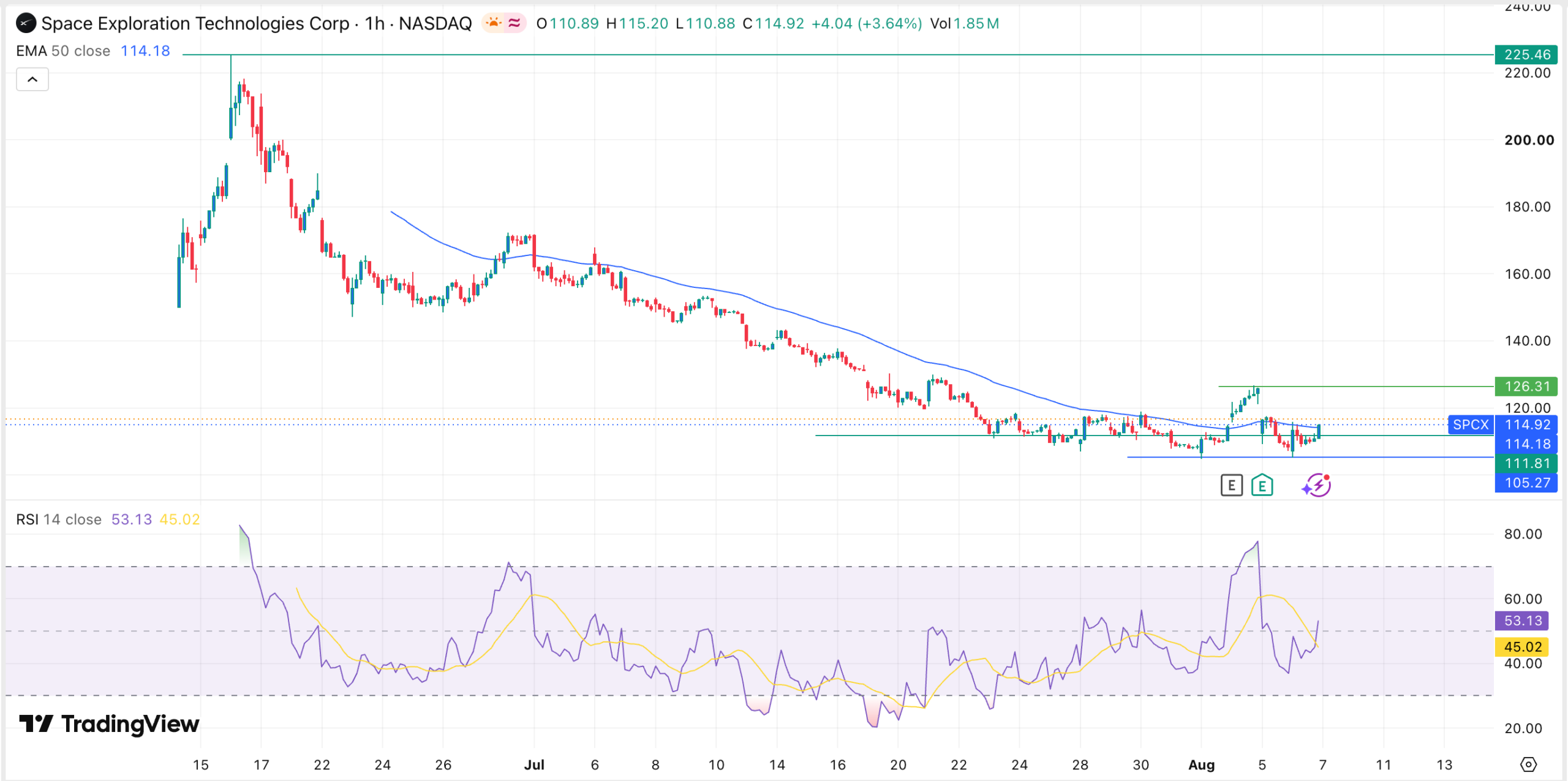
SpaceX shares have shed billions of dollars in value over the past two months, falling sharply from their post-IPO peak of $225 to a record low of $105. Despite mounting short interest, several financial and technical indicators suggest the sell-off may be overdone, potentially creating an attractive entry point for investors. The pullback comes amid a broader market environment in which capital-intensive growth companies—particularly those investing heavily in AI infrastructure—have faced heightened scrutiny over near-term cash burn, even as long-term demand projections for AI compute capacity continue to escalate.
SpaceX Reports Mixed but Strongly Growing Q2 Results
SpaceX released its second-quarter financial results earlier this week, revealing a 92% year-over-year revenue increase to $7.8 billion. The figures underscore sustained demand across the company's core business segments.
The Starlink division closed the quarter with 12 million subscribers and a satellite constellation exceeding 10,000 units. Connectivity revenue reached $4.2 billion for Q2 and $7.5 billion for the first six months of the year. Starlink's subscriber base has grown steadily as satellite broadband competition remains limited; Amazon's Project Kuiper has yet to begin commercial service at scale, leaving SpaceX with a significant first-mover advantage in low-Earth-orbit internet connectivity.
Space revenue climbed to $962 million in Q2, up from $619 million in the same period a year earlier. AI revenue surged to $2.56 billion, compared with $818 million previously. Starlink's connectivity business generated over $1.6 billion, while the space and AI segments posted losses of more than $542 million and $1.2 billion, respectively, during the quarter.
A central concern for investors is the company's escalating capital expenditure. CAPEX exceeded $18 billion in Q2, with the AI segment alone accounting for $15.2 billion. A portion of this AI spending is directed toward Nvidia, which is supplying chips to the company. The spending pattern mirrors a wider industry trend: large technology firms have collectively committed tens of billions of dollars to AI data center buildouts, driven by surging demand from enterprise customers seeking generative AI capabilities.
Analysts Project Continued Revenue Growth
SpaceX is widely expected to sustain its growth trajectory, supported by dominant market positions in satellite launch services and satellite broadband connectivity.
According to Yahoo Finance data, analysts anticipate the company will generate approximately $12 billion in revenue in the current quarter, a substantial increase over Q2. Full-year revenue is projected at $39.1 billion for this year, climbing to $73 billion next year.
A key growth driver is the company's expanding AI data center business. SpaceX has secured agreements including a $1.2 billion-per-month contract with Anthropic, a $950 million deal with Google, and a $150 million arrangement with Reflection AI. Management expects capital spending to moderate once the Terafab project is completed. The ability to transition from heavy construction-phase spending to a more normalized run-rate is a milestone investors are watching closely, as it would mark the point at which the AI infrastructure investment begins translating more directly into margin expansion.
MarketBeat data shows that the consensus price target among analysts covering the stock stands at $229, representing approximately 99% upside from current levels. Firms with bullish ratings include Bernstein, UBS, Wells Fargo, and Piper Sandler.
Technical Analysis Points to Potential Bottom
On the hourly chart, SPCX is exhibiting signs of a potential bottom. The stock has formed a double-bottom pattern at $105.27 with a neckline at $126.31, its high from August 4. Price is currently attempting to reclaim the 50-period Exponential Moving Average, and the Relative Strength Index has moved above the neutral 50 level.
A sustained move could see the stock target the psychological $200 level in the coming months. Conversely, a decline below support at $111 would invalidate the bullish technical setup.

