SpaceX Posts $14.58 Billion Q3 Revenue as AI Segment Surges 830%; Musk Confirms Tesla Merger Committees
Key Takeaways
- •SpaceX's Super Intelligence segment generated $7.56 billion in revenue, up 830% year-over-year, making AI compute and software the company's largest revenue source for the first time.
- •The company reported GAAP net income of $4.4 billion, its first solidly profitable quarter since listing, after a $1.05 billion loss in the prior-year quarter.
- •Nine-month capital spending of $48 billion exceeded operating cash flow of $13.1 billion by roughly $35 billion, though about $90 billion in cash and marketable securities provides a buffer.
- •Starlink connectivity revenue grew 69% to $5.25 billion with consumer subscribers up 89% to 13.6 million, while Starship Flight 14 became the first revenue-generating Starship mission.
- •SpaceX and Tesla have formed special committees of independent directors to explore a merger, and any deal would require approval from more than 50% of all Tesla shares.
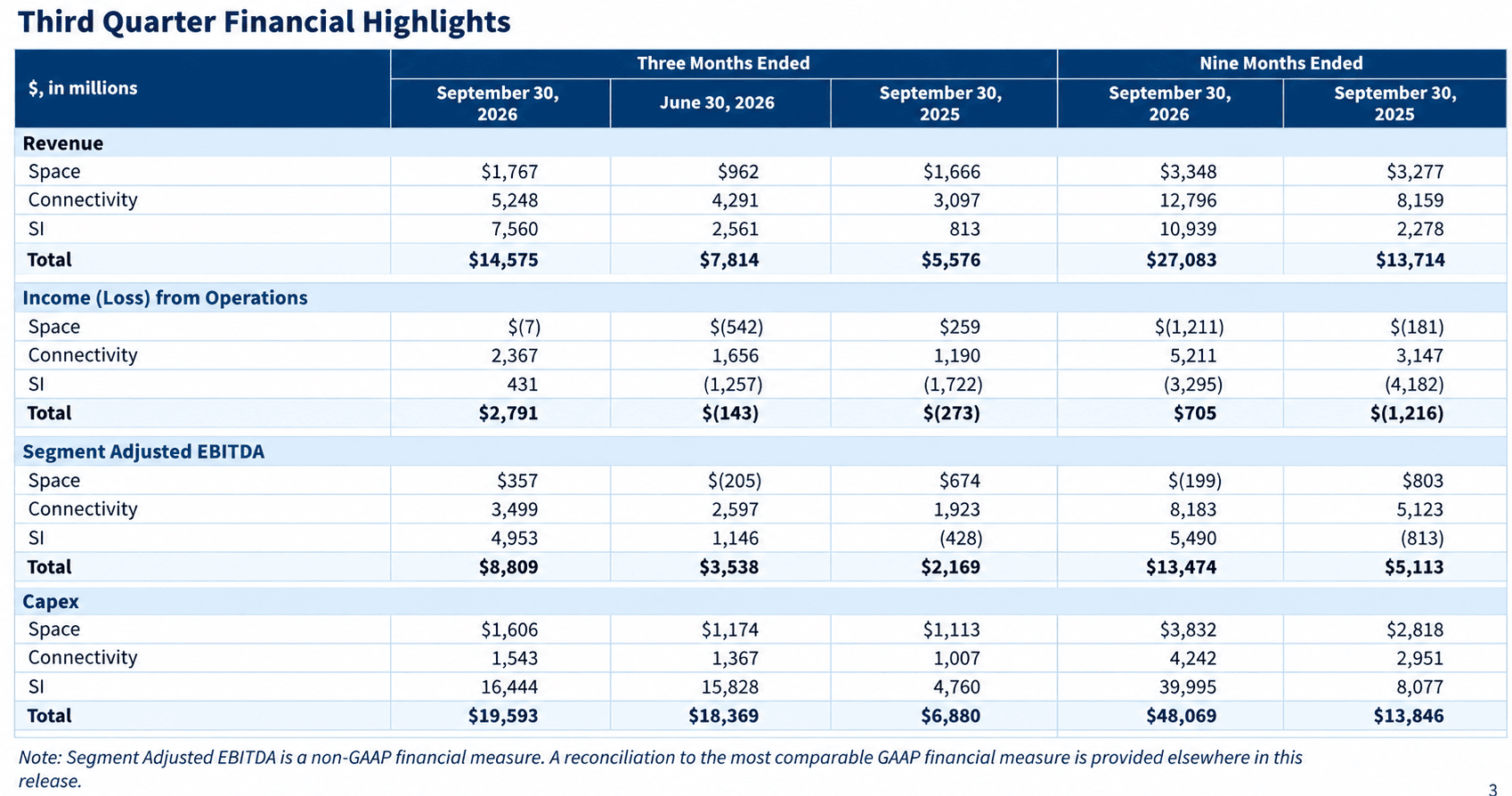
SpaceX reported third-quarter 2026 results after the bell on October 20 that underscored the company's transformation from a rocket-and-satellite operator with an AI side project into an AI compute and software business that also owns the world's dominant launch system and a leading satellite broadband network.
Revenue surged 161% year-over-year to $14.58 billion, comfortably ahead of the roughly $12.7 billion consensus estimate and about $1.7 billion above projections. Now trading under the ticker SPCX following its 2026 IPO, the company saw its newly branded Super Intelligence (SI) segment generate $7.56 billion of revenue, up 830% from a year earlier and, for the first time, more than half of the total. That mix shift is the context for the rest of the report: SpaceX's largest source of revenue is now AI compute and software rather than launch or broadband — the first quarter in which the SpaceXAI restructuring is fully visible in the revenue split.
Adjusted EBITDA came in at $8.81 billion against a consensus of about $6.6 billion, up 306% year-over-year. The company swung to GAAP net income of $4.4 billion from a $1.05 billion loss in the prior-year quarter — its first solidly profitable quarter since listing. Adjusted EPS of roughly $0.35 more than doubled Street expectations of $0.13 to $0.16.
SI Segment Driven by Cloud Deals, Cursor and Grok
The SI segment added $6.7 billion in incremental revenue from three sources: the activation of major new cloud services agreements, the acquisition of coding platform Cursor — which closed mid-quarter and contributed $608 million — and accelerating adoption of the Grok model family, including the newly launched Grok Bot agentic system. All three are new or newly activated revenue lines — a young revenue base where customer concentration in AI compute remains a flagged risk.
The segment also delivered a dramatic turnaround. After posting a $1.26 billion operating loss as recently as Q2, SI turned operationally profitable at $431 million, even while absorbing $1.2 billion in Cursor-related stock compensation, and delivered $4.95 billion in adjusted EBITDA.
On the earnings call, CFO Bret Johnsen offered a striking metric: at current pricing, new compute deployments are paying back in under a year, with compute pricing tracking "slightly above the high end" of 30–50 per watt. Per-watt pricing is the conventional yardstick for data-centre economics, so the sub-one-year payback figure is effectively a statement that each new deployment recoups its build cost within roughly its first year of operation. Nameplate capacity reached 1.7 gigawatts at quarter-end, up from 0.6 GW a year earlier — nearly a threefold increase in twelve months — as construction continued on the COLOSSUS II facility.
Starlink and Space Segments Remain Strong
Starlink, long SpaceX's profit anchor, stayed healthy. Connectivity revenue rose 69% year-over-year to $5.25 billion, with segment operating income up 99% to $2.37 billion. Consumer subscribers climbed to 13.6 million, up 89% from a year earlier, while ARPU ticked up 5% sequentially to $69. Starlink is now installed on more than 3,800 aircraft, and enterprise and government revenue jumped 91%. In other words, the segment that has long anchored SpaceX's profitability is still expanding briskly even as SI becomes the larger business.
The Space segment contributed $1.77 billion, up 6% year-over-year. The quarter was highlighted by Starship Flight 14, the first revenue-generating Starship mission, which deployed 26 V3 Starlink satellites carrying roughly 10 times the downlink capacity of a Falcon 9 launch. That flight turns Starship from a development programme into a revenue-generating asset in its own right. SpaceX also announced Starbase, Louisiana, a next-generation spaceport targeting its first launch in 2029.\n## Heavy Capital Spending Weighs on Cash Flow
The quarter was not without strain. Capital expenditure totalled $19.6 billion, $16.4 billion of it in the SI segment, and nine-month capital spending of $48 billion dwarfs operating cash flow of $13.1 billion — a shortfall of roughly $35 billion over nine months. Adjusted EBITDA of $8.8 billion also sits well above GAAP operating income of $2.8 billion — a gap worth monitoring. Even so, roughly $90 billion in cash and marketable securities provides a formidable buffer, and how durable that buffer proves at the current spending pace is the central financial question hanging over the buildout.
Merger Committees Formed at SpaceX and Tesla
Musk confirmed on the call that both SpaceX and Tesla have formed special committees, composed of independent directors and created at shareholder request, to explore a merger. Because Musk is a conflicted party in both companies, he cannot participate in the discussions. That structure means any combination will ultimately be decided by independent directors and shareholders rather than by Musk himself. He was measured in his remarks: "I don't think we should necessarily assume a SpaceX and Tesla merger is a certainty. And I think that would be overstating it. Do I think it would be a good idea? Yes."
The strategic logic, as Ark Invest frames it, is a combined entity generating $3.8 trillion in sales by 2031, with Tesla's robotaxi cash flows funding SpaceX's orbital data centres and SpaceX's compute serving as the planning layer for Optimus deployments. Governance hurdles remain significant, however: any deal would require approval from more than 50% of all Tesla shares voting yes.
Musk's guidance is likely to intensify the debate. He projected annual recurring revenue of $500 billion to $1 trillion by the end of 2027 — figures that annualize to more than $55 billion in 2026 but imply a growth trajectory no public company has ever sustained.
The quarter produced a series of milestones for SpaceX: SI's 830% growth marked the first full validation of the SpaceXAI restructuring, the segment's profitability marked a first under the new operating model, and the merger committees confirmed months of speculation. The risks — capital intensity, customer concentration in AI compute, and the governance complexity of merging two Musk-controlled companies — remain substantial. The immediate markers from here are concrete: the merger committees' recommendations, construction progress at COLOSSUS II, the trajectory toward the year-end 2027 ARR target, and Starbase, Louisiana's path to a first launch in 2029.

