Google Gemini AI Predicts SpaceX Could Reach $160 to $180 by End of 2026
Key Takeaways
- •Google's Gemini AI projects SpaceX shares reaching $160–$180 by the end of 2026 with a $170 base case, though the target is a model-generated scenario rather than a bank rating with published methodology.
- •Starlink subscribers doubled year over year to 12 million, while Q2 revenue reached $7.81 billion and adjusted EBITDA rose 191% to $3.54 billion.
- •Starlink surpassed 11,000 active satellites in August, supported by more than 100 Falcon launches this year, while rivals such as Amazon's Project Kuiper must buy third-party launch capacity that has included SpaceX's own Falcon 9.
- •SPCX closed at $136.92 after a volatile post-IPO stretch that saw the stock peak at $226 in mid-June and bottom near $106 in late July, with resistance at $150 and support near $130.
- •Gemini identifies Starship payload-cadence delays as the key execution risk that could drive shares toward $115, and notes possible xAI synergies could open government contracts tied to AI-orbit processing, with Q3 subscriber numbers the next likely catalyst.
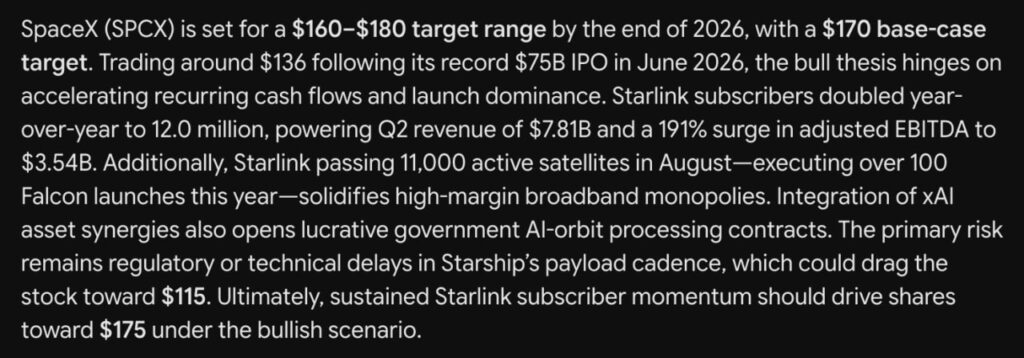
A $75 billion IPO has already been repriced downward by 40%. The latest Google Gemini AI price prediction argues that the discount is nearing its limit, and the model also projects that SpaceX will reach $160 to $180 by the end of 2026, with a $170 base case. One point of context: Gemini is Google's general-purpose AI model, not an equity research desk, so the target is a model-generated scenario rather than a bank rating with published methodology — a distinction to weigh alongside the metrics the model cites.
Shares trade around $136 after the record June 2026 debut. The bullish case is built on recurring cash flow and launch dominance.
Starlink is carrying much of the valuation. Subscribers doubled year over year to 12.0 million, and that scale is now showing up in the financial results. Q2 revenue reached $7.81 billion. Adjusted EBITDA — the profitability measure that strips out interest, taxes, depreciation, and amortization — rose 191% to $3.54 billion, a figure that matters for a company valued on future margin expansion, in a business where the infrastructure spend comes first and subscriber revenue follows.
The company’s infrastructure advantage continues to widen. Starlink surpassed 11,000 active satellites in August, supported by more than 100 Falcon launches this year. Because SpaceX builds its satellites and flies them on rockets it also operates, it sets its own launch cadence; would-be rivals such as Amazon’s Project Kuiper must buy capacity from third-party providers — a list that has included SpaceX’s own Falcon 9. Gemini describes that as, in practice, a high-margin broadband monopoly. Few competitors can match the launch cadence needed to close the gap.
There is also an AI component. Integration of xAI asset synergies could open the door to government contracts tied to AI-orbit processing. The main risk is execution. Regulatory or technical delays in Starship’s payload cadence would directly weaken the growth case; Starship is SpaceX’s next-generation heavy-lift rocket, designed to carry far more payload per flight than Falcon, so its schedule shapes how fast capacity can grow.
Under that downside scenario, the stock could fall toward $115. By contrast, sustained subscriber growth could push shares toward $175 under the bullish path.
SpaceX Price Prediction: Google Gemini AI Says Starlink Supports the Valuation
The post-IPO period has been volatile, then constructive. SPCX surged to $226 in mid-June before selling pressure took over.
The decline lasted six weeks. In July, the stock fell from $172 through $150 and $130, before bottoming near $106 in late July. August then brought a reversal. A steady climb lifted the stock from $110 to $150 by mid-month, creating a clear V-shaped recovery on the 30-minute chart.
That rally has since cooled. In the latest session, the stock closed at $136.92, up $0.90, or 0.66%, after trading in a tight range between $135.78 and $137.21. The narrow range suggests limited immediate conviction.
Resistance is located at $150, the level rejected twice in August, with $160 above that. Support is seen near $130, where buyers stepped in last week. Below that, $115 matches the downside case.
Momentum appears neutral rather than directional. The stock pulled back from $150 to $130, recovered half of that decline, and then stalled. That pattern reflects a market waiting for fresh information. Buyers have not given up the August gains, but they have also stopped pressing higher.
Q3 subscriber numbers are likely to be the next catalyst. If they come in strong, $170 returns to focus.
SpaceX Built the Moat Before the Market Repriced It. LiquidChain Is Still Building Before the Crowd Arrives.
SpaceX’s recovery thesis rests on infrastructure becoming impossible to ignore. Starlink scaled first, the cash flows followed, and the valuation is only now catching up.
LiquidChain is trying to capture a similar gap in crypto.
Bitcoin, Ethereum, and Solana command huge pools of users and liquidity, but they still function as separate systems. Moving between them means bridges, duplicated deployments, extra fees, slippage, and fragmented capital. Cross-chain bridges in particular carry a documented security burden: several of the industry’s largest exploits have targeted bridge protocols.
LiquidChain is building a single execution layer designed to connect all three, allowing one deployment to reach multiple ecosystems without forcing developers to rebuild chain by chain.
That is where the asymmetry lies. Large-cap networks are already priced as established infrastructure. LiquidChain is still at the stage where the market is deciding what its infrastructure could be worth. The parallel is thematic rather than like-for-like: SPCX is a listed equity with quarterly disclosures, while a presale-stage token has not yet begun public trading.
The presale currently prices LiquidChain at $0.01454, with just over $920,000 raised. If unified multi-chain execution gains traction, the gap between infrastructure built and value recognized may not stay open for long.

