Best Space ETFs in 2026: What's Actually Inside Them
Key Takeaways
- •Space ETFs charging roughly 0.75% in fees hold portfolios that differ substantially despite the identical label, making each fund a distinct trade that must be judged on its specific holdings and weights.
- •Newer funds launched around the 2026 SpaceX IPO, including Tema's NASA ETF and Roundhill's MARS ETF, allocate about 25% of assets to SPCX, while older funds such as UFO carry larger weights in established names like Garmin and Trimble.
- •The Tema Space Innovators ETF reached $1.01 billion in assets under management by September 2026, roughly double the UFO fund's $557.15 million, but its two largest holdings exceed 31% of fund value, creating a concentrated trade.
- •VanEck's JEDI UCITS ETF charges a lower 0.55% expense ratio, holds Viasat as its largest position without a stated SPCX stake, and returned about 17% in 2026 to date while carrying roughly double the volatility of the broader market.
- •Pre-IPO exposure through special investment vehicles, such as Tema's SpaceX position, offers potentially high returns but does not guarantee immediate liquidity or price discovery.
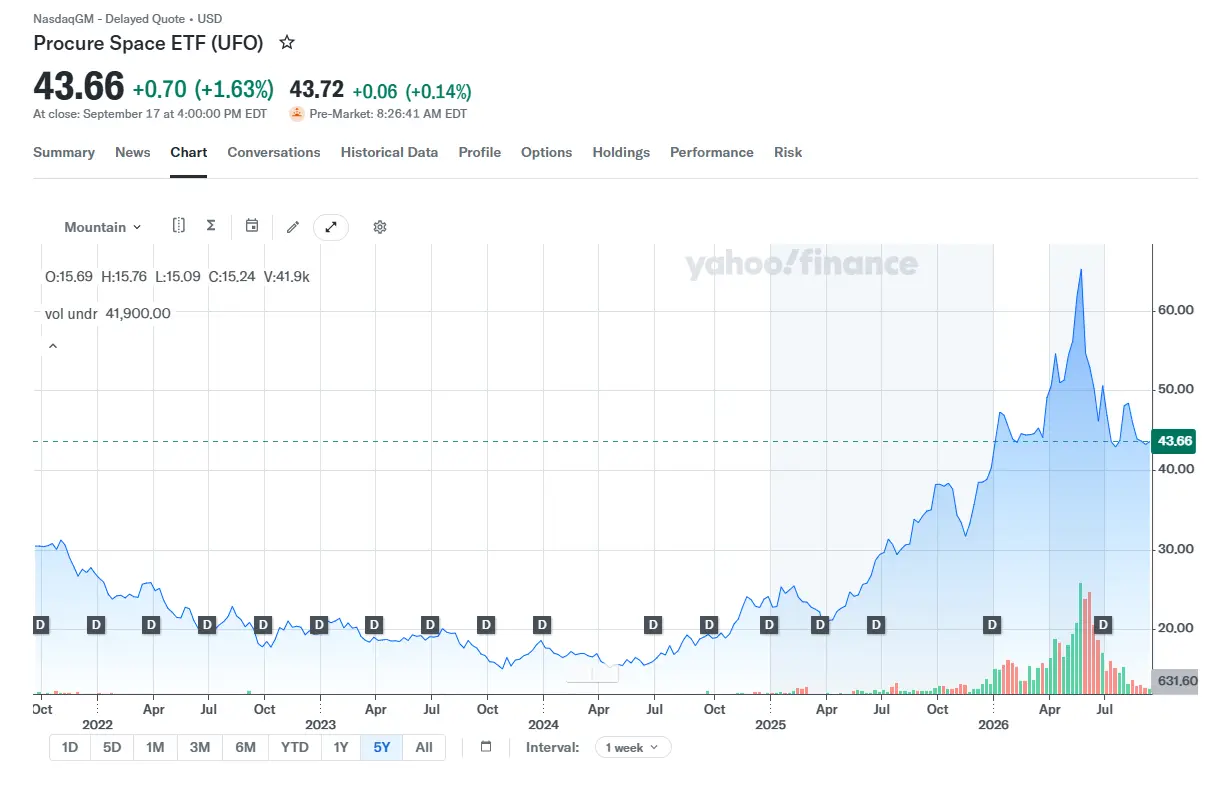
The boom in space exploration and space-related companies has led to the creation of Space ETFs — exchange-traded funds designed to tap into the trend through a single, simple investment product. Yet every fund that describes itself as a space fund selects a different basis for its investments. For a fee of about 0.75%, these funds advertise access to the space business, but the portfolios behind the identical labels are not the same.
As a result, each Space ETF should be considered a distinct trade and evaluated on its own merit, based on the companies selected and their weights. This guide aims for a balanced preview of the best space ETFs in terms of portfolio exposure, the types of space companies chosen, and how closely each fund tracks the latest trends in the space business. Space ETFs differ by age and by the type of companies they hold, ranging from navigation providers to novel space rocket makers — differences reflected directly in each ETF's earnings potential.
Quick Comparison
Top space ETFs are largely actively managed, with shifting equity weights and varying concentrations among top holdings. The data in this article are based on a snapshot as of September 2026.
| Fund (Ticker) | Inception | Expense Ratio | AUM (Sept 2026) | Largest Holding (Weight) | SPCX Weight |
|---|---|---|---|---|---|
| Procure Space ETF (UFO) | 2019 | 0.75% | $557.15 million | Garmin — 6.78% | 5.07 |
| Tema Space Innovators ETF (NASA) | March 30, 2026 | 0.75% | $1.01 billion | SPCX — 25.5% | 25.5% |
| Roundhill Space & Technology ETF (MARS) | March 2026 | 0.75% | Not stated | SPCX — 25.54% | 25.54% |
| ARK Space Exploration & Innovation ETF (ARKX) | Early 2021 | 0.75% | $759.5 million | SPCX — ~10.2% | ~10.2% |
| VanEck Space Innovators UCITS ETF (JEDI) | June 2022 | 0.55% | Up to $1.7 billion | Viasat — 9.56% | Not a stated holding |
These weights are a moving target rather than fixed allocations: UFO rebalances quarterly, Tema actively adds and sheds positions, and changing assets under management alter the composition — so the holdings, not the label, define each fund's risk profile.
What Actually Counts as a “Space ETF”
A space ETF can be any fund related to the aerospace industry that serves as a proxy for a stock portfolio of space companies. Investors, however, differentiate between funds and identify several niches in fund structure. Some ETFs may also extend to investments in private space companies.
At one end, a space ETF can be a pure-play fund of companies directly related to space activities, including launch and rocket providers, satellite production, or other space hardware. The underlying company activities turn the ETF into a pure-play trade, which may also include satellite hardware, space station technology, communications, and general space components.
The pre-SPCX generation: satellite, GPS, and defense in a space wrapper
Some space ETFs also allow for the inclusion of defense verticals. Others add older navigation or satellite companies with established services. Those funds often carry a greater weight in the stock of top navigation companies such as Garmin or Trimble.
A broader ETF category may include aerospace, defense, and other infrastructure companies, NASA contractors, or military technologies. In this configuration, ETFs offer some overlap with the defense industry, including space-based missile interception systems and surveillance.
Space ETFs may also focus on the communications side, including surveillance, connectivity, and telecoms. Other categories cover space-adjacent technologies, such as specialized robotics; space-adjacent innovation is the target of multiple niche space ETFs. Some options include international companies, covering the EU and Southeast Asian aerospace industries. Understandably, an ETF can hold those companies in a mixed portfolio: the criteria may be thematic, or an ETF could have exposure to a broader number of space companies.
The post-SPCX generation: concentrated bets on the listed space economy
The other major division is between the older roster of space ETFs and newly launched funds linked to the SpaceX (Nasdaq: SPCX) IPO. New space ETF launches accelerated through 2026 to harness the increasing hype around space companies.
ETFs have been launched to tap private-market exposure to SpaceX and other companies, single-stock leveraged funds, and space ETFs based on EU space exploration. Several large funds linked to EU space exploration launched in the middle of 2026. The fund creation coincided with a wave of breakthroughs for private space companies, accelerating demand for investments.
From an investor's vantage point, a space ETF is also a trade. Some ETFs work as passive trackers for a portfolio. Others offer riskier leveraged strategies, even linked to a single stock. While the investment opportunities look similar on the surface, space ETFs require in-depth research to select the most suitable fund based on a personally preferred strategy.
Why the label stopped being informative in 2026
A space ETF label was once a clear-cut category, linked to established companies with easily readable financials. From 2026 onward, the space ETF model turned into an entirely different trade, with novel levels of risk. The label now includes novel models, startups, and leverage — going beyond established technologies and moving past the general aerospace and communications model. In practical terms, a reader can no longer infer a fund's risk from its name alone: one space ETF spreads its assets across dozens of established satellite and navigation names, while another places roughly a quarter of its value in a single newly listed stock.
The generational split in holdings
As of September 2026, the available top space company ETFs clearly show a generational split in their holdings. The difference means each investor must check the asset composition of funds, as newer ones lean much more heavily on owning SPCX shares. A comparison of three funds shows that the weight of SPCX in their holdings reveals a generational split and diverging risk profiles.
The Funds
The new generation of space ETFs requires a per-case preview to be certain of their stock weights and the major trade underlying each fund.
Procure Space ETF (UFO)
Procure Space ETF (UFO) was established in 2019 and is based on companies that derive their revenues from the space-related economy. The fund covers 52 companies across all branches of space tech, including satellites, software, launches, and general space technology. UFO predates the recent space economy boom and the demand for listed space companies. It rebalances quarterly and, over time, has shifted from the old-school fund era into a new portfolio of space companies.
The fund has an expense ratio of 0.75%, while assets under management stand at $557.15 million as of September 2026. The ETF's top five holdings Garmin (GRMN at 6.78%, Trimble Inc. (TRMB) at 6.75%, Sirius XM Holdings Inc. at 5.55%, Viasat Inc. (VSAT) at 5.44%, and Space Exploration Technologies Corp. (SPCX) at 5.07%.
Buying UFO means exposure to a portfolio of leading space companies. The ETF's top 10 holdings cover over 48% of portfolio value, with the rest spread among niche stocks. As the UFO fund rebalances, more exposure to new companies is expected. The main risk is missing out on an SPCX rally — or the fund shifting toward over-hyped companies and abandoning established stocks.
Tema Space Innovators ETF (NASA)
The Tema Space Innovators ETF (NASA) launched on March 30, 2026, on the New York Stock Exchange. The fund offers active management of direct public companies and pre-IPO exposure for the space industry. As with other space ETFs, the expense ratio is 0.75%. The fund carries $1.01 billion in assets under management as of September 2026. It is open-ended and does not track a particular index.
NASA carries 36 total stocks as of September 2026, actively adding new opportunities and shedding old holdings. The biggest weight goes to SPCX at 25.5%, followed by Rocket Lab Corp. at 9.94%, AST SpaceMobile Inc. at 6.86%, Viasat Inc. at 5.62%, and Universal Microwave Technology Inc. at 4.81%.
NASA arrived roughly seven years after the launch of UFO, but it has already accrued double the assets under management. The rapid growth also comes with a risk factor: the fund's two leading assets make up over 31% of fund value, turning the space ETF into a highly concentrated trade.
Roundhill Space & Technology ETF (MARS)
Roundhill Space & Technology ETF (MARS) was founded in March 2026, making it one of the new wave of space ETFs. As with other funds, its expense ratio is 0.75%. The fund's issuer is Roundhill Investments, and the ETF trades on the CBOE BZX exchange.
MARS is an actively managed exchange-traded ETF seeking returns from space and technology equities. At least 80% of the fund's assets are allocated to the sector, and the ETF is not diversified.
As of September 2026, the fund holds 25.54% of its investments in SPCX stock. Rocket Lab Corporation (RKLB) makes up 9.26% of the fund, AST SpaceMobile Inc. (ASTS) carries a 6.94% weight, Viasat Inc. (VSAT) stands at 5.06%, and Globalstar, Inc. (GSAT) at 5.04%. The equity weights are based on Stock Analysis data.
MARS combines the old wave of space tech companies, including communications names. The fund allocates nearly a quarter of its value to SpaceX, exposing its main risk to SPCX price fluctuations.
ARK Space Exploration & Innovation ETF (ARKX)
ARK Space Exploration & Innovation ETF (ARKX) was founded in early 2021, before the generational shift in space ETF creation. The fund is actively managed and has a long-term growth outlook. At least 80% of the fund's value is invested in US and global equities of space exploration and defense companies.
The fund's expense ratio is 0.75%, the usual rate for a space ETF. The fund carries $759.5 million in assets as of September 2026, with significant growth over the past year from around $230 million in March. While ARK is an old-wave fund, the arrival of SpaceX boosted investment in ARKX.
SPCX makes up roughly 10.2% of the fund's value, with 6.83% for L3Harris Technologies Inc. (LHX), Kratos Defense & Security Solutions, Inc. (KTOS) at 6.42%, and Deere & Company (DE) at 5.37%. Rocket Lab Corporation is the fifth-largest holding, with a 4.89% weight. The fund is diversified with tech stocks, also including Amazon (AMZN), Nvidia (NVDA), and other leading tech equities.
While ARKX has a smaller allocation to SPCX, it still faces risk if the space tech hype subsides. ARKX is also partially exposed to risk from the AI sector, as any slowdown there could affect its total value.
VanEck Space Innovators UCITS ETF (JEDI)
The VanEck Space Innovators ETF (JEDI) was founded in June 2022, at a time of active onboarding for the aerospace industry, but before the SpaceX IPO hype. The fund operates with a relatively low expense ratio of 0.55%.
The VanEck brand drew in up to $1.7 billion in AUM as of September 2026, boosted by the recent rush into space ETFs in general. The fund returned around 17% in 2026 to date, though it peaked much higher in May, just ahead of the SpaceX IPO. The fund was affected by the hype, which raised demand significantly, before demand and returns returned to average levels.
Despite the effect of the SpaceX IPO, the JEDI space ETF focuses on other aerospace companies. Viasat Inc. is the leading holding with a 9.56% weight, followed by EchoStar Corp. (ECHO) at 7.28%, Globalstar Inc. (GSAT) at 6.52%, and Rocket Lab Corp. (RKLB) with a 6.31% share.
Most of the JEDI fund's value is locked in its top 10 stock holdings. The fund has high exposure to a volatile industry and carries double the volatility risk compared to the broader market. JEDI is not an SPCX trade, but it tracks the effect of SpaceX on aerospace narratives and general demand for investments.
Non-US and UCITS options
The growth of the aerospace industry is not limited to US companies and NASA partnerships. EU space market revenues are growing, and local companies are adopting the new models of private launchers while expanding general aerospace technology. The EU is also running its own bloc-wide space program, combining research, oversight, and user application of space technologies. As a result, EU companies offer a new source of potential gains for space ETFs.
Europe has stricter regulations, especially for UCITS-compliant space ETFs. VanEck Space Innovators is such an ETF, as are other funds that signal their UCITS status next to their name. UCITS (Undertakings for Collective Investment in Transferable Securities) funds have stricter requirements for diversification and aim for a lower risk profile. UCITS is a risk framework created specifically in the European Union, ensuring more conservative investment safety standards for retail investors.
UCITS space ETFs include the iShares Space Technologies UCITS ETF (STRR), with a broad portfolio including satellite systems, orbital technology, and autonomous launch systems. The ETF holds SPCS — a pre-IPO vehicle — addition to established aerospace companies. The fund has a 0.50% expense ratio, similar to other UCITS ETFs.
Other funds include the WisdomTree Space Economy UCITS ETF (SPACE), the Global X Space Tech UCITS ETF (ORBX), and the ARK Space & Defense UCITS ETF (ARKX), already discussed in detail above. The funds offer different portfolios of space companies, but most are more diversified compared to US-based funds or newly created ETFs heavily invested in SpaceX.
The third-biggest source of space ETFs is the Asia-Pacific region. The funds include the Global X Space Tech ETF, based in Australia and tied to the Mirae space index. This ETF includes older communication and space tech, as well as launch and space exploration services. Another Australian fund, the Global X Defence Tech ETF, tracks the defense side of space tech, including satellite cybersecurity and surveillance.
The TIGER Space Tech ETF in South Korea invests mostly in South Korean space tech companies. The fund has a US variant, allowing South Korean investors to gain exposure to US space tech companies. South Korea is also a space tech hub, but its funds track the global industry; the Samsung KODEX US Aerospace ETF tracks international space tech companies, giving local investors that exposure.
Each of those funds operates on different terms and represents a varying risk level, ranging from retail-safe conservative funds to riskier concentrated trades, some using leverage. To pick the best space ETF, the right approach is to vet each fund for its top equities exposure. ETFs are also often a vehicle for pre-IPO companies: an ETF can be a route to invest in private space companies, in which case it would carry a different risk profile compared to established funds with a diversified portfolio spanning all aspects of space tech.
Fees: identical headline, different product
In the past decade, space ETFs were a relatively “boring” investment, spanning similar business models in telecoms, satellites, and infrastructure. The past decade shifted space tech into commercial flight and launch services, culminating in the SpaceX IPO.
As a result, most ETFs, whether US-based or international, applied similar expense ratios. For passive funds, expense ratios range between 0.50% and 0.55%, while actively managed funds charge around 0.75%. The fees depend on operational costs, competition, and the general structure of space tech and equities. Usually, a space ETF will coordinate its fee structure with competitors before launching.
Space tech is a relatively small field, meaning ETFs must rely on curated indices (for instance, Solactive or Mirae Asset). Space ETF fees are relatively high due to the need for filtering and maintaining the niche portfolio. In comparison, large index funds can afford to charge as little as 0.03% in fees, due to economies of scale and much higher AUM. For space ETFs, the costs are spread across a much smaller pool of investors, who must shoulder administrative and other fees.
Space tech is constrained to a few dozen truly liquid equities, meaning most space ETFs hold similar names in their investment baskets. ETF managers cannot justify higher fees, since the selection is mostly clear-cut. This is where the big difference between funds comes in: the ETF selects how much weight to give to each separate equity.
The Pre-IPO Wrinkle
One aspect of space ETFs is their ability to serve as vehicles for private space companies. Tema is one of the leading ETFs to offer pre-IPO positions, most notably its exposure to SpaceX. For now, Tema has not included new pre-IPO shares; any addition of further pre-IPO names would be a concrete change to track against the fund's September 2026 composition. The ability to buy pre-IPO stocks is a high-conviction trade, which may carry high but risky returns. The pre-IPO allocations rely on special investment vehicles and do not guarantee immediate liquidity or price discovery. Investors can also be caught in their positions until the IPO and trading set up a liquid price for the company.
The risks nobody puts in the listicle
Space ETFs may hold niche risks that are not visible when looking at the industry as a whole. While space tech is growing, not all equities have the same risk profile.
The biggest risk is single-name concentration, either in SPCX or in other leading legacy space companies. For some ETFs, the correlation with SPCX may be excessive, turning the fund into a highly concentrated trade.
Newer funds arrived at a time of increased hype for aerospace, but this does not translate into liquidity. Newer ETFs may trade with relatively thin volumes and large daily price fluctuations.
Space tech is also relatively slow to develop and apply. The sector may go through periods of no new development and hype, or even drawdowns and slower growth. The “space” label itself is no guarantee of growth and liquidity outside specific demand conditions.
Final Verdict: Decide Which Space You're Actually Buying
The space label has turned into a shorthand for a booming sector with significant growth promises. Buying into a space ETF, however, may turn into a very different trade. The best approach is to research each ETF and decide what type of risk it represents. Two similar-sounding ETFs may have different portfolio weights — and even leverage — leading to vastly different risk profiles.
This guide has presented a method to evaluate each ETF and avoid the biggest risks, such as concentration in one equity or reliance on legacy companies. The choice of an actively managed or passive ETF should also be taken into account, as well as the divide between older ETFs and the newly created ones aiming to buy SpaceX at its IPO.
While space ETFs may still have significant upside, each fund's volatility depends on its holdings concentration and asset curation. Space ETFs more volatile and carry higher fees compared to broad market indexes, offering both concentrated exposure and a riskier profile for higher potential returns — or steeper losses if the space narrative slows down. From here, the concrete levers are the funds' own mechanics: UFO's quarterly rebalance and Tema's active position changes can shift weights between legacy names and SPCX, new launches may continue to appear after the 2026 wave of debuts, and further pre-IPO allocations inside actively managed wrappers would change concentration. Since the September 2026 snapshot above dates quickly, the holdings list — not the ticker or the label — remains the reliable test of what a space ETF actually is.

