S&P 500 Defies 5% Treasury Yields as AI-Fueled Rally Pushes Indexes to New Records
Key Takeaways
- •The S&P 500 and Nasdaq posted record closes on Tuesday, with the S&P 500 at 7,844 and its total market value reaching an unprecedented $71.3 trillion.
- •The 10-year Treasury yield climbed to approximately 5.34%, its highest reading in roughly 24 years, reflecting inflation concerns, growing government debt, and a resilient economy.
- •Wall Street analysts expect S&P 500 companies to deliver profit growth exceeding 30% year-over-year as third-quarter reporting season gets underway, cushioning equities against elevated borrowing costs.
- •Nvidia moved within striking distance of a $6 trillion market capitalization on sustained demand for its AI data center processors, and every one of the S&P 500's 11 sectors advanced on Tuesday.
- •Strategist views are sharply divided, with some projecting the index could reach 10,000 before the decade ends while Panmure Liberum suggests it could fall to around 5,000 by late 2027 if inflation and interest rates remain elevated.
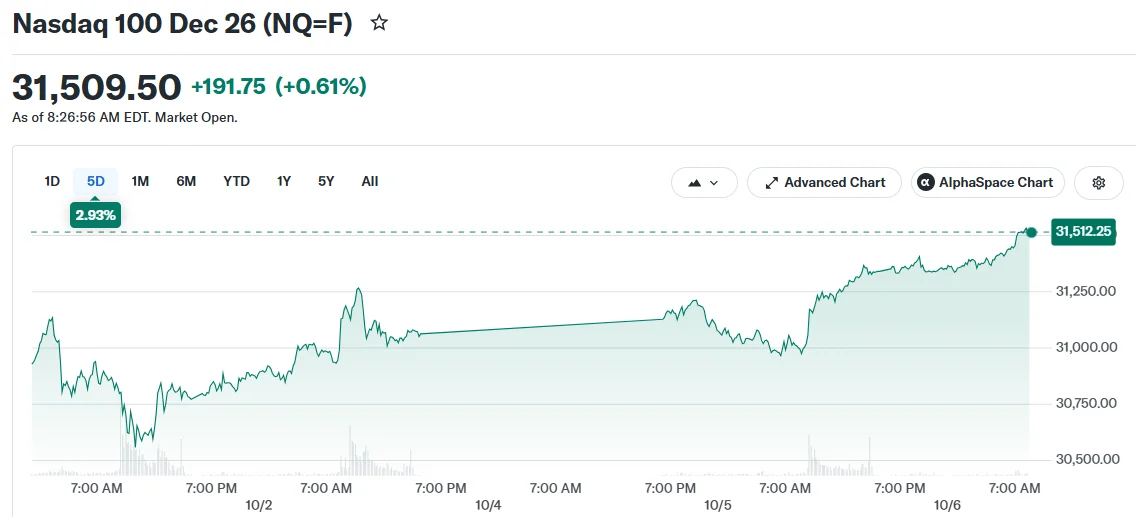
Financial markets hit new milestones this week even as government bond yields hover near their highest levels in more than two decades. The S&P 500 — the benchmark index of roughly 500 large US companies that investors treat as a proxy for the broader market — and the Nasdaq both registered record closes on Tuesday, while the Dow Jones Industrial Average also advanced. The benchmark 10-year Treasury yield, meanwhile, continues to trade above the 5% threshold, recently climbing to levels last witnessed in 2002.
Under typical market conditions, elevated bond yields create headwinds for equity valuations. When Treasury securities offer attractive risk-free returns, investors have less incentive to allocate capital toward volatile stocks, and growth-oriented technology companies generally feel this pressure most acutely. The current environment, however, is proving different, with robust earnings growth absorbing pressure that would normally weigh on share prices.
Robust Profit Growth Provides Market Support
The primary factor sustaining the equity rally is corporate earnings momentum. Wall Street analysts are forecasting that S&P 500 constituent companies will deliver profit growth exceeding 30% on a year-over-year basis as third-quarter reporting gets underway, providing a fundamental cushion despite elevated borrowing costs. Quarterly reporting season, when companies publish results and update their outlooks, is the point at which investors get a direct read on whether those forecasts hold.
BULLISH: S&P 500 hits a NEW ALL-TIME HIGH at 7,844. SPX is up 0.8% as Wall Street bets on a huge AI-driven Q3 earnings season The index is now worth a record $71.3 TRILLION, up 24% from its March 30 low, helping push the total US stock market above $82 TRILLION. That's… pic.twitter.com/ZfiRr6V59C
— Coin Bureau (@coinbureau) October 6, 2026 (link)
Artificial intelligence companies are leading this expansion. Nvidia's stock price climbed again during Tuesday's session, bringing the semiconductor giant's total market capitalization within striking distance of the $6 trillion mark. The chipmaker's processors are widely used to power AI data centers, and the company has been among the primary beneficiaries of the ongoing spending wave on artificial intelligence infrastructure. Additional semiconductor firms also posted gains as market participants continue to anticipate sustained investment in data center capacity and AI computing resources.
The market's strength extends well beyond a handful of technology titans. Every one of the S&P 500's 11 sectors posted advances on Tuesday, with utilities and real estate names performing particularly well as Treasury yields pulled back modestly from recent peaks. The broad participation indicates that the advance extends well beyond mega-cap technology stocks.
The Significance of Rising Treasury Yields
The 10-year Treasury yield — the return investors demand to lend the US government for a decade, and a benchmark that shapes mortgage and corporate borrowing costs — recently climbed to approximately 5.34%, marking its highest reading in roughly 24 years. The rise reflects persistent inflation concerns, expanding government debt levels and an economy that has remained more resilient than many anticipated.
S&P 500 just hit its 28th record high of 2026, crossing $71 trillion in market cap for the first time in history. This is happening despite: 1. 10-year, 20-year and 30-year Treasury yields at 24-year highs 2. Inflation at 3.4%, above expectations 3. Mortgage rates at 7.28%,… pic.twitter.com/84aJu4GJNk
— Bull Theory (@BullTheoryio) October 6, 2026 (link)
Elevated yields present a structural challenge for equity markets. When investors can secure returns above 5% from government-backed securities, the relative attractiveness of stocks diminishes. Rising rates also increase financing costs across the economy for corporations, households and government entities alike.
This dynamic bears down hardest on growth stocks, whose valuations rely heavily on profit projections extending years into the future. As interest rates climb, the present value of those anticipated future earnings decreases. Until now, powerful earnings growth has been sufficient to offset this valuation pressure. Some market observers are now questioning whether 6% yields, rather than the current 5% level, might represent the true tipping point at which equities face meaningful headwinds.
Strategists Sharply Divided on the Path Ahead
Expert opinions about the market's trajectory diverge dramatically. With the S&P 500 trading near 8,000, certain strategists project the index could climb to 10,000 before the decade ends. Conversely, other analysts paint a more cautious picture: Panmure Liberum, a brokerage and research firm, recently published research suggesting the S&P 500 might retreat to approximately 5,000 by late 2027 if inflation remains sticky and interest rates stay elevated. This divergence in professional forecasts underscores the delicate balance characterizing current market conditions.
Market participants will closely monitor upcoming third-quarter earnings releases, Federal Reserve policy signals — the central bank's rate decisions feed into borrowing costs and shape the expectations embedded in long-term Treasury yields — inflation readings and Treasury market movements in the coming weeks, as the interplay between those forces is likely to determine the index's near-term direction. Continued strong earnings combined with moderating yields could propel the S&P 500 well beyond 8,000. The greater risk scenario involves disappointing corporate results coinciding with further yield increases.
For the moment, record equity valuations signal that investors maintain confidence that corporate profit growth will continue outpacing the burden of higher financing costs — a conviction that has so far proven strong enough to outweigh the stiffest bond-market backdrop in more than two decades.
This article first appeared on Blockonomi.

