Ten S&P 500 Stocks Fell More Than 40% in 2026 as AI Concerns Hit Software and Consulting Names
Key Takeaways
- •The S&P 500 has gained 8.28% this year even as ten index stocks have dropped by more than 40%.
- •AI disruption concerns have weighed on software, consulting and advertising stocks, including Intuit, Accenture, Cognizant, Gartner and The Trade Desk.
- •CoStar is the weakest S&P 500 performer this year, down 58.86%, as investors focus on heavy Homes.com spending and profitability concerns.
- •Boston Scientific has fallen 53.59% after cutting its sales growth outlook, facing stronger competition and recalling Accolade pacemakers.
- •AI-linked hardware stocks have surged, with Sandisk up 505.17%, Dell up 247.55% and Micron up 222.68% this year.
The S&P 500 has gained 8.28% this year, even as ten stocks in the index have fallen by more than 40%.
The split reflects a sharp divide in investor positioning. Companies tied to artificial intelligence infrastructure have attracted heavy demand, while businesses seen as vulnerable to AI-driven disruption have been sold off. Because the S&P 500 is weighted by market value, large gains in a relatively small group of bigger companies can offset deep declines elsewhere in the index.
AI Concerns Hit Software, Consulting and Advertising Stocks
The losses have been concentrated in software, consulting and advertising companies, which occupy several spots near the bottom of the Slickcharts performance list.
The pressure began in February after Anthropic released a new AI model. Enterprise software shares sold off heavily, and traders labeled the move the “SaaS-pocalypse.”
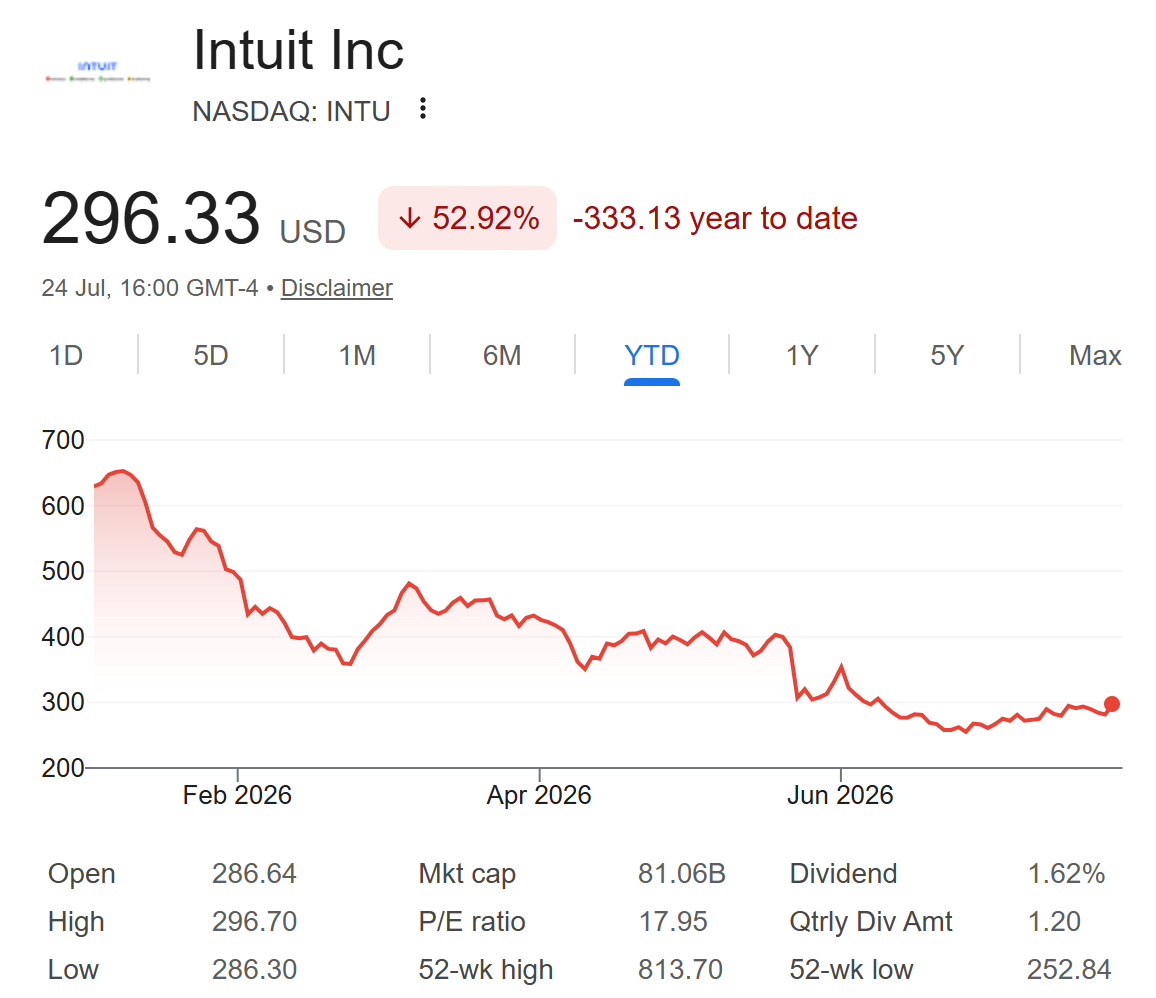
Intuit (INTU) has been among the clearest examples, falling 55.27%. The company owns TurboTax, which accounts for about a quarter of its revenue and profit. The arrival of low-cost AI tax tools added to concerns about that business.
In June, Goldman Sachs analyst Gabriela Borges cut her Intuit price target to $276 from $519. Intuit then reduced its workforce by 17%, or roughly 3,000 jobs, and lowered its TurboTax forecast.
Forbes reported that Intuit is now valued at about $88 billion, down from more than $219 billion a year earlier.
Accenture (ACN) has also been hit, falling 45.21%. Clients have been directing more spending toward AI rather than consultants. New client orders declined to $19.3 billion from $19.7 billion, while Accenture reduced its sales growth forecast to between 3% and 4%. Its shares dropped nearly 18% in one day.
Cognizant (CTSH), Gartner (IT) and The Trade Desk (TTD) have each lost between 44% and 55%. All three operate in areas where investors have raised concerns that AI tools could replicate parts of the work they provide. For software and services companies, that puts added attention on whether AI becomes a margin benefit, a competitive threat, or a reason customers delay existing spending.
S&P 500 worst-performing stocks of 2026 so far 1. CoStar: -58.86% 2. Intuit: -55.27% 3. Trade Desk: -54.45% 4. Boston Scientific: -53.59% 5. Cognizant: -45.24% 6. Accenture: -45.21% 7. Lululemon: -45.01% 8. Gartner: -44.31% 9. Insulet: -42.56% 10. AppLovin Corp: -41.83% pic.twitter.com/n8spGUcoOP — Bull Theory (@BullTheoryio) July 26, 2026
https://x.com/BullTheoryio/status/2081353464144343426?ref_src=twsrc%5Etfw
The Two Worst Performers Fell for Different Reasons
The two biggest decliners in the index were not primarily affected by AI concerns. Their losses were tied to more traditional business issues.
CoStar Group (CSGP) is down 58.86%, making it the weakest S&P 500 stock so far this year. Its main issue has been spending, rather than AI disruption.
CoStar owns Homes.com, a property listings site. In January, the company said Homes.com would not cover its own costs until 2029 and was not expected to become profitable until 2030.
CoStar’s core business continued to grow. Revenue increased 23% to $897 million last quarter, but profit was only $3 million. That combination has made Homes.com spending central to the debate over whether CoStar should prioritize near-term profitability or continue funding a long-term push in residential listings.
In February, hedge fund D.E. Shaw urged CoStar to exit or reduce its investment in Homes.com, saying such a move could unlock more than $10 billion. CoStar described the campaign as “activism malpractice.”
Shareholders supported the board in June. Nasdaq had already removed CoStar from the Nasdaq-100 index in May.
Boston Scientific (BSX) is down 53.59%. Its decline followed slower growth than previously expected.
In February, Boston Scientific forecast sales growth of 10% to 11%. By April, it lowered that outlook to a range of 6.5% to 8%.
Competition also contributed to the pressure. Medtronic said its U.S. heart device sales rose 124% and that it gained “an additional 8 points of U.S. share.”
Boston Scientific later recalled its Accolade pacemakers. Regulators linked the defect to four deaths and 2,557 serious injuries. The company also agreed to acquire Penumbra for $14.5 billion.
AI-Linked Hardware Stocks Outperformed
While those stocks fell, chip and memory companies recorded large gains. Sandisk (SNDK) is up 505.17% this year. Dell Technologies (DELL) has risen 247.55%, and Micron Technology (MU) has gained 222.68%.
Retail investors also participated in the AI capital-expenditure trade through chip-focused funds. A narrow group of AI-related winners has driven much of the index’s gains, according to data on AI stocks driving the rally.
At the same time, companies outside that group have been punished when forecasts weakened. Expensive stocks saw some of the steepest declines when outlooks were cut, a risk previously flagged in recent earnings-bubble warnings.
CoStar and Boston Scientific are both scheduled to report results this week. Those reports will offer new data on whether the scale of this year’s share-price declines was justified by company performance, including CoStar’s spending trajectory and Boston Scientific’s updated growth outlook.

