Goldman Sachs Warns of Sustained S&P 500 Crash: Will Crypto Market Follow?
Key Takeaways
- •The S&P 500 fell more than 11% from its all-time high to enter correction territory, while the Nasdaq 100 dropped over 20% from its peak, closing at 25,028.
- •Goldman Sachs expects the stock decline to continue, with its panic gauge near maximum levels, and momentum traders including commodity trading advisors have sold about $57 billion worth of shares and turned short.
- •AI-related stocks led the declines, with Nvidia falling to $125 from a $243 peak and SanDisk, Marvell, Lumentum, Intel, Dell, and ServiceNow each losing 43% or more over the past month.
- •Stronger-than-expected economic data, including over 165,000 jobs added and inflation above the Fed's 2% target, boosted expectations of a December rate hike, while third-quarter earnings growth slowed to 31% from 51% in the second quarter.
- •Bitcoin fell below $56,000 as the total crypto market capitalization dropped under $2 trillion, with spot Bitcoin ETF outflows exceeding $3.47 billion this month, Ethereum ETF outflows topping $1 billion, and 24-hour liquidations surging 250% to more than $2.5 billion.
The sell-off in United States equities accelerated on Friday, with the S&P 500 Index slipping into correction territory after falling more than 11% from its all-time high. Corrections are conventionally defined as declines of 10% or more from a recent peak. The technology-heavy Nasdaq 100 Index tumbled to 25,028, leaving it down more than 20% from its peak — the threshold commonly used to mark a bear market. Analysts at Goldman Sachs expect the decline to continue, a warning with potential consequences for the cryptocurrency market.
Goldman Sachs Sees Further Downside for the S&P 500
Analysts at the bank believe US stocks may drop further in the near term. Goldman's panic gauge has jumped to near its maximum level, which, according to a Bloomberg report, is a sign that the sell-off has legs. Momentum traders, including commodity trading advisors — systematic funds that follow price trends — have dumped roughly $57 billion worth of shares and turned short.
The warning comes as most constituents of the S&P 500 remain under pressure. Nvidia shares fell to $125, sharply below the stock's all-time high of $243. The index's top laggards are largely AI-related names: SanDisk has lost more than 55% over the past month, while Marvell, Lumentum, Intel, Dell, Nvidia and ServiceNow have each fallen by more than 43%.
These declines reflect profit-taking among investors as fears that the AI bubble could burst continue to rise.
Expectations of a Federal Reserve interest rate hike in December have also strengthened, driven by persistent inflation and improving economic data. Rate expectations matter for both stocks and crypto, since a tighter policy outlook tends to weigh on appetite for risk-sensitive assets such as technology shares and digital coins. The US economy added more than 165,000 jobs in the latest report, while inflation remained above the Fed's 2% target. Stronger retail sales reinforced expectations that policymakers could maintain a tighter monetary stance.
Earnings growth is slowing as well. The most recent FactSet data showed that third-quarter earnings growth reached 31%, substantially lower than the second quarter's 51%.
Crypto Market Falls in Tandem With Equities
The equity crash has coincided with steep declines in Bitcoin and other altcoins. Bitcoin has slumped below $56,000, and the total market capitalization of all cryptocurrencies has dropped below $2 trillion.
Sentiment gauges have deteriorated alongside prices. The Crypto Fear and Greed Index — which aggregates volatility, trading volume and sentiment data into a score from 0 to 100 — fell to 7, its lowest level since March this year and deep within the range the scale labels extreme fear. In most cases, Bitcoin and other cryptocurrencies tend to decline when the gauge sits in the red.
ETF outflows have added to the pressure. Spot Bitcoin ETFs, which hold the underlying coins directly and whose flows are widely tracked as a gauge of traditional-investor demand, have shed more than $3.47 billion in assets this month, after losing over $515 million last month. Ethereum ETFs have also shed more than $1 billion.
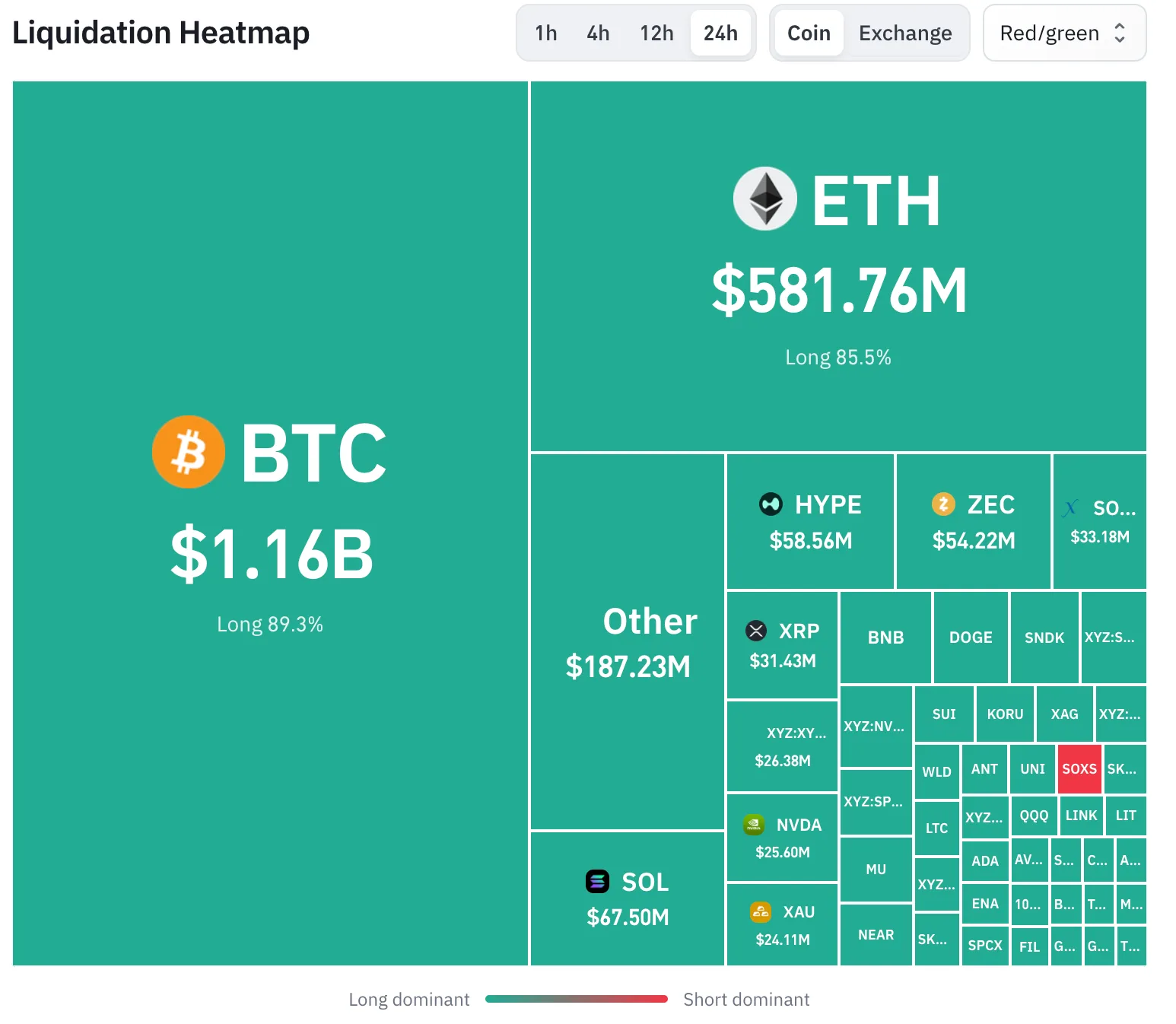
Futures-market demand has continued to weaken this month. Futures open interest — the total value of outstanding derivative contracts — has dropped to $101 billion, its lowest level since July this year, a sign that demand for coins in the futures market is falling. Liquidations have intensified as well: total liquidations jumped by 250% over the past 24 hours to more than $2.5 billion, with Bitcoin and Ethereum the most liquidated assets. Liquidations occur when exchanges forcibly close leveraged positions that no longer meet margin requirements, and they can cascade during sharp price swings.
Bitcoin Price Technicals Point to More Downside
Technical indicators suggest the Bitcoin price has further to fall in the near term. The coin has declined for seven consecutive weeks and is now hovering at its lowest level since September 24.
Bitcoin has moved to the 61.8% Fibonacci Retracement level, a retracement drawn by connecting the lowest level in 2022 with October of last year. The 61.8% ratio is one of the most closely watched retracement levels in technical analysis. A break below this retracement would point to additional downside, potentially toward the psychological level of $50,000. Such a drop would likely deepen weakness across the crypto market, since altcoins usually slump harder when Bitcoin is falling.
This article provides general financial information and does not constitute investment advice. Stocks and cryptocurrencies carry substantial risks, and forecasts cannot guarantee future returns. Investors should conduct independent research before making investment decisions.

