South Korean Won Hits Five-Month High as Kospi Whipsaws After Two-Day Plunge
Key Takeaways
- •The South Korean won reached its strongest intraday level in roughly five months on Thursday, dropping to as low as 1,435.9 per dollar before trading near 1,438.8 by mid-afternoon.
- •Economist Kim Yu-mi attributed the won's appreciation to stronger-than-expected Q2 economic growth, expectations of a narrowing Korea-US interest rate gap, and increased corporate dollar-to-won conversion.
- •The Kospi swung wildly on Thursday, opening higher, falling as much as 2.05 percent, surging to an intraday peak of 5,976.82, and then pulling back to around 5,610 following a 16.2 percent two-session plunge.
- •Foreign and institutional investors each purchased approximately 750 billion won worth of shares, while retail investors were net sellers under pressure to unwind leveraged positions.
- •Samsung Electronics reported record second-quarter revenue of 171.5 trillion won and operating profit of 89.5 trillion won, but its shares gave back gains of as much as 8 percent, underscoring fragile market sentiment.
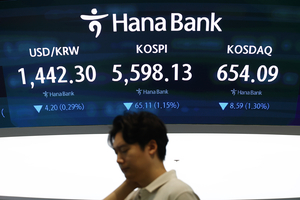
The South Korean won climbed to its strongest intraday level in approximately five months on Thursday, entering the 1,430 range against the US dollar, while the Kospi remained highly volatile after suffering steep losses over the prior two sessions.
As of 2:30 p.m., the won was trading near 1,438.8 per dollar. The exchange rate opened at 1,442.5 at the start of Seoul's daytime session at 9 a.m. and dropped to as low as 1,435.9 around 9:16 a.m. — the won's firmest level since February 27, when the rate touched 1,430.5.
The advance extended a strengthening trend that began midweek. On Wednesday, the exchange rate entered the 1,440 range for the first time in roughly three months, closing the daytime session at 1,446.7.
Kiwoom Securities economist Kim Yu-mi attributed the recent decline in the dollar-won rate to improving domestic conditions, including stronger-than-expected second-quarter economic growth, expectations of a narrowing Korea-US interest rate gap, and increased corporate conversion of dollar holdings into won. The rate differential between the Bank of Korea and the Federal Reserve has long been a key driver of capital flows into and out of Asia's fourth-largest economy, with a narrower gap typically reducing depreciation pressure on the won.
"The won's direction will, for the time being, depend on domestic growth momentum and supply-demand conditions," Kim said.
Internationally, the US Federal Reserve kept its benchmark rates unchanged on Wednesday, which briefly weakened the dollar before it stabilized during Asian trading hours. Wall Street also posted sharp overnight declines, driven primarily by semiconductor stocks.
Against that global backdrop, the Kospi swung wildly on Thursday. The index opened 0.33 percent higher at 5,681.77, then dropped as much as 2.05 percent before surging to an intraday peak of 5,976.82. By approximately 2:30 p.m., however, the benchmark had pulled back to around 5,610.
The turbulent trading came on the heels of a combined 16.2 percent plunge over the previous two sessions, when heavy losses in chip-sector heavyweights — led by Samsung Electronics and SK Hynix, which together account for a dominant share of the Kospi's market capitalization — were compounded by the unwinding of leveraged positions. South Korea is one of the world's largest semiconductor producers, and the sector's performance routinely moves the broader index in tandem with the global chip cycle.
Foreign and institutional investors emerged as net buyers, each scooping up approximately 750 billion won ($521.5 million) worth of shares as of 2:30 p.m. Retail investors, by contrast, were net sellers, caught between bargain-hunting impulses and persistent pressure to unwind leveraged bets.
Samsung Electronics fueled the morning recovery after reporting record second-quarter results, with revenue of 171.5 trillion won and operating profit of 89.5 trillion won. The company's shares surged as much as 8 percent before giving back those gains, highlighting the lingering fragility of market sentiment following the recent selloff.
Source: Korea Herald Business

