Seoul Stocks Extend Gains for Second Session on Strong Exports and Easing Fed Rate Concerns
Key Takeaways
- •The KOSPI closed up 107.73 points, or 1.64 percent, at 6,687.21, extending the previous day's 0.26 percent gain.
- •Fed Governor Christopher Waller indicated he could favor keeping rates steady at the September meeting, easing rate hike concerns.
- •South Korea posted its second-largest current account surplus in July, its 39th consecutive month in surplus, aided by AI-driven exports.
- •Samsung Electronics rose 2.2 percent and SK hynix gained 3.2 percent, while refiners SK Innovation and S-Oil jumped 5.73 and 6.36 percent respectively.
- •The Korean won strengthened 8.9 won to 1,350.4 per dollar, and government bond yields fell.
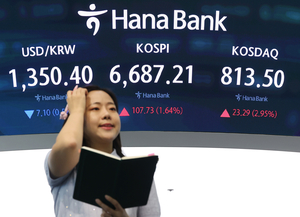
South Korean stocks climbed for a second consecutive session on Friday, finishing nearly 2 percent higher, as strong export figures and easing concerns over further US interest rate hikes bolstered risk appetite. The Korean won strengthened against the US dollar.
The benchmark Korea Composite Stock Price Index closed up 107.73 points, or 1.64 percent, at 6,687.21, after a 0.26 percent gain the previous day. Semiconductors are South Korea's largest export item, which makes the index particularly sensitive to shifts in global chip demand and to US monetary policy, since Fed rate decisions influence the dollar funding conditions that affect trade-driven economies like Korea's.
Trading volume was light at 235.5 million shares worth 17.46 trillion won ($12.9 billion). Advancing issues outnumbered decliners 546 to 309.
Foreign and institutional investors supported the rally, purchasing a combined net 2.15 trillion won, while retail investors sold off 3.72 trillion won.
"Rate hike concerns eased following comments from Federal Reserve Gov. Christopher Waller, while risks stemming from the Middle East and the yen carry trade persist," said Lee Kyoung-min, an analyst at Daishin Securities.
On Thursday, Waller signaled he could lean toward keeping rates steady at the Fed's September meeting, saying recent trends "suggest we are finally seeing some signs of disinflation." The September meeting is the Fed's next scheduled policy decision, making Waller's remarks a widely watched input for global markets in the weeks ahead.
Data from the Bank of Korea underscored the country's robust exports tied to artificial intelligence, with the country posting its second-largest current account surplus in July — the 39th consecutive month the balance has remained in the black.
Large-cap shares closed mixed, with semiconductor makers and oil refiners among the winners. Samsung Electronics gained 2.2 percent to 255,500 won, while rival SK hynix added 3.2 percent to 1,647,000 won. Both companies are major suppliers of memory chips used in AI data centers, a segment that has driven Korean export strength.
Refiners rallied amid the continued conflict between the United States and Iran: SK Innovation surged 5.73 percent to 138,300 won, and S-Oil jumped 6.36 percent to 157,300 won. Higher crude prices can lift refining margins, and Brent crude futures, the international oil benchmark, rose above $95 per barrel as of Thursday, while US Vice President JD Vance ruled out any negotiations with Iran as long as Tehran continues to target commercial shipping.
On the downside, battery maker LG Energy Solution fell 1.92 percent to 358,500 won, and financial firm KB Financial dipped 3.32 percent to 172,000 won.
The Korean won was quoted at 1,350.4 to the US dollar as of 3:30 p.m., up 8.9 won from the previous session.
Bond prices, which move inversely to yields, closed higher. The yield on three-year Treasurys fell 0.4 basis point to 3.884 percent, and the return on the benchmark five-year government bond slipped 1.7 basis points to 4.101 percent. (Yonhap)
