South Korea's FSC Moves to Tokenize Stocks, Bonds and Funds as Lawmakers Push Another Crypto Tax Delay
Key Takeaways
- •The FSC proposal would bring stocks, bonds and funds into scope for on-chain representation for the first time, expanding rules that previously covered only fractional investment products, with an effective date of February 4, 2027.
- •The tokenization rollout follows a phased timeline starting with institutional products such as privately placed money market funds and bonds, then publicly offered securities, and finally an on-chain settlement layer tied to stablecoins.
- •Firms seeking the new issuer account management entity status must hold at least 4 billion won in equity capital and employ designated specialists, while retail investors face a 100 million won net purchase cap on each OTC exchange.
- •Lawmakers from both the ruling and opposition parties have proposed delaying the 20% crypto income tax, set to begin January 1, 2027, to as late as 2030, which would be its fourth postponement after earlier slips to 2023, 2025 and 2027.
- •Public and industry resistance to the tax is mounting, with a Tiger Research and Chainalysis survey showing 73.7% of 2,423 investors opposed and a delay petition clearing 50,000 signatures, though Finance Minister Lee Hyoung-il has backed the January start.
South Korea's Financial Services Commission (FSC), the country's top financial regulator, has presented a new proposition to allow tokenized trading of stocks, bonds and funds in the country, with the framework set to take effect on February 4, 2027. The proposal was unveiled on Thursday, October 1.
The expansion of tokenization—the recording of ownership rights in traditional financial assets as digital tokens on a distributed ledger—coincides with a parallel push to postpone the country's crypto income tax, currently scheduled to begin on January 1, 2027, that is gathering support across the political aisle, with lawmakers from both the ruling and opposition parties joining the effort.
South Korea moves to tokenize stocks, bonds and funds
TheSC has opened a public comment window running from October 2 to November 11, 2026, to receive feedback on subordinate rules under the Financial Investment Services and Capital Markets Act and the Electronic Registration Act.
Both parent laws, scheduled to take effect on February 4, 2027, will expand the scope of tokenization in the country. Under the current regime, only fractional investment products can be represented on the blockchain.
The proposal presented on October 1 would extend that umbrella to conventional securities, including stocks, bonds and funds—bringing instruments at the center of the country's capital markets into scope for on-chain representation for the first time. The FSC's statement confirmed that tokenized instruments will sit alongside non-monetary trust beneficiary certificates and investment contract securities.
The rollout is progressing according to the phased, but flexible, timeline the regulator laid out on September 4:
- Stage 1: Privately placed money market funds and bonds for institutional investors, unlisted stocks through a trust structure, and publicly offered fractional investment securities.
- Stage 2: Publicly offered securities.
- Stage 3: An on-chain settlement layer tied to stablecoins.
The comment window closing on November 11, 2026, is the next procedural milestone for the framework, giving market participants a formal channel to weigh in before the February 4, 2027 effective date.
Who can issue tokenized securities in South Korea?
The FSC draft listed the conditions that issuers must meet to issue tokenized securities in the country, including sharing distributed ledgers across the Korea Securities Depository—the country's central securities depository—and at least two account management entities. The regulator also clarified that issuers cannot charge a direct fee for using the ledger.
A newly created “issuer account management entity” category now allows companies issuing tokenized securities to manage customer accounts as well. Only financial firms could offer this service in the past.
Firms looking to enter the new category must first meet certain FSC conditions:
- Hold at least 4 billion won in equity capital.
- Employ a staff that includes one account-management specialist, one internal-control specialist and two IT specialists.
On the trading side, the proposal adds an over-the-counter licensing unit for debt securities, joining the existing units for unlisted stocks and non-monetary trust beneficiary certificates. As an investor-protection measure, the FSC also capped retail investors' annual net purchases on each OTC exchange at 100 million won.
Lawmakers seek to delay the January crypto tax again
While the tokenization framework moves ahead, pressure is building on the separate crypto income tax set for January 1, 2027. The levy treats profits from transferring or lending digital assets as miscellaneous income, taxed at 20% on annual gains above a 2.5 million won deduction. Cryptopolitan has reported the effective rate at 22% once a 2% local surcharge is added. Gains made in 2027 would first be filed and paid in May 2028.
The split trajectory—securities tokenization advancing on schedule while the tax faces a possible fourth delay—shows South Korea's digital asset rules being set on two different clocks.
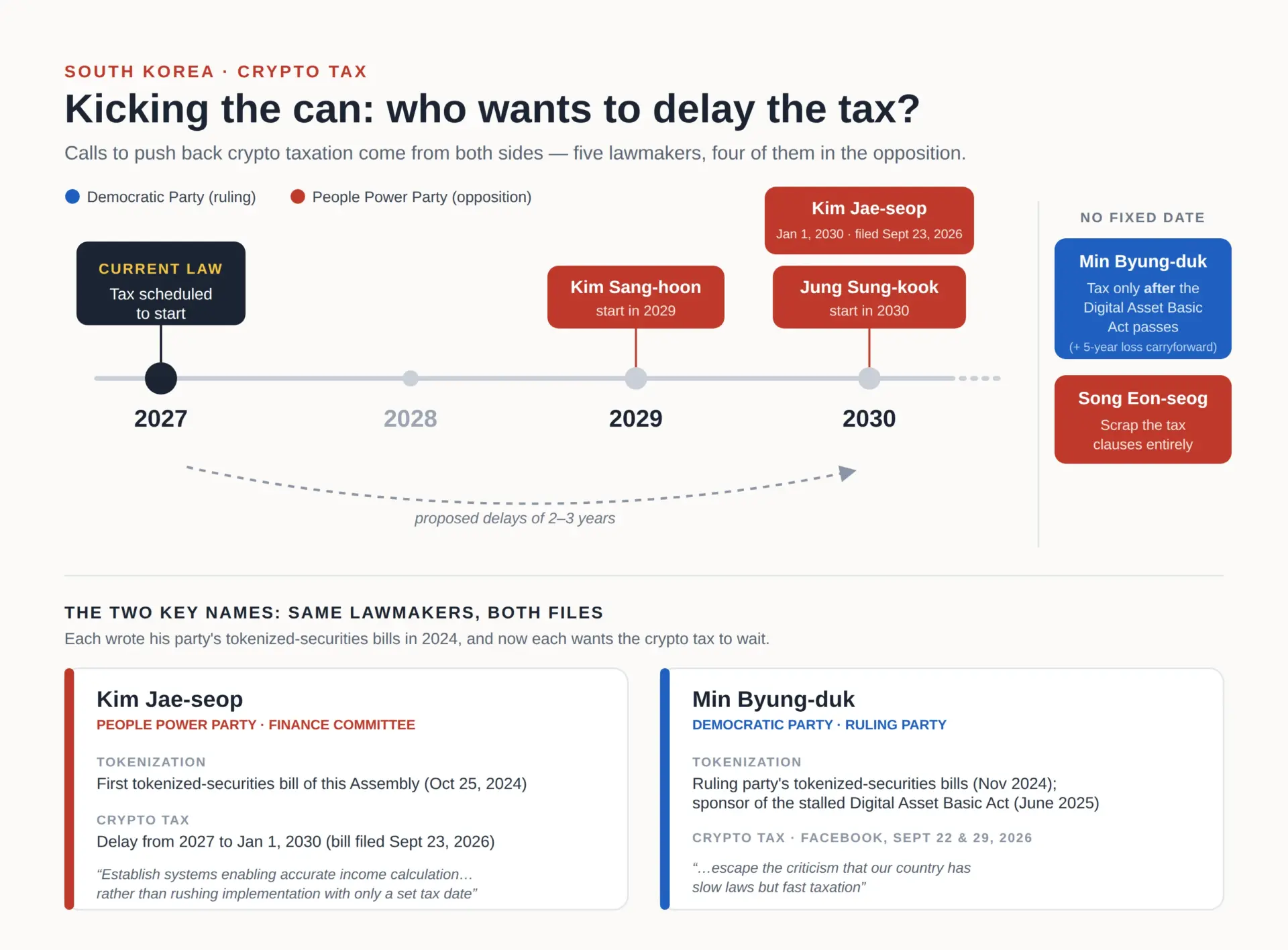
Calls to delay the tax regime have come from both sides of the political divide. Rep. Min Byung-duk of the ruling Democratic Party and Rep. Kim Jae-seop of the People Power Party have advanced separate propositions to push the start date as far back as 2030. Rep. Song Eon-seog has moved to scrap the tax clauses, Rep. Jung Sung-kook has proposed a 2030 start, and Rep. Kim Sang-hoon has suggested a 2029 date, according to The Korea Times and Cryptopolitan.
A fourth delay after three postponements
Industry groups and investors are leaning the same way. The Digital Asset eXchange Alliance has told lawmakers that exchanges still lack a standardized data network with regulators and need more time to build and test it.
A Tiger Research survey conducted with Chainalysis found that 73.7% of 2,423 Korean investors opposed the plan, The Korea Times reported. Separately, a citizen petition seeking a delay cleared 50,000 signatures, sending it to the National Assembly's Strategy and Finance Committee, per Cryptopolitan.
The government is holding its line. Finance Minister Lee Hyoung-il backed the January start on September 28, saying 85% of investors hold crypto worth less than 5 million won and would owe little or nothing after the deduction.
The tax was written for a 2022 launch and has already slipped three times, to 2023, 2025 and now 2027, which is why the current push would mark a fourth postponement. Whether the National Assembly acts on the delay bills before the January 1, 2027 start date remains the open question.

