Profit-Linked Bonuses at Samsung and SK hynix Unlikely to Spread Across Korean Industry Amid Regulatory Pushback
Key Takeaways
- •Samsung Electronics and SK hynix have agreed to allocate 10.5% and 10% of their operating profit respectively to employee performance bonuses following negotiations with labor unions.
- •The South Korean government is considering amendments to the Commercial Act and Financial Investment Services Act that would compel companies to obtain shareholder approval before disbursing profit-linked bonuses.
- •President Lee Jae Myung has stated that disputes over allocating operating profit to performance bonuses should not be classified as labor disputes, with related guidelines expected later this month.
- •A shareholder advocacy group has filed police complaints against the CEOs of both chipmakers and urged the National Assembly to amend labor laws to clarify that profit distribution decisions do not constitute working conditions.
- •SK hynix employees are working to establish a unified union combining production and office workers to strengthen collective bargaining leverage amid government opposition to profit-based bonus arrangements.
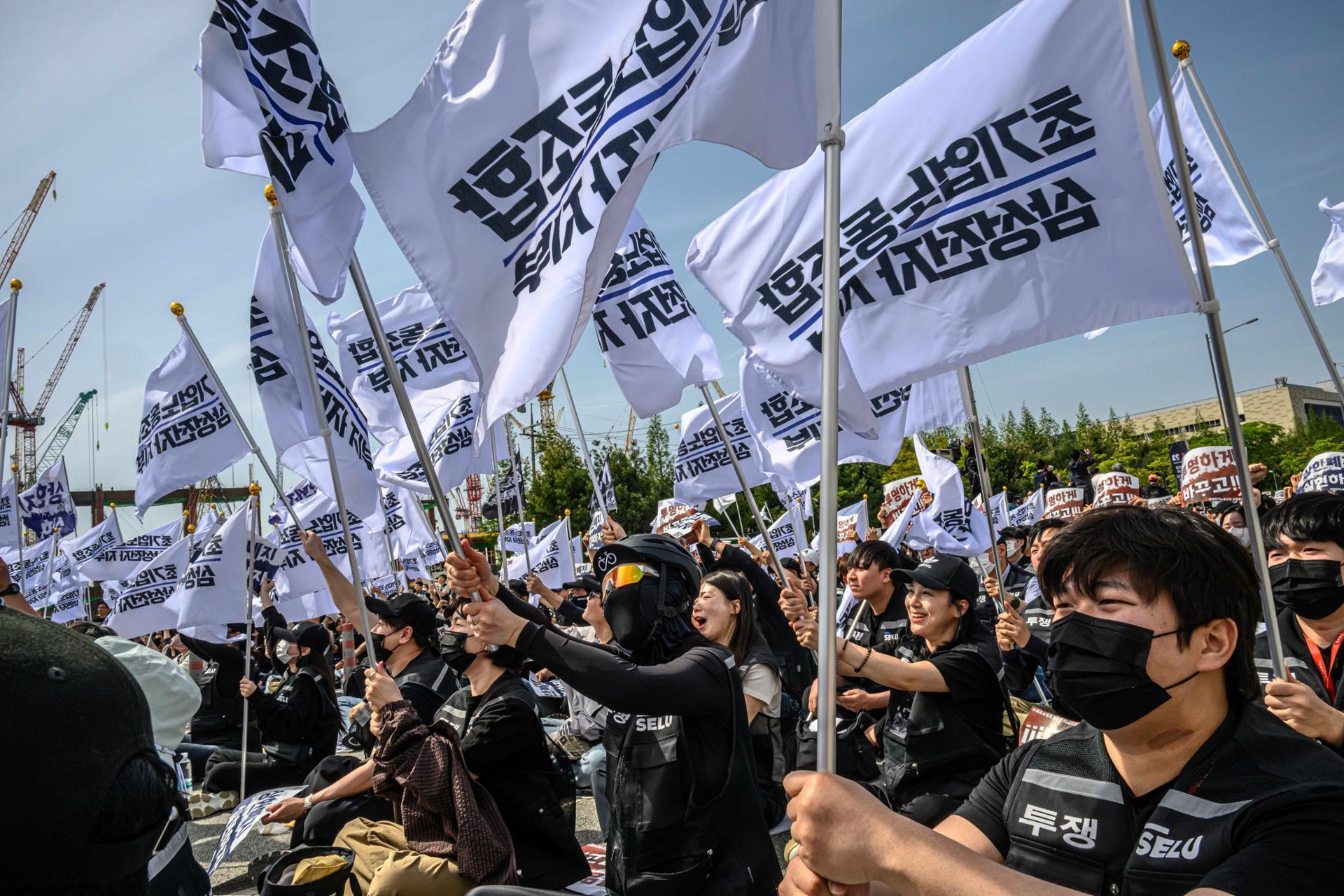
The substantial profit-based performance bonuses agreed at Samsung Electronics and SK hynix — South Korea's two dominant semiconductor companies and pillars of its export-driven economy — are unlikely to become standard practice across Korean businesses, as the government weighs regulatory amendments that would require such bonus plans to obtain shareholder approval.
Speaking at a press forum on Thursday, Industry Minister Kim Jung-kwan said he "opposes linking employee incentives directly to a company's operating profit." He added that the government is discussing revisions to the Commercial Act and the Financial Investment Services and Capital Markets Act that would compel companies to secure shareholder approval before disbursing performance bonuses tied to operating profit.
Kim's remarks come amid growing pressure from labor unions at major Korean corporations demanding that a defined share of operating profit be directed toward performance bonuses. The semiconductor sector, which accounts for a significant portion of South Korean exports, has seen extraordinary profitability in recent memory chip cycles, intensifying the stakes of this debate.
Last year, SK hynix reached an agreement with its labor union to allocate 10 percent of operating profit to performance bonuses, reflecting the extraordinary profits generated by its memory chip business. In May, Samsung Electronics concluded a similar agreement to dedicate 10.5 percent of operating profit to performance bonuses following a prolonged standoff with its own union.
Comparable demands have since emerged at other large companies, intensifying debate over widening economic polarization. Critics have argued that employees are reaping corporate gains while shareholders see no corresponding increase in dividends.
"An incorporated company belongs to its shareholders, and those who are equivalent to them are investors who bear the risks," Kim said. "However, shareholders and investors are absent from the debate over performance bonuses."
President Lee Jae Myung stated last month that disputes over allocating a portion of operating profit to performance bonuses should not be classified as labor disputes. The government intends to release related guidelines later this month.
Following Lee's comments, a group of shareholders including an organization called the Korea Shareholders Movement Headquarters filed police complaints last month against the CEOs of Samsung Electronics and SK hynix. The group also filed a complaint against the labor minister with the Corruption Investigation Office for High-ranking Officials.
The group argued that although performance bonuses are not subject to collective bargaining or labor disputes, the two chipmakers nevertheless negotiated bonus programs with their unions that are funded by a set percentage of operating profit.
In an opinion letter submitted last week, the group urged the government to establish standards through legally binding regulations rather than relying on administrative guidance alone. It also called on the National Assembly to amend labor relations laws to clarify that decisions regarding the allocation or distribution of corporate profits do not constitute working conditions.
Labor unions, however, are pushing back against the government's direction. The Korean Confederation of Trade Unions (KCTU), one of the country's two largest umbrella labor organizations, issued a statement calling Lee's comments "irresponsible" and accusing the administration of turning "a blind eye to the reality of workers."
"Whether compensation is paid as wages or performance bonuses is the result of arrangements that labor and management have developed through years of negotiations," the KCTU said. "Negotiating how workers should be rewarded and how the fruits of their labor should be shared is one of the most fundamental roles of a labor union. Denying this is a biased stance that defends only the exclusive rights of capital."
Meanwhile, employees at SK hynix are moving to establish a new unified union encompassing both production and office workers, Yonhap News Agency reported Sunday. The company currently has separate unions for technical and office workers and for production workers, each conducting wage and collective bargaining negotiations independently.
Employees reportedly concluded that a unified response was necessary after management proposed paying part of the 10 percent performance bonus in treasury shares. The initiative also reflects concern that existing unions have not pushed back forcefully enough against the government's opposition to profit-linked bonus arrangements. The planned unified union is viewed as a strategy to broaden its membership base and enhance collective bargaining leverage.

