Lee and Macron Agree to Deepen Defense, Technology and Trade Cooperation at Paris Summit
Key Takeaways
- •South Korea and France upgraded their April agreement on protecting military secret information to sharpen information sharing between the two countries.
- •The two countries set a goal of expanding annual bilateral trade to $20 billion by 2030 through stronger economic and industrial cooperation.
- •Seoul and Paris agreed to collaborate on next-generation nuclear reactors and launch a high-level dialogue channel on civil nuclear energy cooperation.
- •Both leaders pledged to work together to restore freedom of navigation in the Strait of Hormuz and support peace in the Middle East.
- •Macron affirmed France's backing for South Korea's efforts to ensure peace and stability on the Korean Peninsula.
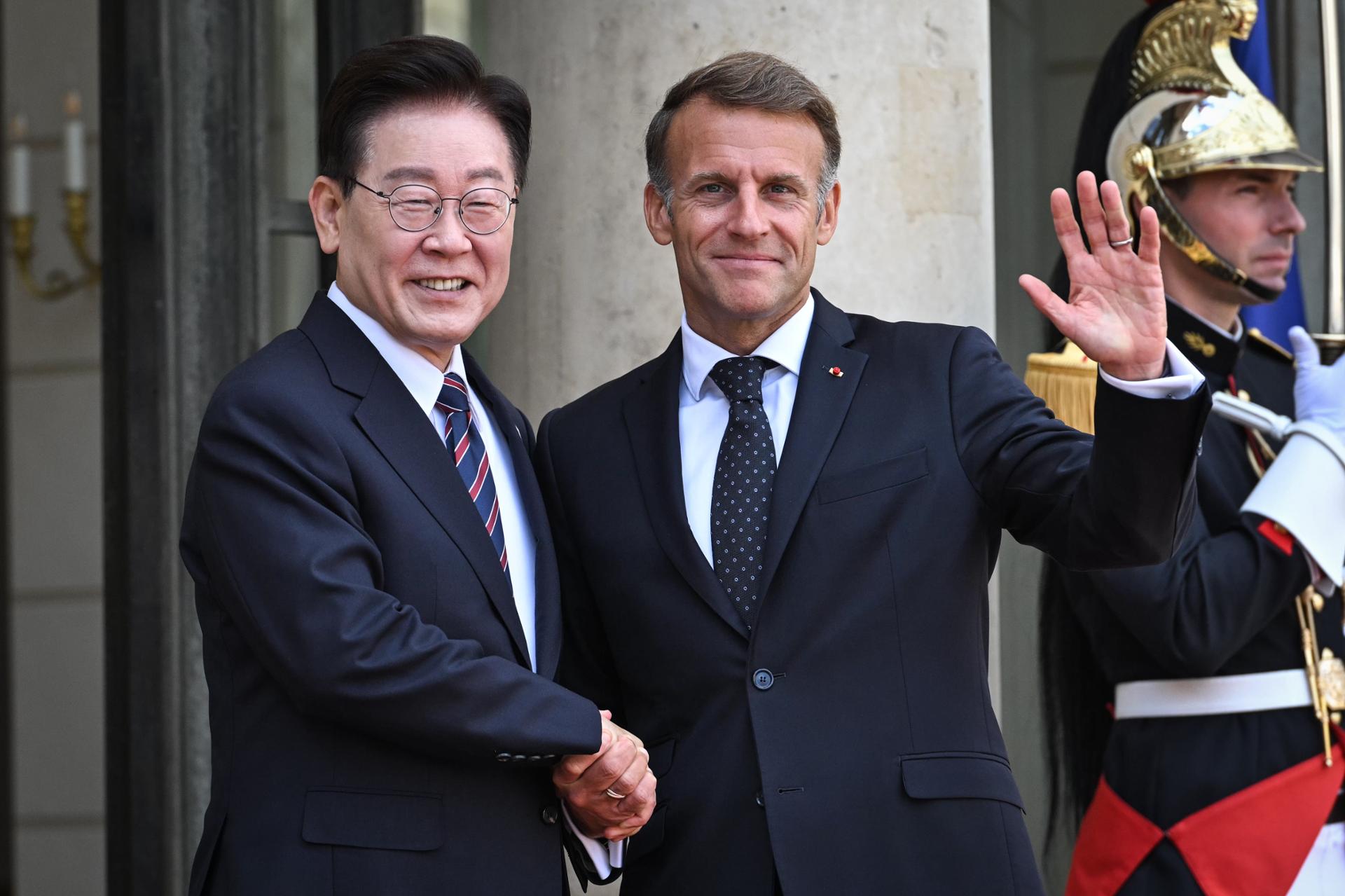
PARIS — South Korea and France signed multiple agreements Tuesday to strengthen bilateral cooperation in national defense, the defense industry and other areas, including the protection of military information, South Korean President Lee Jae Myung announced.
Lee disclosed the outcomes at a joint press event with French President Emmanuel Macron following their summit at the Elysee Palace. The South Korean president began a two-day state visit to the French capital earlier in the day, as the two countries work to deepen their partnership on the 140th anniversary of the establishment of diplomatic ties.
"In order to jointly respond to uncertainties facing the international order, (we) agreed to make tangible progress in cooperation on defense and security," Lee said.
Defense and military cooperation
The two sides signed a pact upgrading a military secret information protection agreement reached during the previous Lee-Macron summit held in Seoul in April, according to the South Korean president. The upgrade, he added, will further sharpen the framework for information sharing between the two countries.
In addition, the two sides agreed to seek the early signing of a separate agreement on mutual military logistics support to enhance the stability and effectiveness of cooperation between the two countries' militaries, Lee noted.
Referring to South Korean companies' expanding technological cooperation with French defense firms — including Airbus, a European defense company in which France holds a stake — Lee said the two sides agreed to pursue mutually beneficial projects that combine France's technological expertise with South Korea's manufacturing prowess.
The defense outreach comes as European countries, including France, have moved to increase defense spending and diversify arms procurement in recent years, while South Korea has sought to expand its defense exports beyond traditional markets — a convergence that has already produced Korean defense sales elsewhere in Europe.
Economic and technology goals
On the economic front, the two countries will seek to expand annual bilateral trade to $20 billion by 2030 through strengthened economic and industrial cooperation, Lee said.
"I will closely communicate with (Macron) to help companies from both countries operate in a more predictable environment and find more opportunities in each other's market," he added.
Lee said he and Macron also agreed to expand bilateral collaboration on artificial intelligence (AI), quantum technology and nuclear energy into the industrial and market spheres, while pursuing joint research and development projects in AI, semiconductors and quantum technology.
On nuclear energy in particular, Seoul and Paris agreed to collaborate on developing next-generation nuclear reactors and diversifying supply chains, while launching a high-level dialogue channel on civil nuclear energy cooperation, Lee noted. Both countries are among the world's major civil nuclear energy players — France derives the majority of its electricity from nuclear power and exports reactor technology, while South Korea has won overseas nuclear plant construction contracts — making next-generation reactor cooperation a natural extension of each side's existing industrial strengths.
Regional peace and the Middle East
As part of joint efforts to promote international peace, South Korea and France will continue working together to restore freedom of navigation in the Strait of Hormuz, Lee said, adding that Macron also expressed support for South Korea's policy on the Korean Peninsula. The strait is a critical chokepoint for global oil shipments, and any disruption there bears directly on energy-import-dependent economies such as South Korea's.
"Based on the deep friendship and trust built over the past 140 years, we agreed to jointly open a new (door for the) next 140 years," Lee said.
Macron said South Korea has France's unwavering backing in ensuring peace and stability on the Korean Peninsula. The French president also said the countries' cooperation could expand to Middle East issues, emphasizing the need to restore freedom of navigation in the region through peaceful solutions.
"We will cooperate to help restore peace in the region," Macron said, adding that the countries will cooperate on multinational duties once a relevant agreement is reached.
Schedule of the state visit
Lee arrived in Paris late Monday, following a two-day trip to Nice, where he and Macron co-hosted a meeting on the future of the film industry. The South Korean president began his state visit to Paris earlier Tuesday with a visit to the Arc de Triomphe to pay his respects to France's fallen heroes, and was welcomed by the French leader to the presidential palace with a friendly hug and a handshake.
Later in the day, Lee was set to attend a business roundtable bringing together some 20 companies from both countries, including Samsung Electronics Co. Chairman Lee Jae-yong, BNP Paribas Chairman Jean Lemierre and L'Oreal Chief Executive Officer Nicolas Hieronimus. He was also scheduled to attend a dinner banquet hosted by the French president and his wife, Brigitte Macron, at the presidential palace.
Source: The Korea Times
