South Korea's Top Five Financial Groups Post Record W13.12 Trillion First-Half Profit on Brokerage Surge
Key Takeaways
- •South Korea's top five financial groups collectively earned 13.12 trillion won in first-half net income, a 9.7 percent year-on-year increase that crossed the 13 trillion won mark for the first time.
- •Brokerage subsidiaries were a major profit driver, with NH Investment & Securities more than doubling net profit to 965.2 billion won and KB Securities surging 135 percent to 796.3 billion won.
- •KB Financial Group led with 3.88 trillion won in net income and posted the highest CET1 capital ratio at 13.74 percent among the four listed groups.
- •All four listed groups announced expanded shareholder return programs, including KB's approximately 3.7 trillion won total return plan and Hana's raised ROE target to 12 percent under its Value Up 2.0 initiative.
- •Woori Bank regained the lead over NH NongHyup Bank with 1.37 trillion won in first-half profit, reversing a first-quarter deficit for the first time in roughly five years.
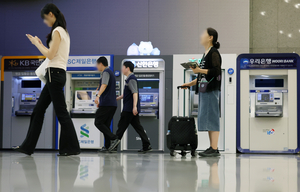
South Korea's five largest financial groups reported a combined 13.12 trillion won ($8.97 billion) in first-half net income, surpassing the 13 trillion won threshold for the first time as a stock market rally fueled brokerage and asset management revenues.
According to regulatory filings released Thursday and Friday, combined profit across the five groups rose 9.7 percent year on year. KB Financial Group led the pack with 3.88 trillion won, followed by Shinhan Financial Group at 3.44 trillion won and Hana Financial Group at 2.4 trillion won. NH NongHyup Financial Group recorded 1.78 trillion won, edging out Woori Financial Group at 1.61 trillion won.
KB, Shinhan, Hana, and NH each delivered record first-half earnings.
NH maintained its lead over Woori for a second consecutive first half, widening the gap to 170.1 billion won from 77.4 billion won a year earlier. The two institutions have alternated positions since 2023, with Woori narrowly overtaking NH by just 1.6 billion won in 2024 before NH reclaimed the advantage the following year.
Brokerage subsidiaries were a key profit driver. NH Investment & Securities more than doubled its net profit to 965.2 billion won, the highest among the group's securities arms. KB Securities posted a 135 percent surge to 796.3 billion won, while Shinhan Securities and Hana Securities saw profits climb 123.1 percent and 155.7 percent, respectively.
The increase in trading activity, combined with growth in assets under management, sharply lifted fee income. Net fees and commissions rose 71.2 percent at NH, 50.6 percent at KB, and 37.7 percent at Hana, driven by wealth management, brokerage, and investment banking operations. The results underscored how noninterest businesses can amplify earnings when market turnover and client investment activity are strong, reducing reliance on traditional lending margins.
KB stood out on both scale and diversification. First-half net income rose 13.1 percent, with nonbank affiliates contributing 44 percent of group earnings and KB Securities alone accounting for 21 percent. The group's return on equity reached 14.09 percent, and its common equity tier 1 (CET1) ratio stood at 13.74 percent — the highest among the four listed groups. CET1 is a closely watched measure of a bank's highest-quality capital, making it central to assessments of loss-absorbing capacity and room for capital returns.
Shinhan reported a comparable 13.3 percent profit increase, supported by gains in both interest and noninterest income. Noninterest income climbed 19.7 percent, and Shinhan Bank's net interest margin edged up to 1.61 percent in the second quarter. Stronger contributions from securities and asset management raised the nonbank share of group profit to 35 percent.
Hana's profit growth was more measured at 4.4 percent, as the group absorbed one-off charges related to a corporate rehabilitation case, foreign-exchange losses, and softer insurance earnings. Credit costs remained contained at 0.29 percent, with higher fee income helping to offset those pressures.
Woori recorded the sharpest quarter-on-quarter rebound. Second-quarter net income jumped 66 percent to 1 trillion won, pushing quarterly profit back above that mark. First-half net operating revenue reached a record 5.72 trillion won, while the nonbank share of earnings climbed to 22.3 percent from 6.9 percent a year earlier, largely due to the addition of insurance operations.
At NH, the record group-level profit masked softer performance at its core banking and insurance units. NH NongHyup Bank's first-half net income fell 2.1 percent to 1.16 trillion won as securities-related gains declined and credit provisions rose.
Woori Bank, with 1.37 trillion won in first-half profit, regained the lead over NH NongHyup Bank after falling behind in the first quarter — the first such reversal in approximately five years. One-off provisions and early-retirement costs had weighed on Woori's first-quarter results before the bank rebounded strongly in the second quarter.
The stronger earnings also gave the four listed groups greater capacity for shareholder returns, an area receiving heightened attention in South Korea as listed companies respond to pressure to improve capital efficiency and shareholder value.
KB expects total shareholder returns to reach approximately 3.7 trillion won this year after announcing an additional 700 billion won share buyback and cancellation for the second half. Shinhan outlined a payout plan of at least 2.8 trillion won and approved a further 700 billion won buyback.
Hana introduced a "Value Up 2.0" plan that raised its return-on-equity target to 12 percent from the prior 10 percent, set a shareholder return ratio of at least 50 percent, and earmarked capital above a 13 percent CET1 ratio for potential distributions.
Woori raised its annual buyback and cancellation plan to a record 350 billion won, more than double the prior year's level.

