South Korea Moves to Eliminate 1 Million Won Threshold for Crypto Travel Rule Reporting
Key Takeaways
- •South Korea plans to remove the 1 million won threshold so that Travel Rule reporting applies to all cryptocurrency transfers regardless of amount.
- •The proposed change specifically targets the FATF Travel Rule and is separate from the country's planned 22 percent tax on crypto gains scheduled for 2027.
- •Regulators aim to close a loophole that allows users to fragment large sums into smaller transfers, a money-laundering technique called smurfing.
- •Major South Korean exchanges already operate under real-name verification and KYC standards that exceed those in many other jurisdictions.
- •Implementation details including the enforcement timeline and specific compliance requirements have not yet been confirmed.
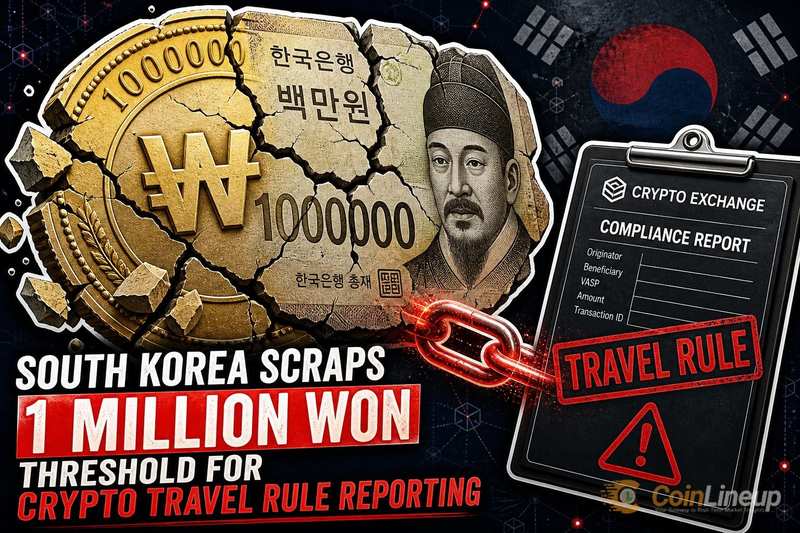
South Korea is preparing to remove the 1 million won (approximately $750) threshold that currently governs crypto Travel Rule reporting, a regulatory change that would extend virtual asset transfer reporting requirements to transactions of any size and tighten oversight of domestic exchanges in one of the world's most active retail cryptocurrency markets.
The proposed shift, tied to the country's Travel Rule framework, would significantly broaden the compliance net for cryptocurrency transfers in South Korea.
Current Rules vs. Proposed Changes
Under existing regulations, virtual asset service providers (VASPs) are required to collect and share sender and recipient information only for transfers valued at or above 1 million won. Eliminating that minimum floor would mean reporting obligations apply regardless of the transfer amount, according to the Financial Services Commission.
The measure applies specifically to the Travel Rule, the anti-money-laundering (AML) standard developed by the Financial Action Task Force (FATF) that requires identifying data to accompany cryptocurrency transfers between platforms. It is separate from South Korea's planned cryptocurrency tax regime, which includes a 22% tax on crypto gains scheduled to take effect in 2027 after multiple delays.
Why the Change Matters for South Korea's Crypto Compliance
The Travel Rule mandates that exchanges attach identifying information about both the sender and recipient when cryptocurrencies move between platforms, giving regulators the ability to trace the flow of funds. Removing the minimum value threshold extends that traceability to low-value transfers that were previously exempt from reporting.
Regulators generally favor threshold-free reporting because small transfers can be used to fragment larger sums—a technique known as "smurfing"—in an effort to evade monitoring. The Financial Services Commission has repeatedly emphasized the need for stricter supervision of domestic virtual asset platforms.
South Korea has maintained one of the more demanding compliance stances toward cryptocurrency exchanges, and the removal of the reporting threshold aligns with that broader pattern of tightening rather than loosening regulatory oversight. The country's major exchanges—including Upbit, Bithumb, Coinone, and Korbit—already operate under real-name verification and KYC requirements that exceed standards in many other jurisdictions.
Implications for Exchanges and Users
For cryptocurrency exchanges operating in South Korea, dropping the threshold will likely require updates to transfer-screening systems and reporting workflows so that every outbound and cross-platform transfer captures counterparty data. Platforms have demonstrated willingness to restrict activity under compliance pressure, as seen when Luno blocked some crypto transfers ahead of an August 31 deadline.
Retail users sending smaller amounts may face additional identity verification steps or increased friction on transfers that previously fell below the reporting threshold.
Key implementation details still require confirmation, including the enforcement timeline, specific compliance requirements, and how platforms will need to adapt their systems before the change takes effect. South Korea's approach may also influence other Asia-Pacific jurisdictions evaluating similar threshold-free Travel Rule reporting, as regulators across the region have been coordinating on virtual asset supervision.

