South Korea to Present Digital Asset Bill at Nov. 24 Committee Review
Key Takeaways
- •The FSC's Virtual Asset Committee will review the Digital Asset Basic Act on Nov. 24, with the government's main proposals expected to be disclosed that week.
- •The draft legislation would establish separate licensing or registration categories for exchanges, brokers and custody providers, each subject to tailored capital, staffing, cybersecurity and internal-control standards.
- •An ownership ceiling for large exchange shareholders, discussed in a range of 15% to 20% alongside possible transition periods and voting-rights limits, remains unresolved ahead of the disclosure.
- •The Bank of Korea favors a won-stablecoin structure in which banks collectively hold at least 50% plus one share of an issuing company, while fintech firms are pushing for broader issuance access.
- •South Korea's finance ministry has proposed moving the start of cryptocurrency gains taxation from 2027 to 2029, and all proposed obligations still depend on approval by the National Assembly.
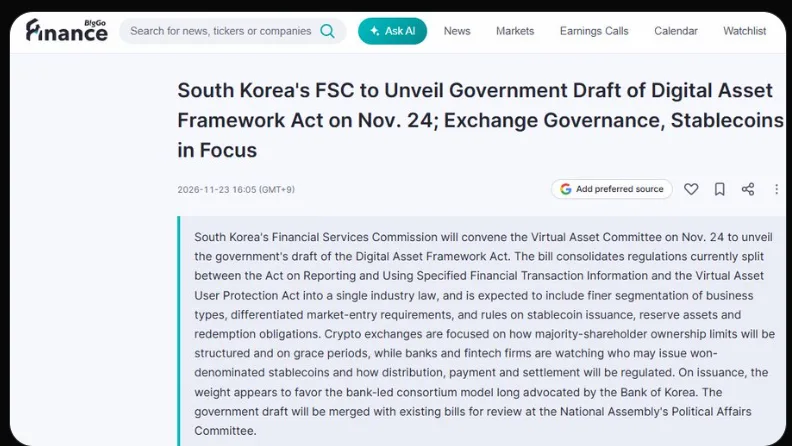
South Korea's crypto regulation is headed for a key committee review on Nov. 24 as authorities prepare to present the Digital Asset Basic Act. The Financial Services Commission (FSC) plans to discuss the proposed legislation at its Virtual Asset Committee meeting, scheduled for 3 p.m. local time in Seoul.
Officials expect to outline proposals covering exchanges, custodians, stablecoin issuers and customer protection. However, the government has not finalized several disputed provisions, and lawmakers must review and approve the legislation before any of the proposed requirements can take effect.
November 24 Committee Review
The FSC has scheduled its Virtual Asset Committee meeting for Tuesday at 3 p.m. local time in Seoul. Officials expect to disclose the government's main proposals this week, as highlighted in a post on X. The regulator also plans to hear from representatives of major domestic exchanges as discussions continue.
South Korea currently applies separate laws to different parts of its crypto sector. The Specific Financial Information Act covers business registration and anti-money-laundering requirements, while the Virtual Asset User Protection Act sets standards for safeguarding customer assets and addressing unfair market conduct.
The new crypto regulation would establish rules for digital asset businesses under a broader legal framework. Officials are examining how to define business activities, set entry conditions and supervise company operations. The government has yet to publish the final wording of those provisions. Those existing statutes address registration, anti-money-laundering and user protection, while the Digital Asset Basic Act would add a unified framework covering how digital asset businesses are defined, what conditions they must meet and how they are supervised.
Separate Licenses for Exchanges, Brokers and Custodians
Under the proposed rules, authorities could classify exchanges, brokers and custody providers as separate business categories, each facing its own licensing or registration requirements. Officials are considering capital, staffing, cybersecurity and internal-control standards tailored to the services each company provides.
Custody providers could face specific requirements for keeping customer assets separate from company holdings. Authorities are also examining whether to introduce common legal standards for exchange token listings and delistings; exchanges currently follow their own procedures alongside industry guidance.
Another unresolved issue concerns large shareholders in cryptocurrency exchanges. Officials have discussed ownership limits ranging from 15% to 20%, along with transition periods for existing businesses. Limits on shareholder voting rights also remain under consideration. The FSC has previously clarified that regulators had not agreed on a final ownership ceiling. The final ceiling, along with transition periods and any voting-rights limits, will be among the provisions to check when the government discloses its proposals this week.
Won Stablecoin Rules Remain Under Discussion
The proposed law also addresses stablecoins tied to the South Korean won. The Bank of Korea favors a structure in which banks collectively hold at least 50% plus one share of an issuing company, an approach that would allow other businesses to participate while banks retain majority control.
Fintech companies have pushed for broader access to stablecoin issuance, but policymakers have not settled the roles that payment firms and technology companies could perform. Discussions also cover reserve assets, redemption requirements and the conditions issuers must meet before offering won-linked tokens. Whichever structure prevails will determine what kinds of firms can issue won-linked tokens and under what reserve and redemption conditions.
Some local companies have already begun preparing for potential stablecoin services. Kakao Pay and KakaoBank signed a September agreement with Fireblocks to examine the infrastructure needed for such products.
Security and Tax Measures
Security requirements form another component of the planned legislation. At a November 12 meeting, the FSC called for stronger cybersecurity measures across digital asset businesses. The agency said its proposed framework would place IT safety and compensation duties on operators comparable to those of financial companies.
Officials urged businesses to monitor systems around the clock, maintain appropriate reserves and strengthen asset storage procedures. They also discussed ways to respond quickly to suspected security incidents. The proposed legal obligations would still depend on lawmakers approving the crypto regulation.
Separately, South Korea's finance ministry proposed moving the start of cryptocurrency gains taxation from 2027 to 2029. After the government presents its digital asset proposal, the National Assembly's Political Affairs Committee is expected to review the text alongside existing bills. Key unresolved points heading into that review include the exchange ownership ceiling, the stablecoin issuer structure and whether common token-listing standards will be adopted.
Proposed legislation may undergo revisions before enactment. This article provides general financial and regulatory information, not investment advice. Investors should review official regulatory announcements before making financial decisions.
This article was originally published by The Market Periodical.

