South Korea Considers Regulated Crypto Market Making After JPYC Surges to 4x Yen Peg on Upbit
Key Takeaways
- •South Korea's Financial Services Commission announced on Sept. 28 that it will examine whether formal market-making rules could improve the efficiency and stability of the digital asset market.
- •The yen-backed stablecoin JPYC briefly traded above four times its peg on Upbit after listing, as shallow order books pushed the token far from its reference rate.
- •The existing Virtual Asset User Protection Act contains no exemption for crypto market makers, leaving legitimate liquidity providers little room to operate legally.
- •FSC digital finance policy director Yoo Young-joon indicated that functions such as abnormal transaction monitoring, token listing support, and trade execution may shift from private to public self-regulation.
- •The Digital Asset Basic Act, advanced in March as South Korea's second crypto legislative phase, would define custody, brokerage, asset management, and advisory services, while some exchange ownership requirements remain unresolved.
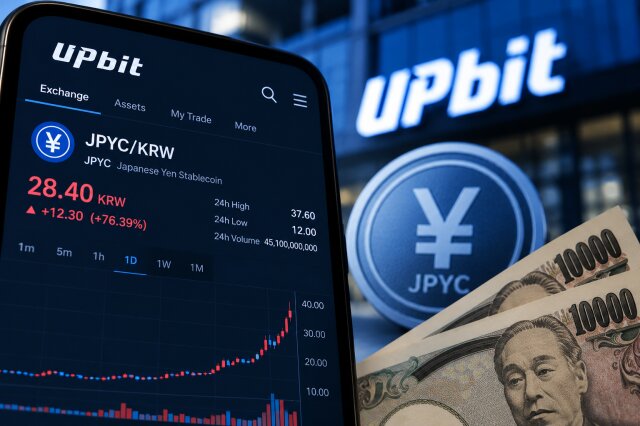
South Korea's top financial regulator is weighing whether to introduce regulated market making for digital assets, after a Japanese yen-backed stablecoin briefly traded at more than four times its peg on the South Korean exchange Upbit.
The Financial Services Commission (FSC) said on Sept. 28 that it will examine whether formal market-making rules could improve the efficiency and stability of the country's digital asset market. The review follows a sudden pricing anomaly in the stablecoin market that has raised fresh concerns about liquidity and investor safety. The proposed measures may also feed into the second phase of South Korea's digital asset-related legislation.
JPYC Price Shock Puts Liquidity in Focus
The issue took on urgency after JPYC, a stablecoin backed by the Japanese yen, was added to Upbit and swung violently away from its reference rate. Owing to shallow order books for an ostensibly stable asset, the token briefly priced at more than four times the value of the yen it is designed to track. The episode illustrates a structural point for pegged tokens: when order books are shallow, even assets designed to hold a fixed value can trade far from their reference rate.
Yoo Young-joon, the FSC's director of digital finance policy, said regulators would examine systems for market efficiency and stability, including market-making activities. He also cited complaints that users had lost money following the JPYC price spike.
Market Makers Face a Legal Barrier Today
South Korea's existing Virtual Asset User Protection Act does not include an exemption for crypto market makers. In practice, that can make traditional market-making structures difficult to operate within, as rules designed to prevent undisclosed dealing and market manipulation leave little room for legitimate liquidity provision. Elsewhere, market makers — firms that continuously quote buy and sell prices to keep trading orderly — typically operate under explicit regulatory carve-outs that distinguish them from manipulative dealers.
A formal carve-out could change that by establishing a clear separation between legitimate liquidity provision and manipulation — although the FSC has not yet announced what its regulation would look like.
Exchanges Could Face Tighter Public Oversight
Market making is only one component of a broader regulatory reform now under discussion. According to Yoo, functions such as abnormal transaction monitoring, token listing support, and major exchange operations that include trade execution may need to be transitioned from private to public self-regulation. The shift would place core exchange functions under closer public scrutiny.
The FSC has also been discussing stronger governance, together with requirements covering exchanges' internal controls and financial capacity. In March, the commission announced it would advance its proposed Digital Asset Basic Act as the second step of South Korea's crypto legislation. That framework could broaden the industry beyond exchange-based businesses by providing clearer definitions for custody, brokerage, asset management, and advisory services.
Stablecoins and Domestic Token Issuance Join the Agenda
Also on the regulatory docket are rules for stablecoins denominated in traditional currencies, as well as domestic rules governing the issuance and disclosure of digital tokens. The FSC believes a wider legislative framework will enhance transparency and offer companies greater avenues for digital asset payments, treasury, and savings investments.
Certain details remain unresolved. In August, the commission said its discussions on the second stage of the digital asset law were ongoing, noting that some requirements related to exchange ownership had yet to be settled.
For crypto traders and exchanges alike, the market-making debate now places liquidity directly at the center of South Korea's next regulatory phase. The markers to watch are the shape of the FSC's eventual market-making rules, the progress of the Digital Asset Basic Act, and how the outstanding exchange ownership requirements are settled.
Source: Crypto Ninjas — South Korea Eyes Crypto Market Makers After JPYC Spikes to 4x Its Yen Peg on Upbit

