South Korea Blocks Polymarket as Prediction Markets Face Global Regulatory Divide
Key Takeaways
- •South Korean authorities charged 26 Polymarket users and referred 18 to prosecutors, with one user accounting for 5.7 billion won of the reported activity.
- •The Korea Media and Communications Standards Commission restricted Polymarket access on August 18 under provisions covering gambling and gambling venues.
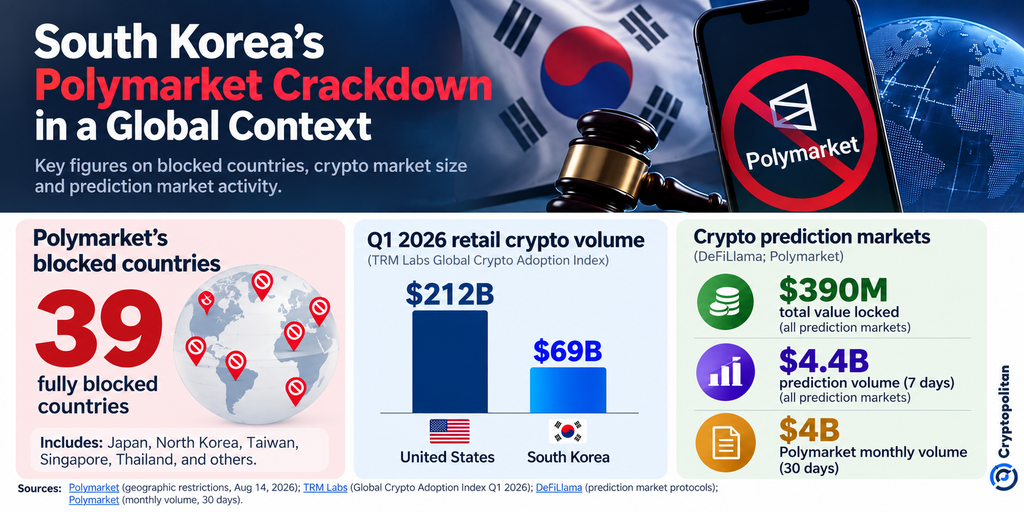
- •Polymarket’s August 14 restrictions listed 39 excluded countries but did not include South Korea among fully blocked or close-only jurisdictions.
- •South Korea ranked second globally for retail crypto volume, with approximately $69 billion in the first quarter of 2026, according to TRM Labs.
- •The United States regulates comparable event-contract markets through the derivatives framework, including CFTC-regulated designated contract markets such as Kalshi.
South Korea has blocked access to Polymarket, while 18 of the platform’s users have been referred to prosecutors on suspicion of illegal gambling. The case involves 17.6 billion won in trading activity, but its broader significance lies in the widening international divide over how crypto-based prediction markets should be regulated.
South Korean authorities are treating event-contract trading as gambling under the country’s criminal law. The United States, by contrast, is placing similar markets under its derivatives framework. The classification matters because it determines which regulator has authority over these products and what rules platforms and participants must operate under. The difference could have implications beyond the two jurisdictions, particularly as platforms respond with stricter geographic controls and users and liquidity move toward markets with clearer regulatory treatment.
18 users referred to prosecutors as access is restricted
South Korean law enforcement said on September 15 that 26 Polymarket users had been charged, with 18 of them referred to prosecutors. The users collectively handled 17.6 billion won, including 5.7 billion won attributed to one user.
On August 18, the Korea Media and Communications Standards Commission (KMCSC) decided to restrict access to Polymarket from South Korea after determining that the platform contributed to illegal gambling. The Commission cited provisions of the Criminal Act and the National Sports Promotion Act. The measures operate on separate tracks: an administrative decision by a media and communications regulator to block domestic access, and a law-enforcement process focused on individual users’ trading activity.
The KMCSC rejected Polymarket’s argument that removing the Korean-language version of its website, eliminating won-denominated payment methods, and disclaiming ownership of accounts held by Korean users meant the platform was outside South Korean jurisdiction. South Korea’s Criminal Act addresses gambling under Article 246 and the operation of gambling venues under Article 247.
The legal issue for Polymarket centers on whether the platform’s characteristics could place it outside the scope of those provisions. These characteristics include its order-book trading model, contracts tied to the probability of an event, and the ability to exit a position before the contract reaches settlement.
Gambling law and the event-contract argument
The dispute turns in part on how the instruments are defined. South Korean officials have focused on the fact that participants put money at risk based on uncertain outcomes. Supporters of prediction markets, meanwhile, emphasize the market structure, the way prices represent expectations, and the ability to sell contracts before their expiration.
According to a report from Tiger Research, a basic contract pays $1 if a specified event occurs and $0 if it does not. Under that structure, the contract’s price reflects the market’s implied probability of the event — a contract trading at 60 cents prices the event at a 60 percent likelihood. An oracle, the mechanism that reports the real-world outcome, makes the final determination after the contract expires.
Those mechanics form the basis of the debate over whether such products should be characterized as gambling instruments or as event contracts operating within a different financial framework.
South Korea is a major crypto market but was absent from Polymarket’s restrictions
The action carries wider importance because of the scale of South Korea’s retail crypto market. Blockchain intelligence firm TRM Labs ranked South Korea second globally for retail crypto volume, with approximately $69 billion, behind the United States at approximately $212 billion, in its Global Crypto Adoption Index for the first quarter of 2026. An access restriction in a market of that size reaches a substantial base of retail crypto users.
The case also highlights a gap between national enforcement and Polymarket’s stated geographic restrictions. Restrictions updated on August 14 said that Polymarket had excluded 39 countries from access to the platform. The listed countries included Japan, North Korea, Singapore, Taiwan, and Thailand. South Korea did not appear on either the fully blocked list or the close-only list.
That mismatch indicates that national authorities may impose compliance obligations beyond the geographic restrictions published by a platform. A platform’s own access policy may therefore not determine how local regulators assess activity involving users in a particular jurisdiction.
US regulatory approach attracts users and liquidity
Prediction markets already account for significant activity. DeFiLlama data cited in the report showed $390 million in value locked and $4.4 billion in trading volume across prediction markets over seven days. Polymarket recorded $4 billion in trading volume over one month.
The US has pursued a different regulatory approach. The US Commodity Futures Trading Commission (CFTC) regulates designated contract markets (DCMs) — exchanges registered with the agency — including Kalshi. In a recent submission to the CFTC, the regulator called for federal oversight of event-contract markets.
That regulatory route has helped event-contract platforms attract additional users through partnerships with CNN and Robinhood. Cryptopolitan has previously reported that restrictive measures in some Asian jurisdictions could direct users, liquidity, and innovation toward Western services operating under some form of regulatory oversight.
The South Korean action may further widen that divide. Its significance is not limited to the 18 users referred to prosecutors or the 17.6 billion won involved. It also concerns how prediction-market liquidity develops, how platforms manage cross-border compliance, and whether differing legal classifications will shape the industry’s structure in different regions. Among the developments to watch are the outcomes of the 18 referrals, any updates toymarket’s published geographic restrictions, and how the CFTC weighs federal oversight of event-contract markets.

