Sompo Japan Launches Industry's First Insurance Cover for GPS Jamming Losses
Key Takeaways
- •Sompo Japan's new policy covers lost earnings when satellite-navigation interference prevents a vessel from operating, even without physical damage to the ship.
- •GNSS jamming and spoofing incidents have increased sharply near conflict-adjacent waters including the Eastern Mediterranean, the Black Sea, and the Persian Gulf.
- •Conventional hull policies contain cyber exclusions that have created uncertainty about whether GPS-spoofing-related losses would be covered.
- •Shipowners enrolled in the coverage must require their seafarers to complete a ClassNK Academy maritime cybersecurity training course.
- •The development of a broader GNSS-disruption insurance market will depend on whether competing insurers and protection-and-indemnity clubs introduce comparable products.
Japanese insurer Sompo Japan has launched what it describes as the shipping industry's first insurance coverage designed specifically to address economic losses stemming from radio interference with vessel navigation systems.
Available from this month, the new policy compensates shipowners when interference with satellite positioning systems renders a vessel unable to operate, even in the absence of any physical damage to the ship. Covered scenarios include vessels being denied port entry, detained, or forced to delay departure as a result of disruption to GPS or other satellite-navigation equipment.
The product targets a growing gap in marine insurance as GNSS jamming and spoofing incidents proliferate across major shipping routes. As Splash reported last year, cyber exclusions embedded in conventional hull policies have raised uncertainty over whether losses stemming from GPS spoofing would be covered. Since then, incidents of satellite interference have continued to rise sharply, with documented hotspots concentrated in and around conflict-adjacent waters — notably the Eastern Mediterranean, the Black Sea, and the Persian Gulf — where GPS signal disruption has affected commercial vessels on a near-daily basis.
Sompo's existing marine cyber product, introduced last November, covers physical hull damage and liability arising from cyberattacks. The newly launched extension goes a step further by covering lost earnings when radio interference triggers an operational shutdown without any collision, grounding, or other physical casualty.
Shipowners adopting the coverage will be required to enroll participating seafarers in a ClassNK Academy maritime cybersecurity course. The training covers cyberattack risks, defensive measures, and the safe use of onboard devices and removable media. The mandatory training element aligns with the International Maritime Organization's 2017 resolution MSC.428(98), which urges shipping companies to address cyber risks within their safety-management systems.
Sompo stated that satellite-positioning interference has become increasingly common worldwide, heightening the risk that ships could be forced to suspend operations even when no physical damage is sustained. The insurer plans to expand the product among both Japanese and international ship operators.
The launch arrives at a time when the shipping industry faces mounting pressure to demonstrate how crews can navigate safely when satellite positioning cannot be relied upon. Modern vessels depend on GNSS data not only for chart navigation but also for automatic identification system (AIS) reporting, engine and fuel optimization, and compliance with increasingly precise port-arrival scheduling. Governments have started questioning operators about contingency procedures, while equipment manufacturers are accelerating the development of alternative positioning and anti-jamming technologies.
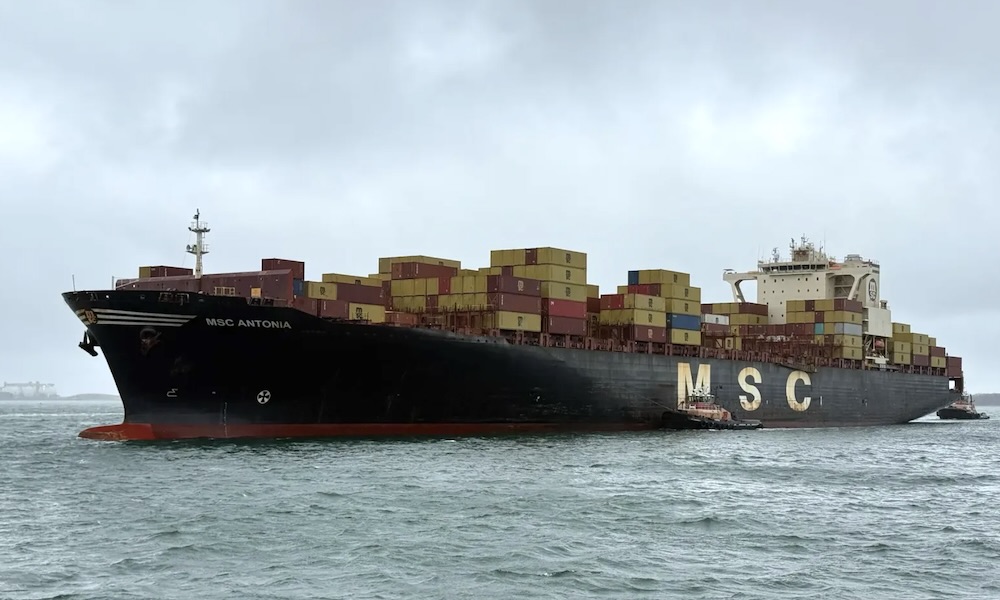
The MSC Antonia, which grounded in the Red Sea last year, exemplifies the issue — vessel tracking services at the time had placed the boxship deep inland in the desert to the west.
Whether rival marine insurers and protection-and-indemnity clubs introduce comparable coverages will shape how quickly the market for GNSS-disruption insurance develops, particularly as shipowners weigh the cost of new premiums against the operational risks of navigating through known interference zones.
