Solo Bitcoin Miner Wins Block 960804, Claiming Approximately $200,000 in Rewards
Key Takeaways
- •A solo Bitcoin miner earned approximately 3.157 BTC, worth roughly $200,000, by solving block 960804 through the Solo CKPool service.
- •CKPool developer Con Kolivas indicated the miner's hashrate likely came from rented computing power that peaked at 100 petahashes per second, representing about 0.011% of Bitcoin's total network hashrate.
- •This discovery marked the 317th solo block found through CKPool, a service that allows individual miners to compete for full block rewards without operating a complete Bitcoin node.
- •The block was the first mainnet solve since Stratum V2 code was incorporated into CKPool's codebase, although the miner actually used the older Stratum V1 protocol.
- •Bitcoin's network hashrate has pulled back from its late-2025 peaks, a trend analysts attribute partly to growing competition from AI data centers for electricity and hardware resources.
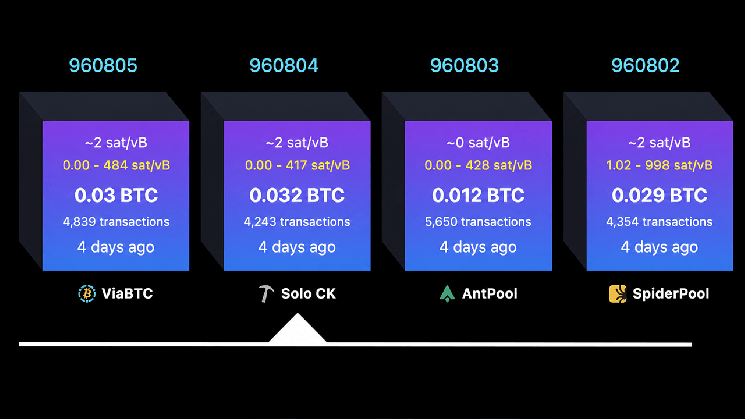
Solo Bitcoin Miner Wins Block 960804, Claiming Approximately $200,000 in Rewards
A solo Bitcoin miner successfully solved block 960804, earning a combined reward of roughly 3.157 BTC — the fixed 3.125 BTC block subsidy plus approximately 0.032 BTC in transaction fees from 4,243 included transactions. Blockchain explorers mempool.space, Blockchain.com, and Blockchair.com each confirmed the payout and attributed it to Solo CKPool.
The winning payout went to a Bitcoin address connected to CKPool, a service that allows individual miners to direct their hardware at shared infrastructure without operating a full Bitcoin node. According to the pool operator's X thread, this marks the 317th solo block discovered through CKPool.
Miner's Hashrate and Network Context
CKPool developer Con Kolivas, known online as Dr -ck, confirmed the find on X. He characterized the miner's computing power as "wildly variable, presumably rental, peaking at 100 PH" — referring to petahashes per second, the standard unit for measuring how many calculations a mining rig performs each second while attempting to solve a block.
At its peak, the miner's hashrate represented approximately 0.011% of Bitcoin's total network hashrate, which stood near 924 exahashes per second at the time. One exahash equals one quintillion hashes per second, or one million petahashes. At that computing level, a miner could statistically expect to find a block roughly once every 64 days, assuming the hashrate remained constant — a far shorter interval than the decades a typical small home setup would require.
How Solo Mining Works
In Bitcoin's proof-of-work system, miners compete to find a cryptographic hash below a network-defined target threshold. The first miner to produce a valid hash earns the right to append the next block to the chain and receive its reward. Solo mining operates differently from traditional pool mining in how that reward is distributed. In a conventional pool, participants share rewards proportionally based on the computing work each contributed, regardless of whether the pool finds a block. Solo mining pays nothing until the individual miner personally solves a block, at which point they receive the entire reward. CKPool charges a small fee, commonly cited at around 2%, on any block its solo users discover.
Kolivas indicated that the miner's hashrate pattern suggested rented computing power rather than a fixed home installation. Hashrate rental markets allow users to temporarily access far more computing power than they own, making solo wins more attainable than pure hobbyist statistics would suggest — though success on any given day remains far from certain.
Developer Commentary and Technical Milestones
Kolivas contextualized the achievement against a turbulent period for the cryptocurrency industry. "Despite the chaos from the hardware wallet exploit, bitcoin just keeps on doing its tick-tock next block," he wrote, referring to reports of the Coldcard hardware wallet exploit, with estimated losses in the nine figures.
He also highlighted a technical development connected to the event. "This is the first mainnet block solved since the incorporation of the Stratum V2 code into the ckpool codebase," Kolivas noted in his X thread, while clarifying that the block was actually found using the older Stratum V1 protocol. Stratum is the communication protocol that mining hardware uses to interact with a pool. Stratum V2, its successor, is designed to improve security and allow miners greater control over which transactions they include in candidate blocks.
Kolivas observed that the timing appeared remarkably predictable in retrospect. "This block was solved on the same main pool that has solved most of the blocks, purely as a function of its hashrate," he wrote. "AU, SG, and US East are yet to solve blocks." He added that the discovery was "virtually deterministic at almost exactly 100% diff," referencing the pool's mining difficulty setting at the moment the block was found.
Broader Implications for Bitcoin Mining
Bitcoin mining has become heavily consolidated around several large industrial pools, including Foundry USA, Antpool, ViaBTC, and F2pool. Solo discoveries remain uncommon within this landscape but continue to occur periodically, demonstrating that any participant with sufficient hashrate and a valid block template can claim a full block reward without requiring permission from a corporation or government entity.
The current 3.125 BTC block subsidy took effect after Bitcoin's most recent halving in April 2024, when the per-block subsidy was reduced from 6.25 BTC. It will remain fixed until Bitcoin's next halving event, expected near block 1,050,000 around spring 2028, when it will decrease to 1.5625 BTC. As the subsidy continues to diminish over successive halvings, transaction fees are expected to carry increasing weight in overall mining rewards.
Upcoming Network Events
Bitcoin's next difficulty adjustment is projected for Saturday, Aug. 8, recalibrating the network's mining difficulty based on recent hashrate levels to maintain the target average of roughly 10 minutes between blocks. The BIP-110 soft fork mandate is also expected to occur around the same timeframe. Meanwhile, network hashrate has shown some pullback from its late-2025 peaks, a trend analysts attribute partly to mining economics and growing competition for electricity and hardware resources from artificial intelligence (AI) data centers.
The identity of the miner behind block 960804 remains unknown, consistent with the pseudonymous nature of Bitcoin addresses. Whether this individual continues renting hashrate, expands operations, or exits the position is not publicly available information.
Source: CryptoNews.net

