Solo Bitcoin Miner Independently Solves Block 960804, Collecting Approximately $199,000 in Rewards
Key Takeaways
- •A solo Bitcoin miner independently solved block 960804 and earned approximately $199,000 in total block rewards.
- •The reward comprises Bitcoin's fixed block subsidy of 3.125 BTC following the April 2024 halving plus variable transaction fees.
- •Historical data indicates only about 23 solo blocks were found over the course of a year, underscoring the rarity of such achievements against large mining pools.
- •Because the block was solved by a solo operator rather than a pool, the entire payout was retained by one individual instead of being distributed among participants.
- •The event illustrates the high-variance upside of solo mining and does not signal any change in Bitcoin's overall incentive design or mining economics.
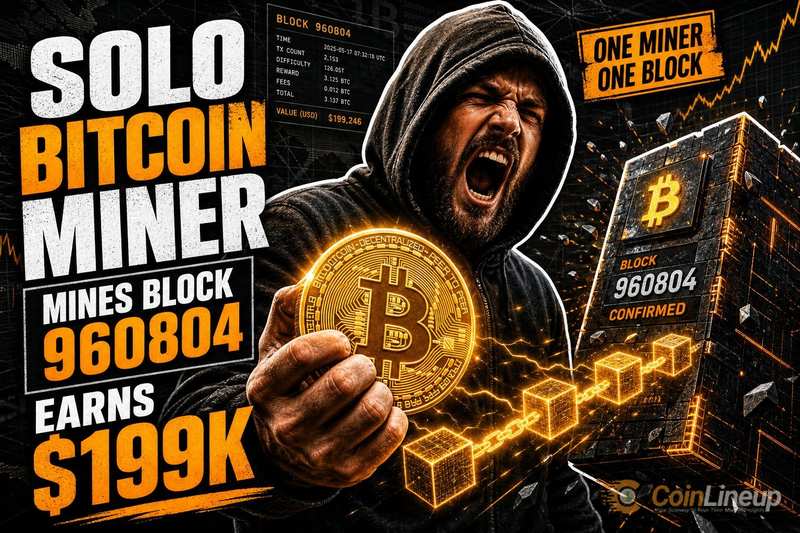
A solo Bitcoin miner has independently solved block 960804, earning a total block reward of approximately $199,000 — a rare feat in a network increasingly dominated by large-scale industrial mining pools.
Details of the Solo Block Discovery
The block was found by a single independent operator working outside any major mining pool, as confirmed by on-chain data from mempool.space and Blockchain.com. Unlike pooled miners who contribute hashpower collectively and share rewards proportionally, solo miners operate entirely on their own and retain the full block payout when successful.
The reported reward of roughly $199,000 comprises Bitcoin's fixed block subsidy plus the transaction fees attached to the transactions included in the block. Following Bitcoin's most recent halving in April 2024, the block subsidy stands at 3.125 BTC, down from 6.25 BTC. Because the block was solved by a solo participant rather than a pool, the entire amount was directed to one operator instead of being distributed among pool members.
Key details:
- Block height: 960804
- Reported reward: ~$199,000
- Miner type: Solo, not pooled
Why Solo Block Wins Are Notable
The majority of Bitcoin blocks are discovered by large mining pools that aggregate thousands of machines and distribute consistent, smaller payments to their members. An individual miner competing against that scale faces exceedingly long odds on any given block attempt. Bitcoin's proof-of-work consensus requires miners to expend computational energy to find a valid block hash, and the protocol adjusts mining difficulty roughly every two weeks — every 2,016 blocks — to keep average block times near ten minutes regardless of how much total hash rate is on the network.
Historical data highlights just how uncommon solo successes are. Reports indicate that only about 23 solo blocks were found over the course of a year, underscoring the infrequency of such outcomes relative to total network activity. Comparable events have occurred before, including one instance where a solo miner overcame approximately 1-in-28,000 odds to claim a $210,000 reward. Services that facilitate solo-style mining attempts, such as the solo ckpool operation that has been credited with 200 solo Bitcoin blocks, continue to produce occasional winners.
Mining Economics Context
A reward of this magnitude reflects Bitcoin's built-in incentive structure. Each block yields a fixed subsidy — the amount determined by the protocol's halving schedule, which cuts the reward in half roughly every four years — combined with variable transaction fees that fluctuate based on network congestion. The precise mix of subsidy and fees at any given time depends on how actively the network is being used.
Because fee conditions shift constantly, this single block serves as a snapshot rather than an indicator of broader trends. One fortunate outcome does not alter the underlying economics for the many solo miners who go extended periods without finding a block. For most independent operators, pooled mining remains the more predictable option, offering steadier, smaller payouts over time. This event illustrates the high-variance upside of solo mining rather than any shift in Bitcoin's overall incentive design.

