Solar Panel Manufacturing Trends of Tomorrow Are Shaping Recycling Economics Today
Key Takeaways
- •Cumulative solar panel waste could reach tens of millions of tonnes globally by 2050, according to the International Renewable Energy Agency, and U.S. states like Washington have begun adopting module stewardship rules for end-of-life panels.
- •Recycled silicon panels are economically viable mainly because valuable aluminum, copper, silicon, and silver subsidize the processing of the panels' predominant low-value glass.
- •SPR recently completed a $12 million upgrade at its North Carolina, Georgia, and Texas plants to improve glass removal, while Florida-based OnePlanet uses high-velocity airflow to remove 99.5% of module glass at 99% purity.
- •Manufacturers exploring silver-reduced panel designs would make panels cheaper to build but less valuable to recycle, potentially destabilizing recycling prices for asset owners.
- •Recyclers are already preparing for tandem perovskite-silicon panels, whose lead content and stronger encapsulants could require hazardous-waste handling and tougher processing methods.
Among the solar industry's many developments over the past decade, one of the most notable has been the build-out of solar panel recycling facilities across the United States. What was once treated as a problem for later down the road is already happening at scale, handled by companies fully invested in the specialized sector — We Recycle Solar, SolarCycle, SolarPanelRecycling.com (SPR) and many more. The stakes are growing: the International Renewable Energy Agency has projected that cumulative solar panel waste could reach tens of millions of tonnes globally by 2050, and in the United States, states such as Washington have begun adopting extended producer responsibility-style module stewardship rules that shape how end-of-life panels are handled.
Although recyclers are part of a green-minded industry, they do not process solar panels purely for goodwill; they are running a business. Today, the primary moneymakers in recycled silicon solar panels are the aluminum frames and the extracted copper, silicon and silver.
"At the end of the day, for recycling to work, someone has to be able to consume the products you're generating and consume it at scale," said Brett Henderson, CEO of SPR. "When you take a silicon panel and break it down to all of its base commodities to be recirculated back into manufacturing industries, the bulk of any panel is glass. Glass isn't a very valuable commodity. Silicon panels are economically viable to recycle [because] you're getting to subsidize it by collecting aluminum, silver."
Just as recyclers play the commodities market, so do manufacturers. Recent high prices for silver have led some panel manufacturers to explore designs that use less of the precious metal — a meaningful consideration for an industry that consumes a significant share of global silver demand each year. No-silver panels would be cheaper to manufacture, but they would also be less valuable to recycle. Manufacturing trends like this are forcing recyclers to become some of the most knowledgeable solar panel experts on the market.
Solar panel recycling basics
The recycling processes described here apply to silicon solar panels, the dominant panel choice in the global solar industry. Cadmium-telluride (CdTe) thin-film panels are installed on many utility-scale solar projects in the United States thanks to First Solar's domestic manufacturing base, but their unique design is not as attractive to third-party recyclers. Thin-film panels are frameless — meaning no aluminum — and the market today is not demanding cadmium or tellurium. First Solar, for its part, runs its own module take-back and recycling program for its thin-film products, a reminder that end-of-life handling can follow different models depending on panel chemistry.
The first step in recycling silicon solar panels is carefully removing the junction boxes and frames. The bulk of what remains is low-value glass, but the more cleanly and completely that glass is removed, the easier it is to access the more valuable components.
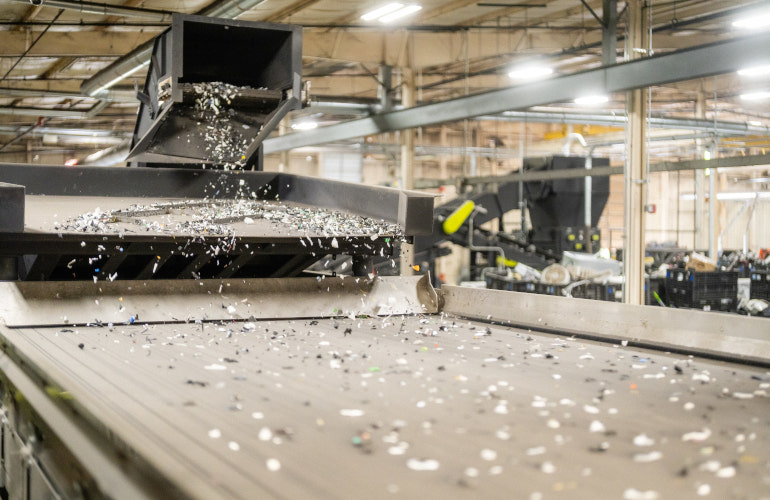
Most recycler R&D is spent on glass removal, whether through grinding, force or another method altogether. SPR recently completed a $12 million upgrade at its three recycling plants — located in North Carolina, Georgia and Texas — to better remove glass without nicking the silicon wafers and encapsulants beneath.
OnePlanet, a solar panel recycler operating outside Jacksonville, Florida, has developed a process that CEO André Pujadas said can remove 99.5% of module glass at 99% glass purity. OnePlanet achieves this with high-velocity airflow: extreme wind fractures and breaks the glass away from the other components.
Once the glass is removed, all recyclers generally follow the same path — shredding the silicon wafer and its connections into a fine powder and sending it through density separation, which yields copper and a silver-silicon mix. Copper is an easy sell for recyclers, while refineries can better split the silver and silicon to sell to larger purchasers.
"To bring [refining] in house wouldn't be a competitive advantage. They're doing this at major scale for industries around the world. SPR isn't trying to reinvent the wheel," Henderson said.
OnePlanet's proprietary recycling process, however, could bring an element of refining to the recycler itself. When glass is removed more cleanly, Pujadas said, the silver-silicon mix is less contaminated by crushed glass, which concentrates the end result into 95% pure silicon with 1% silver — a more valuable commodity for refineries.
"The whole business philosophy here would be to extract and recover minerals and reintroduce them into the supply chain for re-consumption, encouraging a circular economy," he said. "A big part of that is how much value is extracted across the entire value chain. This recycling process is very focused on a high-purity silicon. [Eventually] we will have enough silicon that it can become a feedstock for metallurgical-grade silicon production."
Looking toward the future
Panel recyclers are already studying future manufacturing trends to determine how those changes will affect their ability to stay in business — and those trends may arrive sooner than expected.
With most silicon solar panels expected to function successfully for 25 years and beyond, there has not yet been an influx of decommissioned panels from the first major wave of U.S. installations in the early 2010s. But there is enough supply of damaged panels from shipping and handling incidents, adverse weather and manufacturing errors that recyclers must stay on top of tomorrow's trends today. That first large wave of aging panels is nonetheless expected to reach decommissioning over the coming decades, which is why the processing capacity and commodity markets being built now are being sized for much larger volumes ahead.
Henderson said SPR added bifacial recycling equipment to its processing sites barely two years after launching. "We're getting new technology into our stream right away," he said.
SPR keeps dedicated research analysts on staff to quickly follow manufacturing trends and determine whether the recycler may need new processing technology or new offtakers for different material compositions. If solar panels use less silver, the copper may become more valuable, but the silicon-silver mix could be less attractive to certain refineries. Recycling itself is the easy part; finding the right commodity buyers is more challenging.
"We're starting to see technology out there to not use any silver on a solar panel, or much less of it. If it's still this silicon-based technology, it's just going to change the economics of it," Henderson said. "Over time, insurance costs go higher, equipment costs go higher, labor costs go higher, regulatory costs go higher. And then if you're going to remove one of the components that helps subsidize it, it will probably mean that asset owners are going to have this roller coaster on how recycling pricing may be."
Tandem perovskite-silicon panels, for example, are still new to the market, yet many recyclers are already considering how to process them. One concern is their use of lead, which would require stronger encapsulants to keep out moisture — encapsulants that are harder to break in order to reach the valuable components. Lead's toxicity poses an additional challenge.
"It can become a hazardous material, and then you have to deal with transportation and full framework disposal under a hazardous waste scenario," Pujadas said. "Then you have to beef up your emission systems and safety culture. It could be done, but when do you start doing it?"
That is the conundrum in the solar panel recycling space: when is it time to invest in new processes, and when can a steady stream of older technologies be relied upon? That is why efforts that can be controlled today — improving glass removal and silicon purity — will be advantageous regardless of any future solar panel design.
"It's a strange industry," Henderson said. "Solar panels are the one singular item you're bringing in, but there's so many flavors."
