Yakovenko Proposes Minting SOL to Buy a Company — but Who Would Own It?
Key Takeaways
- •Yakovenko suggested expanding $SOL supply to finance a company purchase, then using the acquired business’s revenue to repurchase and burn tokens.
- •He said the concept could be more bullish than lowering inflation and later described the revenue-driven burns as a way to return value to holders.
- •Solana’s current inflation schedule starts at 8% annually, decreases 15% each year, and is intended to reach a 1.5% floor.
- •In March 2025, validators rejected SIMD-0228, which would have tied inflation to staking participation, after the proposal failed to reach quorum.
- •As of Aug. 18, no acquisition-related SGP or SIMD had been listed in the reviewed official merged-proposal directories.
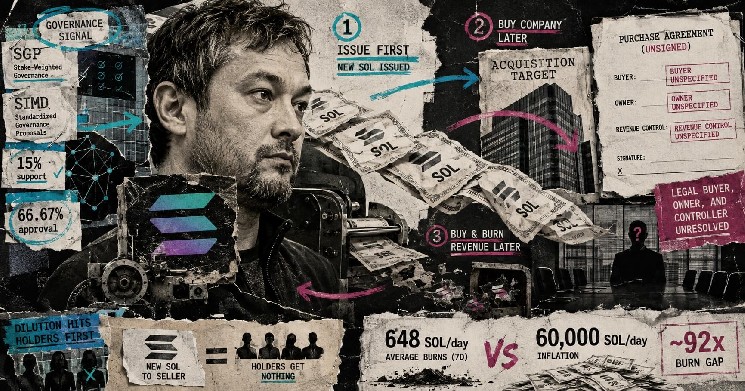
Solana co-founder Anatoly Yakovenko has floated the idea of expanding the $SOL supply, paying for a company with incremental tokens, and then using the acquired business's revenue to buy and burn $SOL. His posts sketch a tokenomic cycle, but leave both its issuance and acquisition mechanics undefined.
In an Aug. 15 post, Yakovenko described the concept as more bullish than simply lowering inflation. He clarified the next day that the company's revenue would fund $SOL purchases and burns — a mechanism he characterized as returning value to holders.
The framing touches an open debate. Solana's issuance follows a disinflationary schedule that began at 8% annual inflation, steps down 15% each year, and is designed to floor at 1.5%. In March 2025, validators rejected SIMD-0228, a proposal that would have made inflation market-driven based on staking participation, after the vote failed to reach the required quorum.
As of Aug. 18, the reviewed official merged-proposal directories contained no acquisition SGP or SIMD.
Protocol approval cannot buy a company
Solana's current governance framework could supply a directional mandate. A validator vote account with at least 100,000 $SOL staked may submit a Solana Governance Proposal, support from 15% of active stake opens voting, and approval requires two-thirds of decisive stake. Individual delegators can override their validator's vote.
Such a vote would answer whether stakeholders want to pursue the idea. However, a completed protocol change would normally require one or more technical proposals, client implementation, and activation under the SIMD process.
The Solana Foundation describes itself as a Zug-based nonprofit, while Solana Labs identifies itself as a separate company group. Validators and delegators are separate network participants, and the cited materials name neither as the buyer nor grant either acquisition authority for the network.
Helius CEO Mert Mumtaz responded sarcastically that validators would have to agree on running a company. A stake-weighted mandate would not identify a legal buyer, and the cited governance materials do not specify who could sign a purchase agreement, hold the asset, appoint management, or direct revenue.
If newly issued $SOL were transferred to a seller, total supply would rise at issuance. A holder receiving none of the new tokens would then hold a smaller share of total supply — unless, and only to the extent that, later burns reduced it.
A separate draft fee-burn proposal, SIMD-0553, estimates that Solana currently burns about 648 $SOL per day from signature fees alone, at roughly 3,000 transactions per second, compared with about 60,000 $SOL of daily inflation. Its staged resource-fee burns illustrate the scale of the existing gap, but the document contains no acquisition mechanism and does not authorize Yakovenko's idea.
Token destruction funded by network or business activity has precedent elsewhere in crypto: Ethereum's EIP-1559 upgrade has burned the base-fee portion of every transaction since 2021, and Binance has run recurring BNB burn programs tied to its exchange business. Both, however, feed existing fees or commercial activity into burns rather than minting new tokens to fund an acquisition.
Until a formal proposal defines both tracks, control remains unresolved: validators and delegators could signal a direction, the SIMD process would still require technical specification, implementation, and activation, and the corporate side would need to identify who selects the target, which legal entity buys and owns it, and who controls operations and revenue.
Source: CryptoSlate via CryptoNews.net

