Solana vs Ethereum: Speed, Fees, Security and DeFi Compared
Key Takeaways
- •Solana emphasizes high throughput and low base-layer transaction fees, using a combination of proof of stake and Proof of History to coordinate transaction processing.
- •Ethereum combines an established smart contract and decentralized finance ecosystem with a scaling strategy that relies on layer-2 networks built atop its mainnet, having transitioned to proof of stake in September 2022.
- •The frequently cited figure of 65,000 transactions per second for Solana represents theoretical capacity rather than guaranteed real-world throughput.
- •Solana has experienced network outages and performance incidents in its history, making reliability a factor to weigh alongside speed and cost.
- •Neither SOL nor ETH is automatically the better investment, since their performance depends on adoption, token economics, market conditions, competition and regulation.
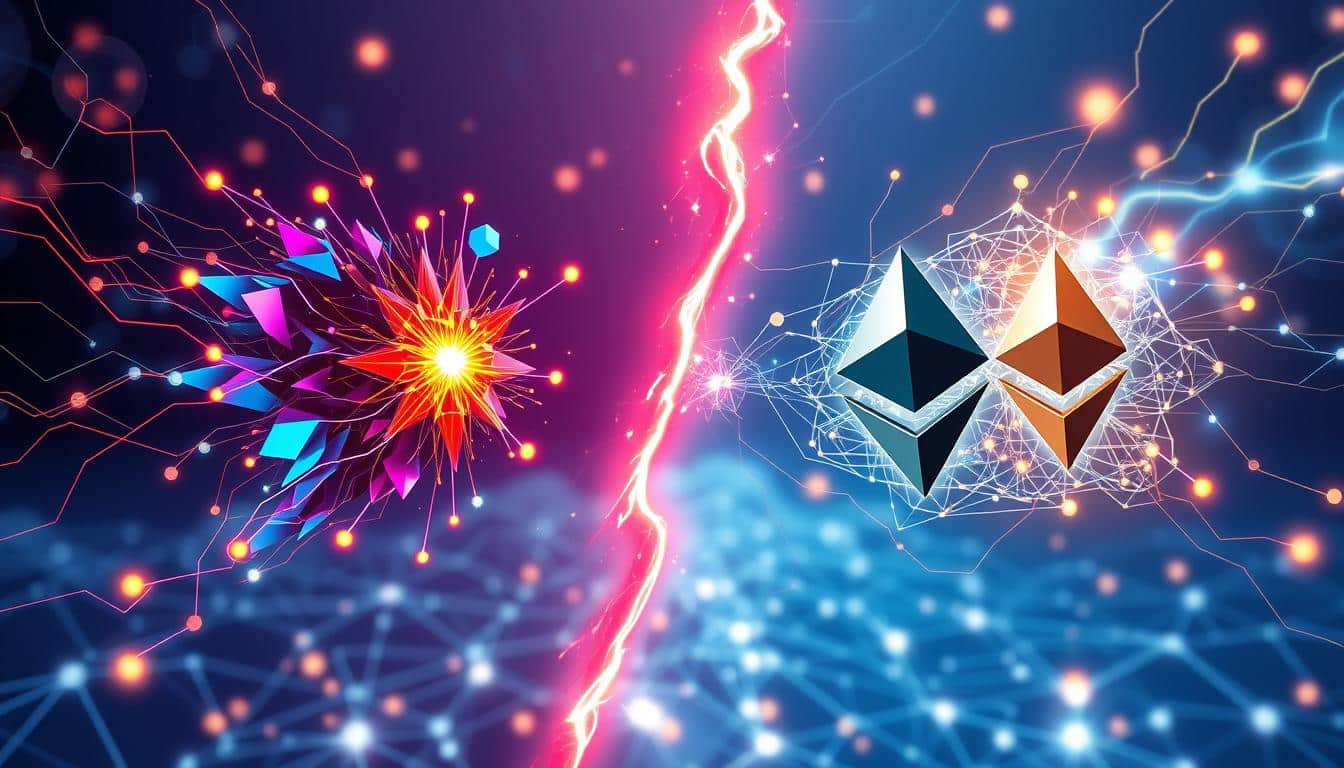
Solana vs Ethereum is ultimately a comparison of two different approaches to blockchain performance, scalability, security and ecosystem development. Solana prioritizes high throughput and low transaction costs directly on its base layer, making it attractive for applications that require frequent, inexpensive transactions. Ethereum pairs a widely established smart contract ecosystem with a scaling strategy that spans its mainnet and a broader set of layer-2 networks.
Neither blockchain is universally better. Solana may suit applications that prioritize fast, low-cost execution on a single network, while Ethereum may be preferable for projects that depend on its established decentralized finance infrastructure, EVM compatibility and wider network of scaling solutions.
Any head-to-head comparison describes broad architectural differences rather than a permanent ranking. Actual costs, throughput and application activity change over time.
Which Blockchain Is Better?
The answer depends on the use case:
- For low-cost, frequent transactions: Solana is often a strong choice.
- For applications already built around the Ethereum Virtual Machine (EVM): Ethereum or an EVM-compatible layer 2 is often more practical.
- For DeFi: Compare the specific protocols, liquidity, collateral and smart contract risks on each network.
- For NFTs and consumer applications: Evaluate marketplace activity, wallet experience, transaction costs and the target audience.
- For investment: Assess SOL and ETH separately, including token economics, valuation, adoption and downside risk.
These are starting points for evaluation rather than guarantees of performance or investment returns.
What Are Solana and Ethereum?
Solana and Ethereum are public blockchain networks that allow independent participants to verify transactions and interact with applications without relying entirely on a central operator. Both support smart contracts, digital assets and decentralized applications (dApps). Their primary differences lie in how they execute transactions, coordinate validators, manage network resources and scale activity.
What Is Solana?
Solana is a high-throughput blockchain designed to process transactions with low latency and relatively low fees. It supports smart contracts, tokens, decentralized exchanges, NFT applications, payment systems and other on-chain services.
Its architecture combines proof of stake with Proof of History (PoH), a cryptographic mechanism that helps establish an ordered record of events. PoH is not a standalone consensus mechanism; it works alongside Solana's consensus system.
Solana's main advantages include:
- Low fees for many ordinary transactions.
- Fast transaction processing and confirmation.
- A design suited to applications with frequent user interactions.
- An ecosystem of trading, payments, NFT and consumer applications.
- Rust-based development tools and frameworks such as Anchor.
The trade-offs include demanding infrastructure requirements for some network participants, the need to weigh historical reliability, and the usual risks associated with smart contracts, applications and bridges. Developers can consult the official Solana documentation for details on architecture, transaction fees and program development.
What Is Ethereum?
Ethereum is a programmable blockchain that introduced a widely used platform for deploying smart contracts and decentralized applications. Its ecosystem includes decentralized exchanges, lending protocols, stablecoins, tokenized assets, NFT marketplaces and blockchain infrastructure.
Ethereum uses proof of stake to coordinate validators and secure its mainnet. It also supports a scaling ecosystem in which layer-2 networks execute many transactions separately and use Ethereum for some combination of settlement, data availability and security.
Ethereum's key advantages include:
- A mature smart contract ecosystem.
- Extensive Solidity tooling and EVM-compatible infrastructure.
- Established DeFi protocols and liquidity.
- Multiple layer-2 scaling options.
- A large body of technical documentation, audits and developer resources.
Its trade-offs include potentially expensive mainnet transactions during periods of high demand, a more complex user experience across different layer-2 networks, and application-specific security risks. Ethereum's official proof-of-stake documentation explains its validator system and economic security model.
Speed, Fees and Scalability
Solana generally offers lower-cost transactions on its base layer, while Ethereum uses a combination of mainnet execution and layer-2 scaling to serve different performance and security needs. The most meaningful comparison depends on the transaction type, network conditions and whether Ethereum mainnet or a layer 2 is being evaluated.
Transaction Speed and Throughput
Solana is designed to handle high transaction volumes. Its architecture supports parallel transaction execution when transactions do not conflict over the same state.
Ethereum mainnet uses a different execution and scaling model. Its base layer prioritizes decentralized validation and settlement, while rollups and other layer-2 technologies increase the capacity available to users.
The frequently quoted figure of 65,000 transactions per second for Solana should not be treated as its guaranteed or typical real-world throughput. Maximum theoretical capacity, observed transaction rates and successful user transactions are different measurements.
When comparing throughput, check:
- Successful transactions per second over the same time window.
- Whether the data includes failed transactions or voting transactions.
- Network congestion and demand during the measurement period.
- Confirmation or finality time, not just block production time.
- The cost and reliability of completing a specific user action.
For a decentralized exchange, for example, the relevant metric is not simply how many transactions the chain can theoretically process. It is whether users can execute swaps reliably at acceptable costs during peak demand.
Transaction Fees: Solana vs Ethereum
Solana generally has low base transaction fees, although users can pay additional priority fees to improve the likelihood of timely inclusion.
Ethereum mainnet fees depend on network demand, transaction complexity and the gas price. Interacting with a smart contract can cost more than making a simple transfer because the operation requires more computation.
Ethereum layer-2 networks often offer lower fees than mainnet, but their costs vary by network, application and data-publication requirements.
A fair comparison should use actual transaction receipts collected at the same time. Fixed fee ranges quickly become misleading in a market where congestion and token prices change. Protocol-level details are available in the Solana transaction fee documentation and Ethereum's scaling documentation.
Ethereum Mainnet vs Layer 2: What Is the Difference?
Ethereum mainnet is the base settlement layer. Layer-2 networks process transactions using their own execution environments and rely on Ethereum in different ways to inherit security or settle transaction data.
Rollups can reduce the cost of transactions by processing activity in batches. However, not every layer 2 has identical security properties, decentralization, withdrawal conditions or data availability arrangements.
This distinction matters because comparing Solana directly with Ethereum mainnet alone may omit alternatives that Ethereum users actually choose. For an application with frequent, low-value transactions, a particular Ethereum layer 2 may be more relevant than mainnet.
Practical takeaway: Compare Solana against the specific Ethereum environment that your users will access, including any bridging, wallet and withdrawal costs.
How Do Solana and Ethereum Consensus Mechanisms Work?
Consensus mechanisms allow blockchain participants to agree on the valid state and ordering of transactions. Solana and Ethereum both use proof of stake, but their implementations differ.
Solana: Proof of History Plus Proof of Stake
Proof of History provides a cryptographically verifiable sequence that helps establish the ordering and passage of time between events. It helps Solana coordinate transaction processing efficiently.
Proof of History is not equivalent to proof of stake. Solana also uses a proof-of-stake-based consensus process in which validators participate in securing the network and agreeing on blocks.
This combination helps support Solana's performance-oriented design, but it does not eliminate network congestion, software bugs or infrastructure failures.
Ethereum: Proof of Stake Since September 2022
Ethereum replaced proof of work with proof of stake in September 2022. Validators stake ETH and participate in proposing and attesting to blocks. The protocol rewards honest participation and can penalize certain forms of misconduct.
Ethereum's consensus model emphasizes economic security and decentralized validation. Its scaling strategy also separates some execution activity from the mainnet through layer-2 systems.
Both networks require users to distinguish consensus security from application security. A blockchain can continue operating correctly while an application deployed on it contains a vulnerability.
Smart Contracts and Developer Tools
Ethereum is often the practical choice for teams that need EVM compatibility, while Solana is attractive to developers building high-throughput applications with its native programming model. The better platform depends on the team's experience, technical requirements and intended users.
Programming Languages and Frameworks
Solana programs are generally written in Rust, and the Anchor framework helps simplify common development patterns. Developers can start with the Solana Rust programming guide.
Ethereum developers commonly use Solidity and frameworks such as Hardhat or Foundry. The Ethereum smart contract language guide provides an overview of supported languages and their characteristics.
Which Blockchain Is Easier to Build On?
There is no universal answer.
Ethereum may be easier for developers who already understand Solidity and EVM tooling. Its established infrastructure can reduce the need to create new integrations from scratch.
Solana may be a good fit for developers who are comfortable with Rust and need efficient on-chain execution. However, its account model and runtime require developers to understand concepts that differ from the EVM.
Before choosing a network, evaluate:
- Available libraries, SDKs and testing environments.
- Security audit expertise for the relevant programming language.
- Wallet and exchange integrations.
- Infrastructure and RPC provider costs.
- Existing protocols that the application needs to integrate with.
- Migration costs if you later decide to support another chain.
The size of a developer community is useful context, but the availability of experienced developers and production-ready tools for a specific application is more actionable.
Which Blockchain Is Better for DeFi, NFTs and Payments?
The best blockchain depends on the application's performance requirements, users, liquidity and security assumptions. Solana and Ethereum both support multiple categories of decentralized applications, but their ecosystems have different strengths.
Decentralized Finance (DeFi)
Ethereum has an established DeFi ecosystem spanning decentralized exchanges, lending markets, stablecoins, derivatives and asset-management protocols. Its broader layer-2 ecosystem gives developers additional options for reducing transaction costs.
Solana is well suited to applications that benefit from fast, inexpensive interactions, including trading interfaces, on-chain markets and consumer-facing financial applications.
For DeFi users, the most important comparison is often the protocol rather than the blockchain alone. Consider:
- Available liquidity and trading depth.
- Borrowing rates, collateral requirements and liquidation rules.
- Smart contract audits and known vulnerabilities.
- Oracle design and exposure to market manipulation.
- Bridge dependencies and governance controls.
- Historical protocol performance during market stress.
Total value locked (TVL) can help measure the value deposited in DeFi protocols, but it is not a direct measure of unique users or safety. Token price movements can change TVL even when deposits remain unchanged. For current comparisons, use a consistent date and methodology with a dashboard such as DefiLlama.
NFTs and Digital Assets
Both networks support NFTs and tokenized assets. Solana's relatively low transaction costs can make it attractive for consumer applications involving frequent interactions, while Ethereum's ecosystem offers established NFT infrastructure and access to applications across its mainnet and EVM-compatible layer 2s.
When choosing a network for an NFT project, compare:
- Marketplace reach and target audience.
- Wallet compatibility.
- Minting and transfer costs.
- Royalties and marketplace policies.
- Indexing, metadata hosting and asset storage.
- Secondary-market liquidity.
NFTs remain speculative assets in many markets. Low minting costs or high transaction volumes do not guarantee demand, resale value or long-term project viability.
Payments and Stablecoins
Stablecoins can be transferred and used on both Solana and Ethereum-based networks. Solana's low fees can make it attractive for frequent, smaller payments, while Ethereum and its layer-2 ecosystem offer multiple settlement and distribution options.
For payment applications, evaluate more than transaction speed:
- Stablecoin issuer and redemption arrangements.
- Availability in the target country.
- Exchange and on/off-ramp access.
- Regulatory requirements.
- Confirmation requirements for merchants.
- Wallet usability and recovery options.
- Total cost, including conversion and withdrawal fees.
A fast blockchain does not remove the risks of a stablecoin issuer, an exchange, a payment provider or a smart contract.
Security, Decentralization and Network Reliability
Security is not a single metric. It includes consensus design, validator distribution, client diversity, software quality, application-level controls and operational reliability. Neither Solana nor Ethereum should be considered risk-free.
Consensus Security
Ethereum's proof-of-stake mechanism uses economic incentives and penalties to discourage dishonest validator behavior. Solana also relies on proof of stake and validator participation, with Proof of History helping coordinate event ordering.
These systems use different designs, so comparisons should consider the cost of attacking consensus, validator participation, stake concentration and recovery mechanisms rather than simply comparing transaction speeds.
Decentralization: More Than Validator Counts
Decentralization involves several dimensions:
- How many independent validators participate.
- How stake is distributed among operators.
- Whether a small number of infrastructure providers dominate access.
- The diversity of client software and geographic distribution.
- The practical cost and expertise required to operate a validator.
- The influence of governance, upgrades and other decision-making processes.
A high validator count alone does not prove that a network is decentralized. The distribution of stake, the independence of operators and the ability to participate meaningfully are also important.
Network Reliability and Outages
Historical reliability matters because downtime can affect payments, trading, liquidations and application availability. Solana has experienced network outages and performance incidents in its history. Ethereum also depends on complex software and infrastructure, and applications running on Ethereum can fail even when the base network remains operational.
Before deploying a production application, review the Solana status page and the relevant client, RPC provider and application status information. For both chains, consider monitoring, transaction retry logic, fallback RPC endpoints, incident response and the consequences of temporary unavailability.
Smart Contract and Bridge Risks
A secure base blockchain does not guarantee that every application on it is secure. Smart contracts may contain exploitable logic, compromised upgrade authorities or faulty integrations. Cross-chain bridges can add additional risks through validators, messaging protocols, custodians or verification mechanisms.
Users and developers should review audits, permissions, upgrade controls and incident history for the specific protocol they intend to use.
SOL vs ETH: Utility and Investment Risks
SOL and ETH are the native assets of their respective networks. Both support network operations and staking, but their economic roles and supply dynamics differ. Neither SOL nor ETH is automatically the better investment. Their future performance depends on adoption, token economics, market conditions, competition, regulation and the valuation investors assign to future demand.
SOL Token Utility
SOL is used to pay Solana transaction fees and participates in the network's staking system. Users may stake SOL directly or through staking services, subject to the relevant terms and risks.
Factors to evaluate include:
- Demand for block space and network applications.
- Staking rewards and token issuance.
- Validator economics and operating costs.
- Competitive pressure from other blockchain networks.
- Network reliability and developer adoption.
ETH Token Utility
ETH is used to pay transaction fees on Ethereum mainnet and participates in proof-of-stake security. It also serves as collateral and a settlement asset in parts of the broader Ethereum ecosystem.
Factors to evaluate include:
- Demand for Ethereum block space.
- Layer-2 adoption and the resulting demand for Ethereum settlement and data availability.
- Staking rewards, issuance and fee burning.
- Competition from alternative layer-1 and layer-2 networks.
- Changes in regulation and institutional demand.
Layer-2 growth can expand Ethereum's reach, but its effect on ETH demand and value depends on fee economics, settlement usage and broader market conditions.
How Should Investors Compare SOL and ETH?
Use a consistent analytical framework instead of relying on short-term price predictions.
A Note on Historical Price Figures
An earlier version of this comparison contained prices around $255 for SOL and $3,300 for ETH, alongside predictions for 2024 and 2025. Those figures are historical and should not be presented as current market data. When citing current prices, an article should show the source, currency and retrieval timestamp. Forecasts should be identified explicitly as third-party estimates or scenarios, with their assumptions explained, and never presented as established facts.
Cryptocurrency assets are volatile. Readers can lose a substantial portion or all of their invested capital, and this comparison is educational rather than personalized financial advice.
How to Choose Between Solana and Ethereum
Use actual application requirements to make the decision; that framework is more useful than selecting a winner based on a single benchmark.
Before committing to a network, run a small proof of concept. Measure the cost of representative transactions, test failure and retry behavior, evaluate the available tooling, and document the assumptions behind the choice. For larger applications, compare performance under realistic traffic conditions rather than relying solely on advertised maximum throughput.
The right blockchain is the one that satisfies the requirements with an acceptable balance of cost, performance, security, operational complexity and ecosystem support.
Frequently Asked Questions About Solana vs Ethereum
What is the main difference between Solana and Ethereum?
Solana emphasizes high throughput and low-cost execution on its base layer. Ethereum combines a smart contract ecosystem with a base settlement layer and a broad set of layer-2 scaling solutions. The main difference is how each network balances performance, decentralization, security and scalability.
Is Solana faster than Ethereum?
Solana is designed for high transaction throughput and generally offers faster, lower-cost execution for many base-layer transactions than Ethereum mainnet. However, actual performance varies with workload and network conditions, and Ethereum layer-2 networks must be considered for a complete comparison. The theoretical maximum of a blockchain should not be confused with observed throughput.
Is Solana cheaper than Ethereum?
Solana generally has lower base transaction fees than Ethereum mainnet. Ethereum fees vary with demand and contract complexity, while many layer-2 networks offer lower-cost transactions. For a fair comparison, measure the total cost of the same operation on each network, including any bridging or withdrawal fees.
Which blockchain is better for DeFi?
Ethereum offers an established DeFi ecosystem with extensive protocol infrastructure and liquidity, while Solana offers a high-throughput environment suited to many trading and financial applications. The better choice depends on the protocol, available liquidity, collateral, security audits and the user's transaction requirements.
Is Solana more secure than Ethereum?
Neither network can be declared universally more secure without defining the threat model. Ethereum uses proof of stake with economic penalties, while Solana uses its own proof-of-stake consensus architecture alongside Proof of History. Security assessments should include validator distribution, software diversity, reliability, smart contract risks and bridge dependencies.
Can Solana and Ethereum work together?
Yes. Cross-chain bridges and messaging protocols can transfer supported assets or information between Solana and Ethereum-based environments. These systems have their own trust assumptions and security risks, so users should verify the specific bridge, destination network and asset before transferring funds.
Should I buy SOL or ETH?
That depends on financial objectives, risk tolerance, investment horizon and an assessment of each asset's valuation and adoption prospects. SOL and ETH have different token economics and network roles, and both can experience substantial price declines. Compare their fundamentals and risks rather than relying on price predictions or past performance.
Which blockchain is better for developers?
Ethereum is often a practical choice for teams using Solidity, EVM tooling and existing Ethereum-compatible applications. Solana may be more suitable for teams building high-throughput applications with Rust and Solana's account-based execution model. The best option depends on technical expertise, integrations, infrastructure costs and user needs.
Is Ethereum still relevant now that Solana offers lower fees?
Yes. Transaction fees are only one factor in a blockchain's usefulness. Ethereum continues to offer smart contract infrastructure, established DeFi applications, staking-based security and a network of layer-2 solutions. Solana's performance advantages make it competitive for many applications, but lower fees alone do not determine which ecosystem is best.
The Bottom Line
Solana and Ethereum address overlapping needs through different architectural choices. Solana is compelling for applications that prioritize fast, inexpensive transactions on a high-throughput base layer. Ethereum remains compelling for developers and users who value its established smart contract ecosystem, EVM compatibility, DeFi infrastructure and layer-2 scaling options.
For users, the most important comparison is the actual application and transaction they intend to use. For developers, it is the full cost of deployment, security, maintenance and integration. For investors, it is the relationship between adoption, token economics, valuation and risk.
There is no permanent winner in the Solana vs Ethereum debate. The strongest choice depends on measurable requirements and current evidence — not a single speed statistic, a temporary market trend or an unsupported price forecast.
This article first appeared on Cryptsy and was written by Ethan Blackburn.

