Solana vs Ethereum in 2026: Speed, Fees, TVL and Adoption Compared by the Numbers
Key Takeaways
- •Ethereum, launched in 2015, uses a modular architecture with Layer 2 rollups such as Arbitrum, Optimism and Base, while Solana, launched in 2020, runs a monolithic single-layer blockchain secured by proof-of-stake plus proof-of-history.
- •Solana processes roughly 600 to 700 transactions per second versus 15 to 30 on Ethereum's base layer, with average fees near $0.00025 compared with $0.50 to $3 for simple Ethereum transfers.
- •Ethereum leads in DeFi total value locked — figures range from about $42.6 billion to $70 billion versus $5.37 billion to $8 billion for Solana — and hosts more than 4,000 dApps and about 31,800 active developers against Solana's roughly 17,700.
- •Ethereum's validator set exceeds 890,000 and its base layer has had no unplanned downtime, whereas Solana runs roughly 800 validators and experienced outages including a February 2024 failure that left the network offline for more than five hours.
- •Solana has led Ethereum in weekly decentralized exchange volume since 2024 and offers roughly 6% staking yield versus 2% to 4% on ETH, with many institutions now treating the two networks as complementary.
Solana and Ethereum stand as the two dominant smart contract platforms in crypto. Both give developers the tools to build decentralized applications, and both rely on proof-of-stake to secure their networks. Yet the two chains pursue sharply different architectural paths: Ethereum, live since 2015, distributes its workload across Layer 2 networks, while Solana, launched in 2020, runs the entire stack on one fast layer.
This comparison draws on five industry sources published in 2026. Their figures do not always align, so where numbers differ, the article presents the range and attributes each figure to its source. That five separate publications produced head-to-head comparisons within a single year is itself a sign of how central the two chains' rival designs — monolithic versus modular — remain to the industry's debate over how blockchains should scale.
Market Size and Background
Ethereum is the older and larger of the two networks. It launched in July 2015, following Vitalik Buterin's late-2013 proposal of the concept. Solana's main network went live in March 2020 and was founded by Anatoly Yakovenko.
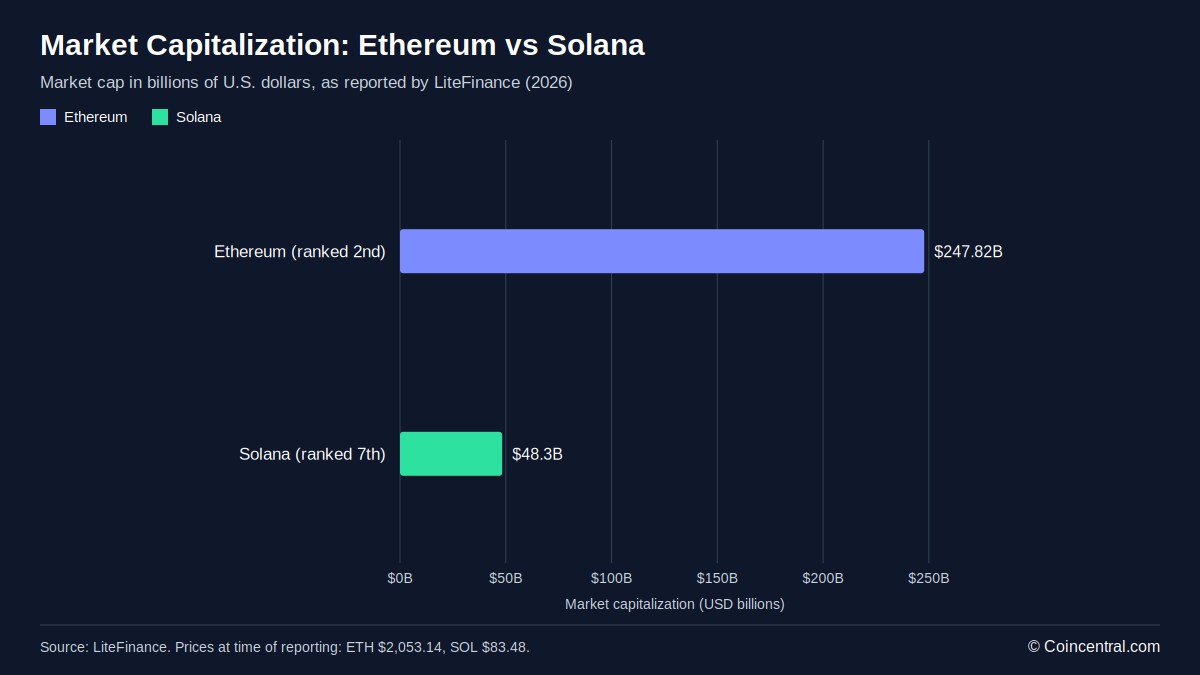
LiteFinance reports Ethereum's market capitalization at $247.82 billion with the token priced at $2,053.14, placing it second on CoinMarketCap. Solana's market cap stands at $48.3 billion at $83.48, ranking seventh. On this measure Ethereum is roughly five times larger, though daily price movement shifts the gap with the market.
Both networks secure themselves with proof-of-stake, but Solana layers on a timing mechanism known as proof-of-history. Ethereum switched from proof-of-work to proof-of-stake in September 2022. Ethereum developers code in Solidity; Solana developers work in Rust.
Phantom outlines the core architectural split: Solana operates as a single-layer, or monolithic, blockchain, whereas Ethereum is modular, relying on rollups such as Arbitrum, Optimism and Base to absorb extra traffic.
These designs shape network behavior. According to Phantom, Solana's single-layer construction delivers high speeds and low latency, fitting applications that need real-time processing, though it can become harder to scale beyond certain limits. Ethereum's modular structure allows each layer to be upgraded independently, but Phantom notes this adds complexity that can degrade the user experience.
Speed and Throughput Statistics
Solana processes dramatically more transactions than Ethereum's base layer. CoinTracker places Ethereum at 15 to 30 transactions per second (TPS) under typical conditions, versus 600 to 700 for Solana, whose theoretical ceiling is 65,000 TPS.
Real-world Solana throughput varies by source: BitGo cites roughly 1,100 to 6,200 TPS, while LiteFinance reports 2,500 to 3,500 TPS. Neither source explains the divergence.
Ethereum's Layer 2 networks expand capacity. CoinTracker says combined Layer 2 throughput lifts Ethereum's total above 5,000 TPS; those transactions execute off the main chain and settle back to it later.
Finality — the interval before a transaction is treated as settled — runs about 12 minutes on Ethereum's base layer against 6 to 13 seconds on Solana, per CoinTracker. BitGo says Solana achieves practical finality in under a second. Block times follow the same pattern: Solana Company reports roughly 12 seconds for Ethereum and about 400 milliseconds for Solana.
In practice, both networks miss their stated maximums. LiteFinance notes Solana's real-world speed sits far below its claimed peak and that no chain has yet solved the trade-off among speed, security and decentralization. CoinTracker adds that Ethereum's Layer 2 strategy preserves base-layer security but can scatter assets across multiple networks, complicating the user experience.
Transaction Fee Statistics
Fees reveal one of the sharpest contrasts. CoinTracker pegs Solana's average transaction cost at about $0.00025, staying under a cent even at peak demand. Solana Company lists roughly $0.003, and LiteFinance puts it under $0.03.
Ethereum's mainnet charges more. CoinTracker reports $0.50 to $3 for simple transfers and $15 to $30 for complex DeFi actions during congestion. Solana Company gives a typical fee of $0.18, while LiteFinance cites $1 to $2.
Layer 2 networks cut Ethereum's costs. CoinTracker lists $0.10 to $0.50 per transaction after the Pectra upgrade — still 100 to 1,000 times higher than Solana. LiteFinance reports that the March 2024 Dencun upgrade reduced Layer 2 fees by 55% to 99%.
Solana's fees can climb when demand surges. LiteFinance says the average fee rose from $0.002 to $0.5 during the memecoin boom, and that fee revenue grew roughly 900% between November 2024 and January 2025.
CoinTracker explains that Solana isolates local fee markets, so congestion in one segment does not raise fees across the entire network, whereas Ethereum's global fee market means a demand spike affects all users.
Fee levels matter most for applications with many small actions. Solana Company says Solana suits organizations running high-frequency on-chain activity and notes that Ethereum fees can spike to $5 to $20 or more under congestion, making frequent on-chain activity costly.
Validator and Decentralization Statistics
Validators — the computers that verify transactions and secure each chain — are far more numerous on Ethereum. Token Terminal data cited by LiteFinance counts more than 890,000 Ethereum validators, and BitGo says the set exceeds one million. Solana runs about 800. LiteFinance says the active figure moves between 700 and 900, down from a peak near 2,500; BitGo describes this as a threefold pruning of underperforming nodes, while LiteFinance attributes it to high operating costs and stricter hardware requirements.
Entry rules differ. Running an Ethereum validator requires 32 ETH, while Solana sets no minimum, though validators there need more powerful hardware, according to Solana Company.
Ethereum has its own concentration points. LiteFinance reports that Lido, Coinbase, Kraken and Binance together control over 50% of staked ETH, with 39.23 million ETH staked in total. The same source scores decentralization at 7 out of 10 for Ethereum versus 3 out of 10 for Solana — its own rating rather than a measured figure.
Consensus design also differs. LiteFinance explains that proof-of-history functions as a built-in clock, letting validators spend less time agreeing on the ordering of events, and links the design to confirmation times of about 400 milliseconds. The source cautions that validators with greater resources may gain an edge under this model.
BitGo observes that a smaller validator set would normally signal less decentralization, but Solana is deliberately trimming underperforming nodes. It adds that Ethereum's large validator population spreads stake widely, making a 51% attack financially prohibitive at the current scale.
DeFi Total Value Locked and Market Share
Total value locked (TVL) measures the assets held in a network's DeFi smart contracts. Ethereum leads in every source, though the size of the lead depends on the date and data provider. LiteFinance puts Ethereum TVL near $42.6 billion as of May 2026 against $5.37 billion for Solana — roughly an eightfold gap. CoinTracker lists about $55 billion for Ethereum and $8 billion for Solana, while Solana Company cites about $70 billion for Ethereum.
Market share tells a similar story. CoinTracker says Ethereum holds about 68% of global DeFi TVL, and BitGo places the figure near 52% as of May 2026. LiteFinance ranks BNB Chain second by TVL and Solana third.
Trading activity points the other way. CoinTracker says Solana overtook Ethereum in weekly decentralized exchange volume in 2024 and has held the lead through 2026, and CryptoRank data cited by LiteFinance showed Solana first in transaction volume in April 2026.
Institutional funds lean toward Ethereum. BitGo notes that BlackRock's BUIDL fund and Franklin Templeton's BENJI fund run on Ethereum-based infrastructure. On Solana, Circle issues USDC natively, and Jupiter and Raydium are active exchanges there. CoinTracker says Ethereum anchors the majority of stablecoin supply on-chain.
LiteFinance reports that Ethereum's TVL growth during the August-to-September 2025 bull market appeared modest compared with earlier cycles, and says Solana's rises came mainly during price spikes and bursts of user activity, making those gains less stable.
Developer and Application Statistics
Ethereum fields more developers and more applications. CoinTracker counts about 31,800 active developers on Ethereum versus about 17,700 on Solana — a lead of roughly 80%. The same source lists more than 4,000 dApps on Ethereum against about 500 active dApps on Solana, while LiteFinance counts more than 1,850 projects in Ethereum's DeFi sector. These counts use different definitions and should not be compared directly.
Tooling also favors Ethereum. Solana Company names Hardhat, Foundry, Remix and OpenZeppelin as mature options and notes that the Ethereum Virtual Machine powers many Layer 2 networks and sidechains. Solana developers use Rust with frameworks such as Anchor.
Solana's application mix leans retail. Phantom lists in-wallet perpetual futures trading, the Pump.fun memecoin launchpad, Hivemapper mapping rewards and MagicBlock gaming tools. In 2025, Backed launched more than 55 tokenized U.S. equities on Solana.
Ethereum's app lineup tilts toward finance: Phantom names Lido, EigenLayer, Aave, Pendle and Uniswap among its flagship projects.
Solana's developer base continues to expand. BitGo says new developer participation has risen steadily, helped in part by Solana Foundation programs. CoinTracker adds that Solana leads on daily active addresses and per-transaction cost, while Ethereum leads on developer count and institutional adoption.
Network Reliability and Security Statistics
Reliability is where the two networks diverge most. CoinTracker says Ethereum's base layer has experienced no unplanned downtime, and BitGo adds that Ethereum's consensus layer has run without a breach since launch.
Solana has an outage history. LiteFinance lists incidents on October 1, 2022, February 25, 2023 and February 6, 2024; in the 2024 event the network was offline for more than five hours, which the source counts as the 10th such failure.
Recent performance looks improved. CoinTracker reports uptime above 99.9% since mid-2024, and Solana Company says the network has seen no downtime since February 2024. The Firedancer validator client, launched in late 2025, gives Solana a second independent software implementation, reducing the network's dependence on any single codebase — a development worth tracking for readers following Solana's reliability record.
Security incidents have touched both ecosystems. BitGo cites the August 2022 Slope wallet incident, which affected about 9,000 wallets, and LiteFinance points to the 2016 DAO hack, which split Ethereum into Ethereum and Ethereum Classic. BitGo says Solana's outages caused no direct loss of funds — an availability risk rather than a theft risk — while LiteFinance reports that in November 2022 a single user shut down 1,000 nodes simultaneously, likening it to a 20% attack on the network.
BitGo notes that Solana's faster development cycle brings more frequent protocol upgrades and, with them, more room for software bugs. On Ethereum, the main risk sits at the application layer in smart contracts rather than in the protocol itself. Institutions on either network still need to review every protocol they use.
Staking, Treasury and Institutional Adoption
Staking yields favor Solana. Solana Company reports roughly 6% annual yield on SOL against 2% to 4% on ETH; its FAQ gives a 2% to 3% range for Ethereum.
Public companies and governments hold both assets. Solana Company counts 23 holders of Ethereum and 16 of Solana, and says Solana adoption is growing faster. It also notes that Coinbase has put part of its treasury into Ethereum.
Energy use differs by source. Solana Company lists 2.6 million kWh per year for Ethereum and 16.0 million kWh for Solana, adding that Ethereum's energy consumption fell about 99.98% after the Merge.
Regulated products now cover both assets. LiteFinance says the SEC approved spot Ethereum ETFs in July 2024 and that spot Solana ETFs launched in October 2025. BitGo notes that custody support is more standardized for Ethereum, while Solana staking setups vary more between providers.
Upgrades continue on both sides. Ethereum's Pectra upgrade went live in May 2025, and LiteFinance listed the Glamsterdam fork for the third quarter of 2026, so readers should verify its current status. On Solana, the Alpenglow upgrade targets resilience and lower latency. Earlier upgrades on both networks have already shifted the numbers in this comparison — per Solana Company, the Merge cut Ethereum's energy use by about 99.98%, and per LiteFinance, Dencun reduced Layer 2 fees by 55% to 99% — which makes Glamsterdam and Alpenglow the nearest scheduled checkpoints for how the gaps above evolve.
Corporate interest is also building. BitGo says some organizations have added Solana to their balance sheets as part of diversified digital asset reserves, linking the trend to broader growth in Bitcoin treasuries. Solana Company notes that both the IMF and the Bank for International Settlements have pointed to tokenization's potential to improve settlement and custody.
Solana Company says staking SOL can be straightforward through validators such as Helius and Jito, but cautions that SOL's price swings tend to be larger than ETH's, calling for stronger risk controls.
What the Statistics Show
The figures describe two networks built for different jobs. Ethereum leads in DeFi TVL, developers, validators and uptime history, while Solana leads in speed, fees, trading volume and staking yield. The sources agree on the direction of most gaps even when exact numbers diverge.
BitGo says many institutions treat the two as complementary. CoinTracker says most observers view Ethereum as a settlement layer for large capital and Solana as a fast layer for retail and consumer applications.
Choosing between the two depends on the goal. Solana Company says Ethereum is built for stability and liquidity while Solana offers cost efficiency and throughput. LiteFinance suggests some investors hold both to spread risk but warns that short-term purchases of either coin carry a high risk of loss.
All figures come from the sources listed below and reflect 2026 conditions. Crypto data changes quickly, so check live trackers before making any decision. This article is not investment advice.
Sources
- Solana vs. Ethereum: Key Differences for Institutions (BitGo)
- Solana vs Ethereum: Key differences, speed, fees, and use cases (CoinTracker)
- Solana vs Ethereum: Everything you need to know (Phantom)
- Solana vs Ethereum: Which Blockchain Leads in Performance and Adoption? (LiteFinance)
- Solana vs. Ethereum Through a Treasury Lens (Solana Company)

