Kraken's Late Switch Pushes Solana's Disinflation Vote Over the Two-Thirds Line
Key Takeaways
- •SGP-0002 passed with 67% support against 25.16% opposition, exceeding the required 66.67% supermajority by 0.33 percentage points on 60.7% turnout.
- •The proposal doubles Solana's annual disinflation rate from 15% to 30%, so the 1.5% terminal inflation rate will now be reached in roughly 2.8 years instead of 5.7 years.
- •An estimated 18.9 million fewer SOL will enter circulation over the next six years, reducing holder dilution but lowering staking rewards.
- •Kraken initially voted no but flipped over 90% of its roughly 8.9 million SOL of voting stake to yes before voting closed, while Figment, Everstake, and P2P Validator opposed the measure.
- •The companion fee proposal SGP-0003 failed with 53.90% support, keeping SOL burns near 650 SOL per day rather than the 7,500-9,000 SOL it could have generated.
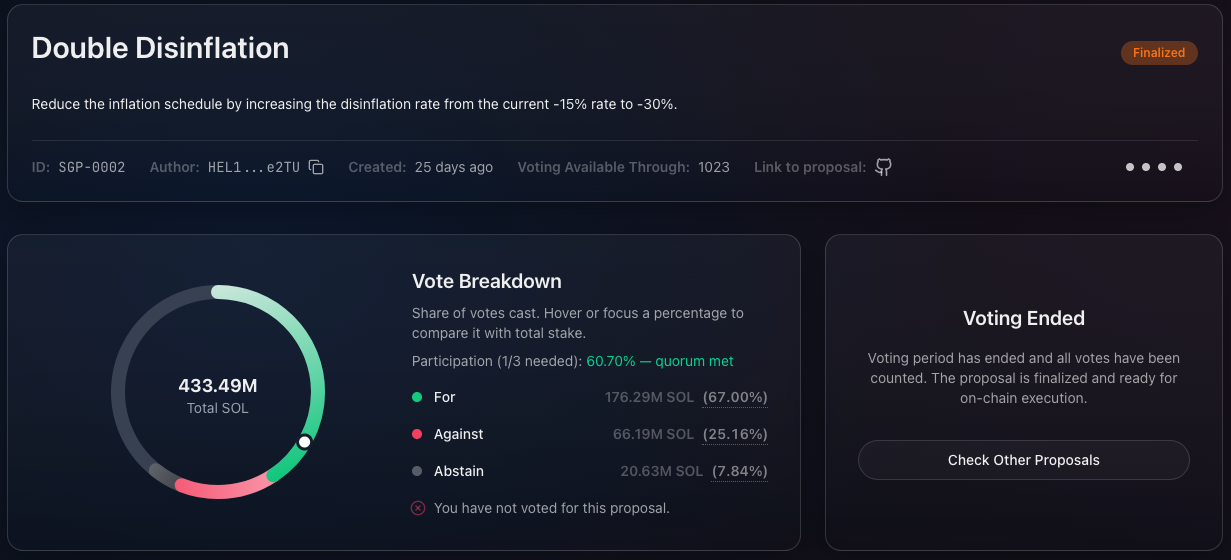
Solana validators have narrowly approved a proposal to double the network's annual disinflation rate, clearing the two-thirds supermajority threshold by just 0.33 percentage points after Kraken flipped most of its stake from no to yes in the final hours of voting.
Issuance reaches its 1.5% floor in 2.8 years
SGP-0002, known as Double Disinflation, passed with 67% support against 25.16% opposition and 7.84% abstentions, on a turnout of 60.7% of eligible stake. Support came in just above the 66.67% bar required for the measure to pass.
Kraken had voted against both supply proposals at 12:33 UTC on August 28, pushing SGP-0002 below the supermajority with less than three hours remaining before the count closed at 15:00 UTC for epoch 1024. Earlier that morning, support had stood at 68.77%, with about 47.72% of eligible stake having voted. Kraken's no vote knocked support down to roughly 65%.
Kraken then moved again. By the close, the proposal had the backing of over 90% of the US exchange's approximately 8.9 million SOL of voting stake.
The plan, tied to SIMD-0550, doubles Solana's yearly disinflation rate from 15% to 30% while keeping the network's long-term inflation target at 1.5%. The disinflation schedule — under which the issuance rate decays by a fixed percentage each year until reaching a floor — has been part of Solana's monetary design since the network's launch, and this vote marks the first time holders have altered it. Under the previous schedule, Solana would have reached its 1.5% terminal rate in about 5.7 years; it will now do so in roughly 2.8 years. This translates into an estimated 18.9 million fewer SOL entering circulation over the next six years. The upside is reduced dilution for SOL holders, while the downside is lower staking rewards for validators and delegators. The trade-off between supply growth and staking yield is a recurring theme in proof-of-stake networks; Ethereum has faced similar debates around how much issuance should be curbed in favor of scarcity.
Figment staked 17.1 million SOL entirely against SGP-0002
Figment, which held 17.1 million SOL in the finalized governance data, voted against the proposal, while Helius and Jupiter voted in favor. Other prominent custodial stakers also opposed at least SGP-0002, including Everstake and P2P Validator.
Custodial exchanges earn revenue when new SOL is issued, so faster disinflation means APY declines more quickly and income falls. Mert Mumtaz, CEO of Helius and a co-author of the proposals, called that logic "mathematically nonsense" in an X post, arguing that any price appreciation from slower supply growth would exceed the foregone yield.
Solana Company, a Nasdaq-listed treasury company trading under the symbol HSDT, said on August 21 that it supports the Solana Constitution but opposes both supply proposals. Reopening the inflation schedule introduces uncertainty into the multi-year models institutions rely on, the firm said.
SGP-0002 was part of Solana's first binding governance process. The Solana Constitution, SGP-0001, passed with 85.97% support. Previously, Solana protocol changes moved through the SIMD process with decisions effectively made by validators and client teams off-chain, without formal binding stake-weighted votes, making this round a shift toward on-chain governance with enforceable outcomes.
SGP-0003 failed with 53.90% support. The fee change under SIMD-0553 would have required transactions to pay for the computing power they book and burned part of what they paid. Its rejection means SOL burns will remain around 650 SOL per day, in contrast to the 7,500 to 9,000 SOL — roughly $800,000 a day at current prices — that the fee change would have generated.
SOL was trading at about $104, down approximately 5.2% on the day, according to data from CoinGecko.
Both rejected supply proposals may be resubmitted without any cooling-off period, but supporters would need to win over custodians who have now publicly stated their objections. How future resubmissions navigate the split between custodial stakers and solo validators is likely to shape the trajectory of Solana's young governance system.
