Firedancer Validator Runs on a Tablet as Solana Pushes Back on Hardware Criticism
Key Takeaways
- •A Solana mainnet full node ran on less than one CPU core of a tablet connected via 5G, reaching the chain tip and voting within roughly 10 seconds, according to Firedancer developer Ritchie Patel.
- •The demonstration occurred at Block Zero in London ahead of Solana Breakpoint 2026, which is being held at Olympia London from Nov. 15 to 17.
- •Yakovenko's Nov. 15 post on X targeted Bankless co-founder David Hoffman, reopening a January 2023 dispute in which Hoffman argued lower hardware needs are vital to accessibility while Yakovenko downplayed that priority.
- •Anza currently advises production validators to use machines with at least 12 CPU cores, 256GB of RAM, and high-performance NVMe storage, with staked validators recommended to have a symmetric connection of 2 Gbit/s or faster.
- •Firedancer, an independent validator client built to improve performance and client diversity, has shipped regular mainnet releases in 2026 and expanded support from x86 servers to ARM computers.
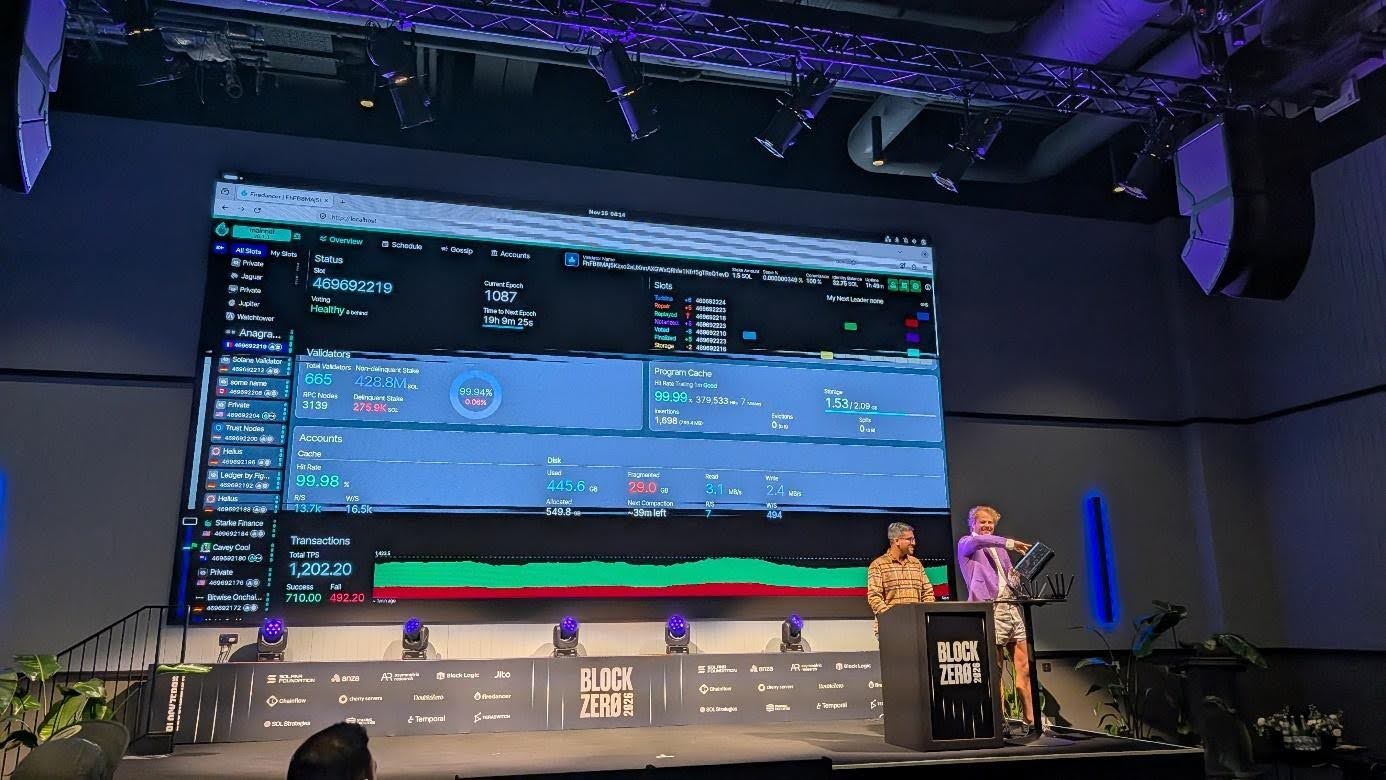
Solana co-founder Anatoly Yakovenko has revived a long-running debate over the network's decentralization after Firedancer developers demonstrated a live Solana validator running on tablet hardware. The demonstration, staged in London ahead of Solana Breakpoint 2026, gave Yakovenko a pointed rebuttal to critics who argue that Solana's demanding hardware requirements restrict access to its network.
Hardware requirements have long been a flashpoint in blockchain design because the cost of the machines needed to run a validator shapes who can participate in consensus — a consideration both critics and builders tie to how decentralized a network can become in practice. That backdrop is what gives the tablet demo its force: it speaks directly to the accessibility argument at the center of the dispute.
On Nov. 15, Yakovenko marked the result on X with a short reply directed at Bankless co-founder David Hoffman and several other community members:
@TrustlessState @mryalamanchi @toghrulmaharram @mikebelshe We did it @TrustlessState; sol is money
— toly 🇺🇸 (@toly) November 15, 2026
Post on X
Firedancer Puts a Solana Validator on Tablet Hardware
Firedancer developer Ritchie Patel reported that a Solana mainnet full node ran on less than a single CPU core of a tablet while connected to the internet over 5G. According to Patel, the machine went from nothing to fully caught up with the chain tip and voting in roughly 10 seconds — a process that included compiling the client with the make -j flag and completing an initial snap sync.
Solana mainnet full node running on less than a single CPU core of a tablet, networking via 5G. 10 seconds from nothing to caught up to chain tip and voting, including make -j, and initial snap sync.
— ripatel ✠ (@fd_ripatel) November 15, 2026
Post on X
An independent blog post devoted to the setup described a live Firedancer validator running on a single CPU core with 20GB of RAM at the conference venue, offering a public account of the configuration behind the demonstration.
The demonstration took place at Block Zero, Solana's validator and infrastructure-focused event in London, staged ahead of the main Solana Breakpoint 2026 conference. Breakpoint itself is taking place at Olympia London from Nov. 15–17 and is listed on the official Solana schedule. The timing places the hardware debate in front of the conference audience for the duration of the three-day program.
Yakovenko Revisits a 2023 Hardware Debate
The reply — "We did it," followed by "sol is money" — was aimed squarely at Hoffman, with whom Yakovenko publicly clashed over hardware requirements in January 2023. In that exchange, Hoffman maintained that reducing the blockchain's hardware needs was crucial to its long-term resilience and accessibility. Yakovenko countered that easing Solana's hardware load was not a high priority for engineering work, and argued that smaller hardware requirements should not be treated as a cultural objective for blockchain networks. Hoffman, for his part, insisted that keeping the blockchains accessible was essential.
Nearly four years after that exchange, the Firedancer tablet test has handed Yakovenko another concrete and highly visible answer to the argument that Solana's hardware demands undermine its accessibility.
Firedancer Keeps Pushing Solana Toward Lighter Infrastructure
Firedancer is an independent validator client for Solana, developed to enhance the network's performance and client diversity. Client diversity — a network running on multiple independently built validator programs rather than a single codebase — is widely treated in the industry as a resilience safeguard, since a fault in one implementation is less likely to affect every validator at once. Development has continued to progress through 2026, with regular mainnet releases already shipping and support for ARM computers extended beyond x86 servers.
That progress makes the tablet demonstration more than a novelty. It illustrates that software optimization alone can lower the computing barrier for certain forms of involvement in the Solana network — a consideration central to the debate over how accessible the network can realistically be.
Even so, the demo should not be mistaken for the requirements involved in running a production validator continuously under live network conditions.
Production Solana Validators Still Need Much More Power
Anza currently recommends that validators operate on machines with a minimum of 12 CPU cores, 256GB of RAM, and high-performance NVMe storage. For a staked validator, the team additionally calls for a symmetric internet connection of at least 2 Gbit/s — preferably 10 Gbit/s.
Measured against those recommendations, a single-cored tablet with 20GB of memory sits at a significant distance. Firedancer's demo demonstrates what is technically possible in a controlled setting; it does not set a new benchmark for production Solana validators, which must sustain continuous operation under real network load. How that gap evolves as Firedancer's mainnet releases continue is an open question in the debate — one that hangs over the remaining days of Breakpoint, which runs through Nov. 17.

