Solana Outpaces NYSE in Weekly Trade Count as SOL Holds Below $90, Fidelity Reports
Key Takeaways
- •Solana's decentralized exchanges accounted for roughly 15% of trades recorded across major U.S. exchanges in 2026, a sharp increase from 0.30% in 2022, and in one week Solana's transaction count exceeded the NYSE's.
- •Fidelity's comparison measures executed trade counts rather than value exchanged, and it is further complicated by off-exchange venues handling roughly half of U.S. equity trading volume in 2025.
- •Solana's maximum block capacity rose 66% to100 million compute units, slot times stabilized near 400 milliseconds with a developer target of about 200 milliseconds, and median transaction fees stayed below one cent during the January 2025 trading surge.
- •Monthly tokenized-asset trading on Solana grew from under $100 million to nearly $5 billion, though some products carry investor eligibility and transfer restrictions, and Solana-based platforms processed over $590 billion in perpetual futures notional volume over 12 months.
- •SOL traded around $89.59 on November 8, down roughly 19% over the previous month with a market capitalization near $52 billion, while spot Solana ETFs recorded net outflows of about $24.2 million on November 6.
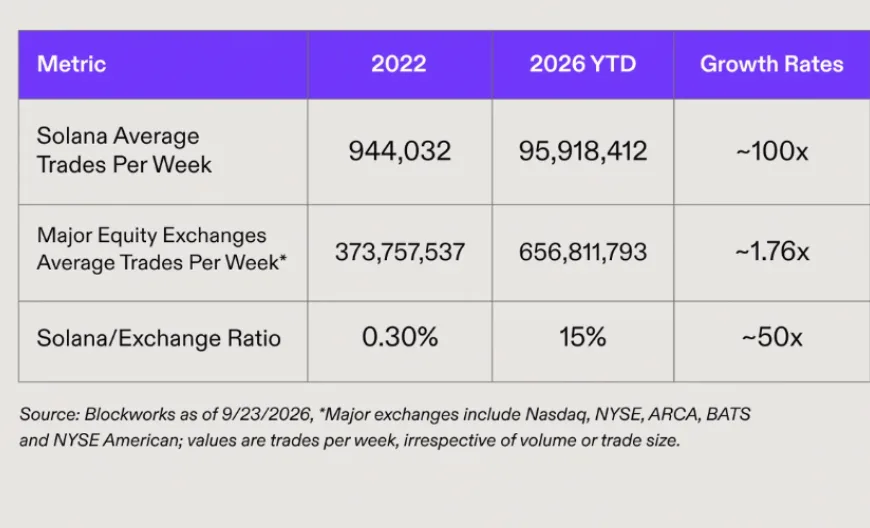
Solana recorded more weekly trades than the New York Stock Exchange (NYSE) during one week in 2026, according to research from Fidelity Digital Assets published on November 6. The milestone reflects increased trading activity on the blockchain, even as SOL remained below $90. The report examined trading activity across Solana's decentralized exchanges, along with network upgrades, tokenized assets, and transaction fee revenue.
Fidelity analyst Max Wadington found that decentralized exchanges on Solana accounted for roughly 15% of the trades recorded across major U.S. exchanges in 2026, up from just 0.30% in 2022. In one week, Solana's transaction count also exceeded the NYSE's.
The comparison rests on the number of executed trades rather than the value of assets exchanged. Solana primarily handles digital asset transactions, while the NYSE facilitates trading in listed securities, meaning the figures show differences in trading activity rather than the amount of money moving through either market.
A further limitation concerns where U.S. stock trading actually takes place. A large share of it occurs away from traditional exchanges, and Nasdaq data showed that off-exchange venues accounted for roughly half of U.S. equity trading volume in 2025.
Network Upgrades Aim to Support Higher Trading Volumes
Fidelity's report also examined changes to Solana's network performance. Slot times have stabilized at around 400 milliseconds, while developers are working toward reducing them to approximately 200 milliseconds. More predictable processing intervals could help trading applications execute transactions with less uncertainty.
The network's maximum block capacity has increased from 60 million to 100 million compute units, a 66% increase that gives each block room to handle more computation. The higher limit also places greater demands on validators, making efficient network performance an important consideration as activity grows. Fidelity additionally discussed the Alpenglow consensus upgrade and other changes to transaction execution.
Costs have remained contained: during the January 2025 trading surge, median transaction fees stayed below one cent. Taken together, network capacity, processing consistency, and fee behavior are key measures for assessing how Solana's infrastructure is handling its expanding range of trading activity.
Tokenized Assets and Derivatives Broaden Solana's Markets
Solana's trading activity is no longer limited to cryptocurrencies and stablecoins. Tokenized Treasury products, equities, commodities, and private credit instruments have added new asset types to its blockchain-based markets. Monthly trading in tokenized assets on Solana has grown from less than $100 million to nearly $5 billion, according to figures cited in the report.
However, these products do not all operate under the same conditions as freely transferable crypto tokens. Some carry investor eligibility requirements, restrictions on transfers, and specific ownership arrangements. Those differences are relevant when comparing tokenized-asset activity with activity in more openly accessible digital markets.
Derivatives have also become a substantial part of the network's trading activity. Fidelity reported that platforms built on Solana processed more than $590 billion in perpetual futures notional volume over the preceding 12 months.
SOL Price Stays Below $90 as Selling Pressure Persists
The growth in network activity has yet to translate into stronger price performance for SOL. SOL traded at approximately $89.59 on November 8, down around 19% over the previous month, and its market capitalization stood near $52 billion.
Spot Solana exchange-traded funds also saw withdrawals, with preliminary fund data showing net outflows of approximately $24.2 million on November 6. SOL was trading below its short-term averages at the time. Technical estimates placed support near $87.02 and resistance around $91.44, levels that serve as reference points for traders tracking the Solana price prediction.
Fidelity also examined how Solana generates revenue from trading. The network collects base fees and priority fees, alongside payments linked to transaction ordering. Revenue from priority execution can vary with demand, meaning periods of lower trading activity may generate less income.
This article provides market information, not financial advice. Cryptocurrency prices carry substantial risks, and historical trading activity does not guarantee investment returns.

