Solana Sets New Weekly Record With 1.3 Billion Non-Voting Transactions
Key Takeaways
- •Solana processed a record 1.3 billion non-voting transactions in the latest week, reflecting sustained demand from applications and users.
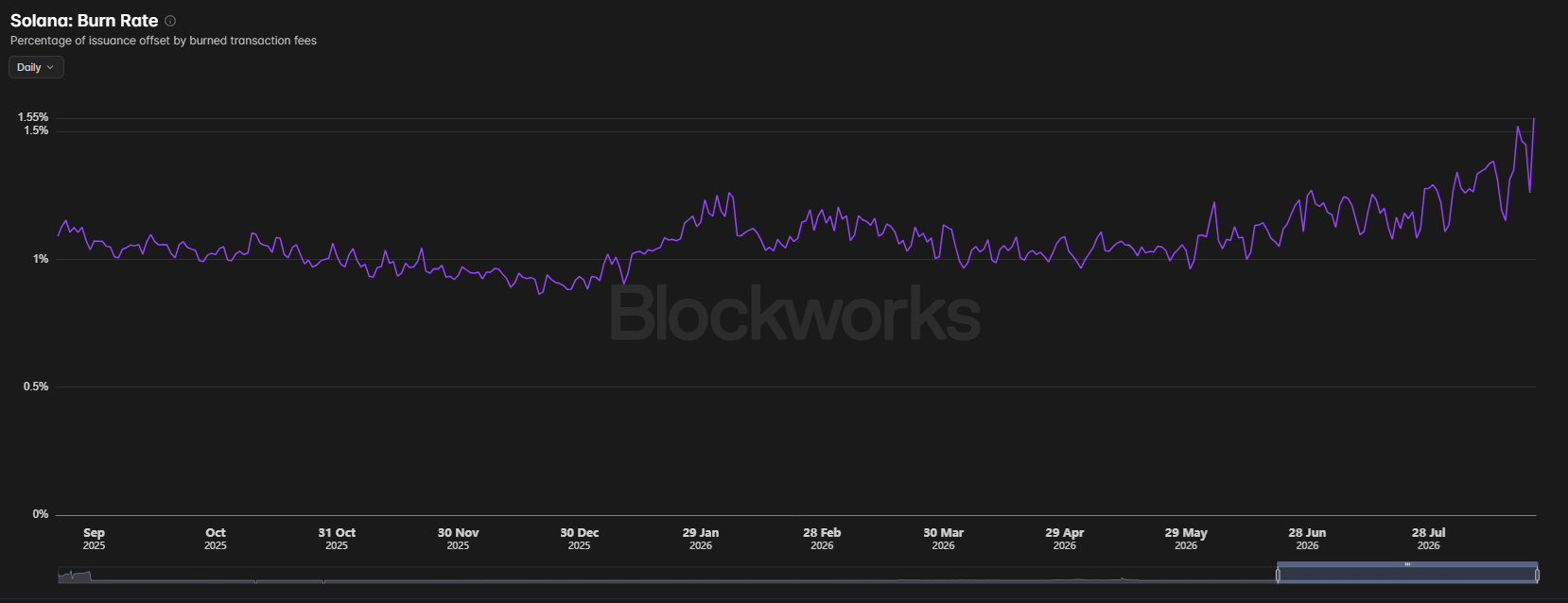
- •The network has about 2.6 million daily active users, and its burn rate reached 1.53% on August 23, the highest since early 2025.
- •Solana generates more than $10 million in daily app-based fees and over $250 million in monthly app revenues, while priority-fee spending has returned above $1 million a day.
- •FOMO and Pump.fun have been major drivers of recent activity, with Pump.fun DEX daily fees rising above $4.9 million.
- •Solana is preparing governance changes and a vote on reducing SOL emissions over six years, alongside a proposal that could raise the burn rate.
Solana's on-chain activity has remained elevated for the past four weeks, with the network processing a record 1.3 billion non-voting transactions in the previous week — a revival tied largely to meme token activity (SolanaFloor).
Transaction activity picked up through August, producing a series of records. Weekly non-voting transactions have regularly moved above the 1 billion milestone. Unlike raw transaction counts, which are inflated by the automatic votes validators cast as part of consensus, the non-voting metric isolates activity driven by applications and end users, making it a cleaner gauge of actual demand.
The increased activity is underpinned by roughly 2.6 million daily active users, who are each performing a larger number of transactions. The surge has also driven Solana's daily burn rate to a multi-year high of 1.53% as of August 23, the network's highest burn rate since the start of 2025, according to Blockworks data. Fee burning permanently removes SOL from circulation, so rising usage translates directly into more SOL taken out of the circulating supply.
Solana's most widely used applications remain the primary source of its transaction activity. The chain generates over $10 million in daily app-based fees, per DefiLlama, along with more than $250 million in monthly app revenues. The recent growth shows that Solana reacts quickly to improved crypto market sentiment as well as renewed attempts to revive meme token launches.
Heightened activity has also made the network more competitive. Priority fees let users pay a premium for faster inclusion when blockspace is contested, and daily spending on network bribes and fees for faster transactions is back above $1 million, close to the highest level of the past six months, with most of the increased revenue going toward priority fees.
FOMO app usage lifts Solana activity
A major factor behind the increased activity is the FOMO app, another venue for meme token launches that offers a further wave of mainstream adoption and meme token activity.
Although most meme token traders remain in overall losses, as previously reported, the app still offers chances for short-term gains and reinforces one of Solana's main use cases.
FOMO owes much of its popularity to its copy-trading feature, a mechanic familiar from mainstream social trading platforms, which lets users replicate the trades of influencers and is creating new meme token runners. The app is now looking for its first trading influencer with more than 1 million followers.
Alongside FOMO, Pump.fun has also increased its revenues. The platform popularized one-click token launches during Solana's 2024 meme token boom and remains a bellwether for speculative activity on the chain. The meme token platform and DEX once again passed Hyperliquid, a decentralized perpetuals exchange that operates its own layer-1, in daily fees. The Pump.fun DEX now logs over $4.9 million in daily fees, making it the leading on-chain app with the exception of the stablecoins USDT and USDC.
At the same time, meme token trading has changed fundamentally, shifting toward a more aggressive peer-to-peer mode rather than building communities of holders.
Solana prepares for disinflation and constitutional changes
Beyond non-voting transactions, Solana is preparing several significant protocol-level changes. A new Solana constitution would formalize governance rules, giving individual users more rights and protecting against governance attacks by overly influential actors.
Under the constitution, users would be able to vote independently of their validators. Most decisions would be accepted through a super-majority to prevent small factions from wielding outsized influence, and proposals would move through a detailed five-step process designed to keep the community involved and informed (governance proposals).
The next major decision, open for voting until Thursday, August 27, concerns cutting SOL emissions over the coming six years. Staking emissions are the main source of new SOL supply, and the vote follows an earlier emissions-cut proposal that failed to gather sufficient validator support earlier in 2025. A third proposal introduces a Resource and Inclusion fee that could potentially increase the SOL burn. Faster disinflation combined with increased burning may strengthen SOL's overall position. As of August 24, SOL traded around $96.19, its highest level since May.

