Solana Processes Record 169.9 Million Daily Transactions Following Block Compute Limit Increase
Key Takeaways
- •Solana processed 169.9 million non-vote transactions on August 4, marking the highest single-day transaction count in the network's history.
- •The SIMD-0286 upgrade activated on July 29 increased Solana's per-block compute limit from 60 million to 100 million units, a 66% rise that represents the largest throughput expansion since launch while maintaining 400-millisecond block times.
- •Market makers continuously updating on-chain automated market maker quotes accounted for approximately 20% of all Solana transactions as of late 2025, representing the dominant source of new transaction flow.
- •Western Union launched its Stablecard on Solana rails through Rain on August 4, enabling USDPT stablecoin spending across 175 million merchant locations in 37 markets.
- •Q2 network fees fell to $51 million, Solana's weakest quarterly revenue since Q3 2023, as the transaction mix shifted from higher-fee memecoin speculation toward lower-cost infrastructure and payments traffic.
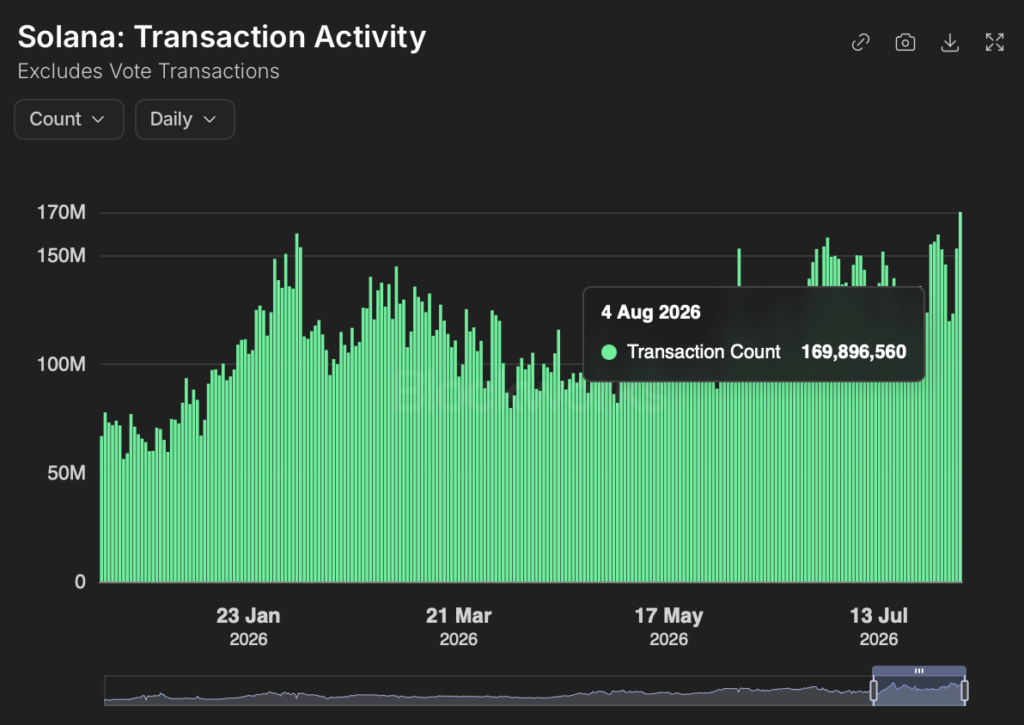
Solana processed 169.9 million non-vote transactions in a single day on August 4, according to data from Blockworks — the highest single-day transaction count in the network's history. Non-vote transactions exclude the consensus messages validators exchange to agree on blocks, meaning the figure reflects genuine user and application activity rather than overhead.
On a weekly basis, transaction counts have surpassed the peaks recorded in early February and are up approximately 55% from this year's lows in April.
A 66% Capacity Increase Filled in Six Days
On July 29, Solana activated a network upgrade known as SIMD-0286 at the beginning of a new epoch — the roughly two-day cycle Solana uses to rotate validator duties. The upgrade raised the maximum compute limit per block from 60 million to 100 million compute units, representing a 66% increase. SIMDs, or Solana Improvement Documents, are the network's formal mechanism for proposing protocol changes, analogous to Ethereum's EIP system. Compute units measure processing work, so a higher ceiling allows more transactions to be included in each block.
Authored by Jito Labs engineer Lucas Bruder — Jito is the infrastructure firm behind the widely adopted Jito-Solana validator client used for MEV extraction and block production — the upgrade marks the largest throughput expansion Solana has delivered since the network launched. Block times held steady at 400 milliseconds with no degradation in speed. The increase was made possible after XDP kernel-bypass networking — a technique that enables validators to move data faster by bypassing portions of the operating system — cleared 70% of staked SOL in support.
The Previous 60 Million Cap Was Being Strained by Real Traffic
Data from the Solana Foundation shows that 11.2% of blocks were reaching 56 million compute units or higher under the former 60 million limit. That ceiling was stressed during volatile market periods — precisely when traders need their orders to confirm. The blockspace was not idle; demand was being constrained.
Most of the New Flow Is Trading Infrastructure
Market makers operating proprietary automated market makers (AMMs) continuously update their on-chain quotes, and Blockworks Research estimated that this flow accounted for roughly 20% of all Solana transactions as of late 2025. Arbitrage and order-book maintenance compound on top of that activity. This category of traffic naturally expands to fill available blockspace, which is inherent to how liquidity provision functions on a network with 400-millisecond block times and sub-cent fees. It is also the traffic that keeps spreads tight for all participants.
The payments sector arrived the same day. Western Union's Stablecard went live on August 4 on Solana rails through Rain, a stablecoin card infrastructure provider, covering 37 markets and operating on the USDPT stablecoin. Circulation remains near 7.4 million tokens — a level small enough that it is not yet meaningfully impacting transaction counts. However, the rationale behind Western Union's selection of Solana is the same factor that enabled the transaction record, and the network now has the capacity for that payment flow to scale. Western Union's deployment joins a broader trend of established payments and financial-services companies issuing stablecoins on public blockchains, a movement that has accelerated as digital-asset regulation has taken clearer shape in major markets.
BREAKING: Western Union's Stablecard is live. Spend instantly anywhere Visa works, across 175M merchant locations in 37 markets at launch. The card runs on USDPT, @WesternUnion's own stablecoin issued onchain on Solana and powered by @raincards. pic.twitter.com/01NajGWGPe — Solana (@solana) August 4, 2026
Record Throughput Alongside the Weakest Fees Since 2023
The counterpoint lies in network revenue. Q2 fees totaled $51 million, Solana's weakest quarter since Q3 2023, and DEX volumes are at their lowest since September 2024. Transaction counts are setting records while the monetary value attached to each transaction declines.
The transaction mix has shifted. Memecoin speculation generated higher per-transaction fees, whereas market-maker requoting and stablecoin payments do not. This dynamic represents healthier infrastructure usage but a leaner business model — a genuine tension rather than a minor detail. The divergence between surging transaction counts and declining fee revenue underscores a structural question relevant across high-throughput blockchains: whether networks optimized for volume can sustain validator economics when the activity filling blocks is low-cost infrastructure traffic rather than high-value trading.
Looking ahead, Alpenglow and 200-millisecond block slots are next on Solana's development roadmap. The network is designing for throughput levels it has not yet reached.

