Solana Price Faces $122–$124 Test as Fed Opens Review of Stablecoin Rules
Key Takeaways
- •Solana's price moved above $120 on September 25, reaching an intraday high of $122.18 after a 4.97% daily gain as part of a recovery from below $100 earlier in the month.
- •Two-week ETF purchases exceeded 1.4 million SOL and approximately $19.5 million in short positions were liquidated, flows that reinforced the rally while Solana outpaced Bitcoin.
- •The Federal Reserve began a 60-day comment period on September 24 for two GENIUS Act proposals addressing stablecoin reserves, capital, custody, risk management, and a tailored approval process for Board-supervised banks, and the proposals neither regulate Solana nor endorse its token.
- •Immediate resistance sits in the $122 to $124 band, where a sustained close above $124 would leave $132 as the next upside target, while a reversal would first test support near $116 and potentially the $108 to $110 zone.
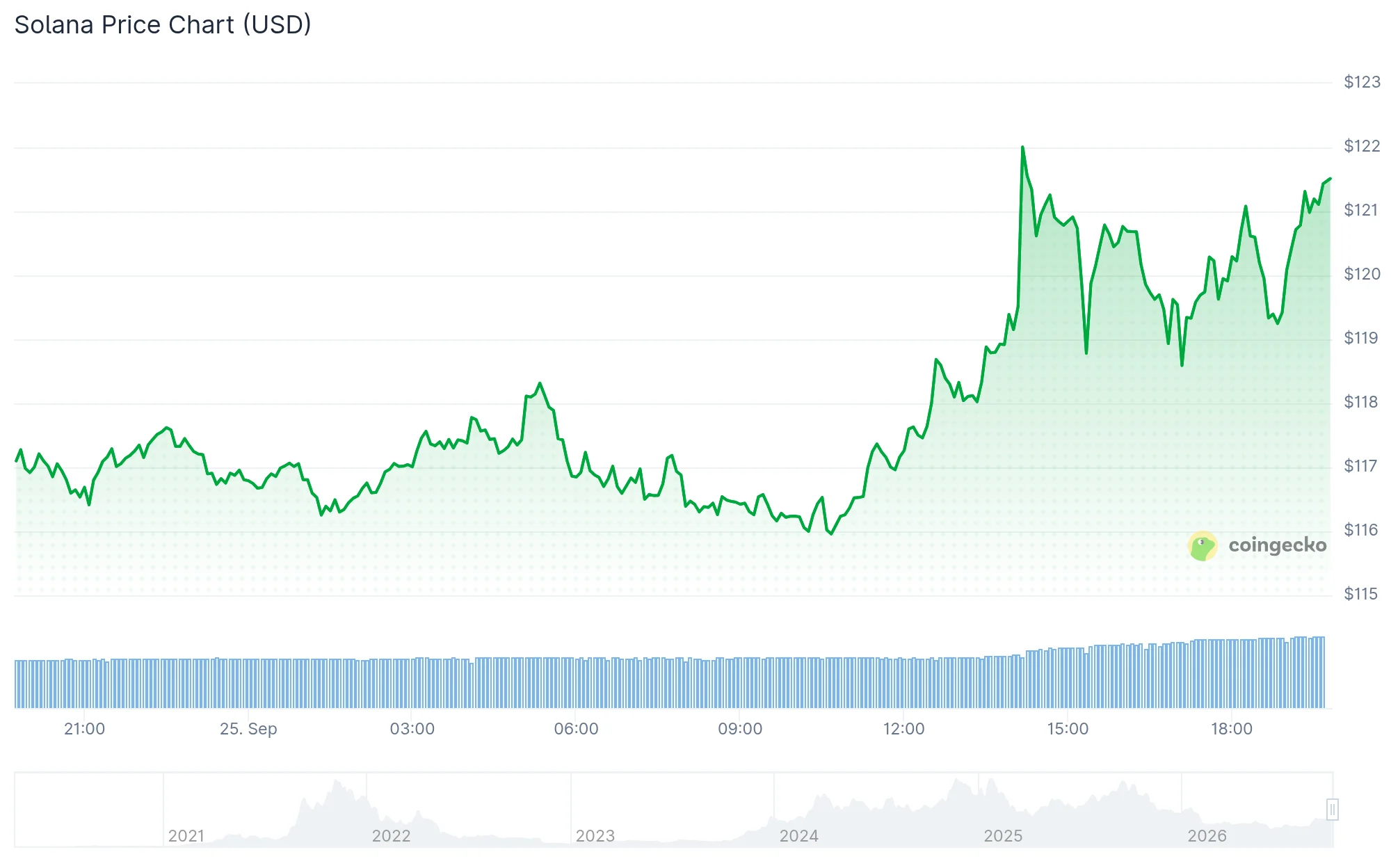
Solana's price climbed above $120 on September 25, touching an intraday high of $122.18 after a 4.97% daily gain. The move carried SOL into its strongest trading range in months, capping a from below $100 earlier in September and outpacing a mostly flat Bitcoin. Renewed spot demand and liquidations supported the advance, and traders now face a narrow technical decision at the $120 breakout level, with the $122 to $124 band at the center of the next test.
Attention is split between the chart and Washington. On September 24, the Federal Reserve opened public comment on two GENIUS Act proposals covering reserves, capital, custody, risk management, and application procedures for supervised stablecoin issuers. The action does not regulate Solana or endorse SOL, although stablecoin regulation can shape how supervised issuers approach public blockchain activity.
The next ceiling sits between $122 and $124, the band where sellers slowed the session. A durable move through that zone could bring the $132 chart target into view, while a reversal could return attention to $116 first.
Fed Opens Comment on GENIUS Act Stablecoin Proposals
On September 24, the Federal Reserve requested comment on two payment stablecoin issuer proposals under the GENIUS Act. Payment stablecoins are tokens designed to hold a steady value against a reference asset, typically the U.S. dollar, and the GENIUS Act established a federal regulatory framework for their issuance in the United States.
The first proposal would require issuers to fully back payment stablecoins with permissible reserve assets. Short-term Treasury bills and other high-quality liquid assets appear among the listed examples. It also sets standardized capital requirements for credit and operational risks, establishes risk management standards, and lays out rules for firms safeguarding reserve assets.
Under the proposal, payment stablecoins would need to hold assets that can be converted rapidly during redemptions. Capital standards would address losses stemming from credit and operational events. The comment period closes 60 days after publication in the Federal Register, and public comments may shape the final standards before they take effect.
The second proposal creates a tailored application process for Board-supervised banks seeking approval to issue payment stablecoins. Applicants would be required to submit business plans and financial information to the Federal Reserve.
The rules concern supervised institutions, reserves, custody, and approval procedures. They do not regulate the Solana blockchain or endorse its token. Solana's price nevertheless moved higher as traders tracked a broader rotation into large-cap alternative coins.
Stablecoin regulation can matter to the network because digital dollars support trading, payments, and decentralized finance activity. Clearer rules may reduce uncertainty for supervised issuers without determining which public blockchain they use. Any issuer choosing Solana would still need to meet those institution-level standards, and network activity alone does not alter an issuer's regulatory status. Nothing in the proposals creates a new approval for a blockchain.
SOL Faces the $122 to $124 Test
Attention now turns to the chart. SOL reached $122.18 before moving back toward $120, leaving the $122 to $124 area as immediate resistance. The rally began near $115.86 and accelerated after the price moved through $118.38 on the 30-minute chart, a pattern that placed $120 at the first support level to watch. Solana needs to hold above that former barrier to preserve the short-term breakout.
Solana $SOL is ready for the next leg up! Here's the target. pic.twitter.com/4L4RHQBtmF
— Ali Charts (@alicharts) September 25, 2026
Analyst Ali Charts marked $132 as the next upside objective if buyers maintain control, a target that reflects a technical scenario rather than a confirmed outcome. Volume increased alongside the price climb, lending support to the recovery, yet the intraday pullback showed active selling near the high. Buyers must still reclaim the upper range on a sustained basis.
Flows reinforced the move. Two-week ETF purchases exceeded 1.4 million SOL, while roughly $19.5 million in short positions were liquidated. Spot ETFs hold the token inside a regulated, exchange-listed structure, giving investors SOL exposure without direct custody of the asset. Those flows coincided with stronger interest in other large-cap tokens, and Solana outpaced Bitcoin during the same period. Forced buying from closing short positions can accelerate an existing rise, but it can also fade quickly, which makes the next close around $120 important for SOL.
A rejection below that level exposes $116 as the nearest support. A wider pullback could direct attention toward the $108 to $110 zone, where buyers previously stepped in to defend the price. The $122 to $124 range will show whether demand can absorb supply. A close above $124 would strengthen the current chart structure and leave $132 as the next chart target for buyers.

