ChatGPT AI Forecast Targets Solana at $150–$190 by End of 2026 on Alpenglow and Tokenized Asset Growth
Key Takeaways
- •Solana’s tokenized real-world assets reached $3.73 billion in July as tokenized equities expanded.
- •ChatGPT’s forecast targets SOL at $150 to $190 by the end of 2026, with $165 described as a realistic base case.
- •The Alpenglow upgrade is presented as the main catalyst, with a target of sub-150ms finality and progress toward mainnet.
- •Morgan Stanley’s Solana ETF can stake SOL holdings, which may increase capital demand and reduce circulating supply.
- •The bear case assumes a failed Alpenglow rollout or weakening on-chain activity, which could send SOL toward $50 to $60.
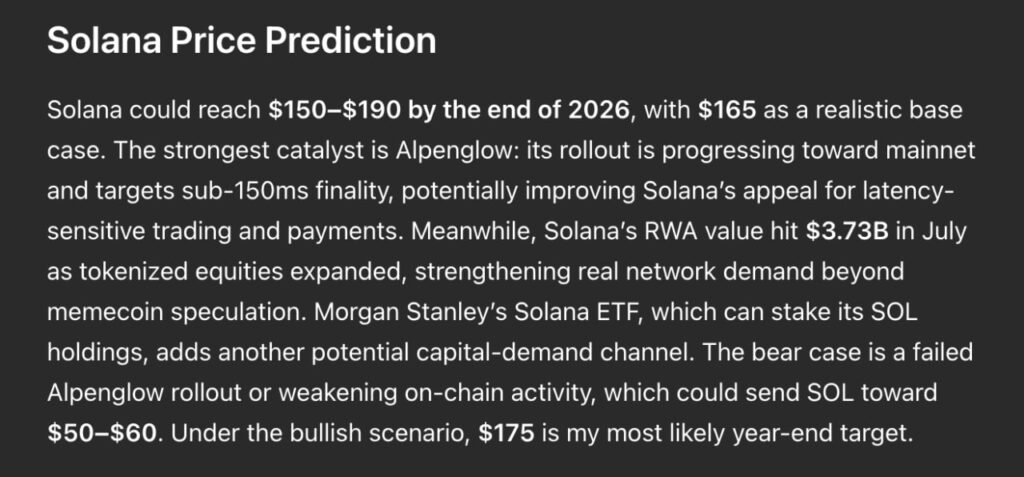
Solana has spent years being defined by memecoin trading volume, but $3.73 billion in tokenized real-world assets is starting to change that label. A ChatGPT AI price prediction argues that this shift can carry the price higher, targeting a range of $150 to $190 by the end of 2026, with $165 as a realistic base case.
Three Pillars Behind the Forecast
Alpenglow is framed as the strongest catalyst. The upgrade's rollout is progressing toward mainnet and targets sub-150ms finality — a threshold that matters for latency-sensitive trading and payments, the use cases where milliseconds decide whether a venue is viable.
The real-world asset (RWA) figure is the second pillar. Solana's tokenized asset value hit $3.73 billion in July as tokenized equities expanded. ChatGPT frames that growth as real network demand rather than speculation — the part of the thesis that does not depend on sentiment.
Morgan Stanley's Solana ETF adds a third channel. The product can stake its SOL holdings, which creates capital demand and locks supply at the same time.
The forecast also reflects a simple execution risk: if Solana's upgrade path or usage trend stalls, the same narrative can weaken quickly. The bear case rests on two triggers: a failed Alpenglow rollout and weakening on-chain activity. Either could send SOL toward $50 to $60, while the bullish scenario points to $175 by year-end.
Price Action: Two Full Cycles and a Slow Recovery
The weekly chart shows two complete cycles. SOL climbed from $20 in 2023 to a peak near $293 by January 2025. A second run reached $255 in September 2025, marking the top before the trend turned decisively.
Early 2026 broke that structure, cutting the price from $145 toward $80. The decline continued through spring to a low near $61. Recent weeks have stabilized, with price grinding slowly higher and now sitting in the upper $70s.
The weekly close reads $77.15, up 3.50% and $2.61, with a weekly range spanning $74.36 to $77.39. Support sits at $74, followed by $68 and $61 at the spring low. Resistance appears at $90, then $100 and $120.
The RSI reads 42.06, with its signal line below at 38.21. The oscillator leads by nearly four points — a constructive crossover from depressed levels — though both lines remain under the midline. Momentum is turning up, but no trend reversal has been confirmed yet.
ChatGPT's base case implies more than a double from current levels. Alpenglow reaching mainnet is presented as the event that would justify the market repricing SOL accordingly, especially if it arrives alongside sustained tokenized asset growth and continued institutional participation.
An Execution Story With Measurable Milestones
The Solana thesis now has benchmarks that traders can measure: Alpenglow reaches mainnet, tokenized assets keep growing, and institutional products continue pulling SOL out of circulation.
Kalshi, an event-driven prediction market, is built around that same mindset. Rather than taking exposure to every variable affecting SOL, users can trade directly on real-world outcomes across crypto, politics, economic data, Fed decisions, and other events that can move markets. That approach is useful when a thesis comes down to whether a specific milestone happens, not simply whether a token looks cheap.
For Solana, the distinction is important. A successful Alpenglow rollout could strengthen the entire valuation case, while a delay or failure would change it immediately. Event markets let traders focus on those outcomes before the reaction works its way into price.

