Microsoft Copilot AI Projects Major Solana Rally by End of 2026 — If Key Conditions Are Met
Key Takeaways
- •Solana trades near $100 in early September 2026, roughly two-thirds below its January 2025 all-time high of about $295.
- •U.S. spot Solana ETFs, launched in late October 2025, have accumulated roughly $1.3–1.34 billion in cumulative net inflows, with Bitwise's BSOL surpassing $1 billion in assets under management.
- •Microsoft Copilot's base case projects SOL at around $200 by January 1, 2027, with an optimistic scenario of $400–$500 in a full bull market.
- •The Alpenglow consensus upgrade, targeting roughly 150-millisecond finality, is expected on Solana mainnet around October 2026.
- •Standard Chartered lowered its near-term SOL target to about $135 from earlier figures near $250, while projecting up to $400 into 2027 in some notes.
As of early September 2026, Solana trades near $100, roughly two-thirds below its January 2025 all-time high of around $295. Microsoft Copilot AI has produced a forecast suggesting SOL could break past that all-time high by the end of 2026 — provided certain market conditions align.
The projection follows a turbulent year. After a prolonged stretch of consolidation and monthly declines in early 2026, SOL rebounded sharply in August with a recovery of roughly 46%, driven by accelerating inflows into U.S. spot ETFs and improving network fundamentals. The forecast is also notable because Solana's 2025 peak was itself driven by the anticipation of ETF approval, meaning the asset is now testing whether regulated products can sustain demand rather than merely price it in ahead of launch — a dynamic Bitcoin faced after its own spot ETFs went live in January 2024.
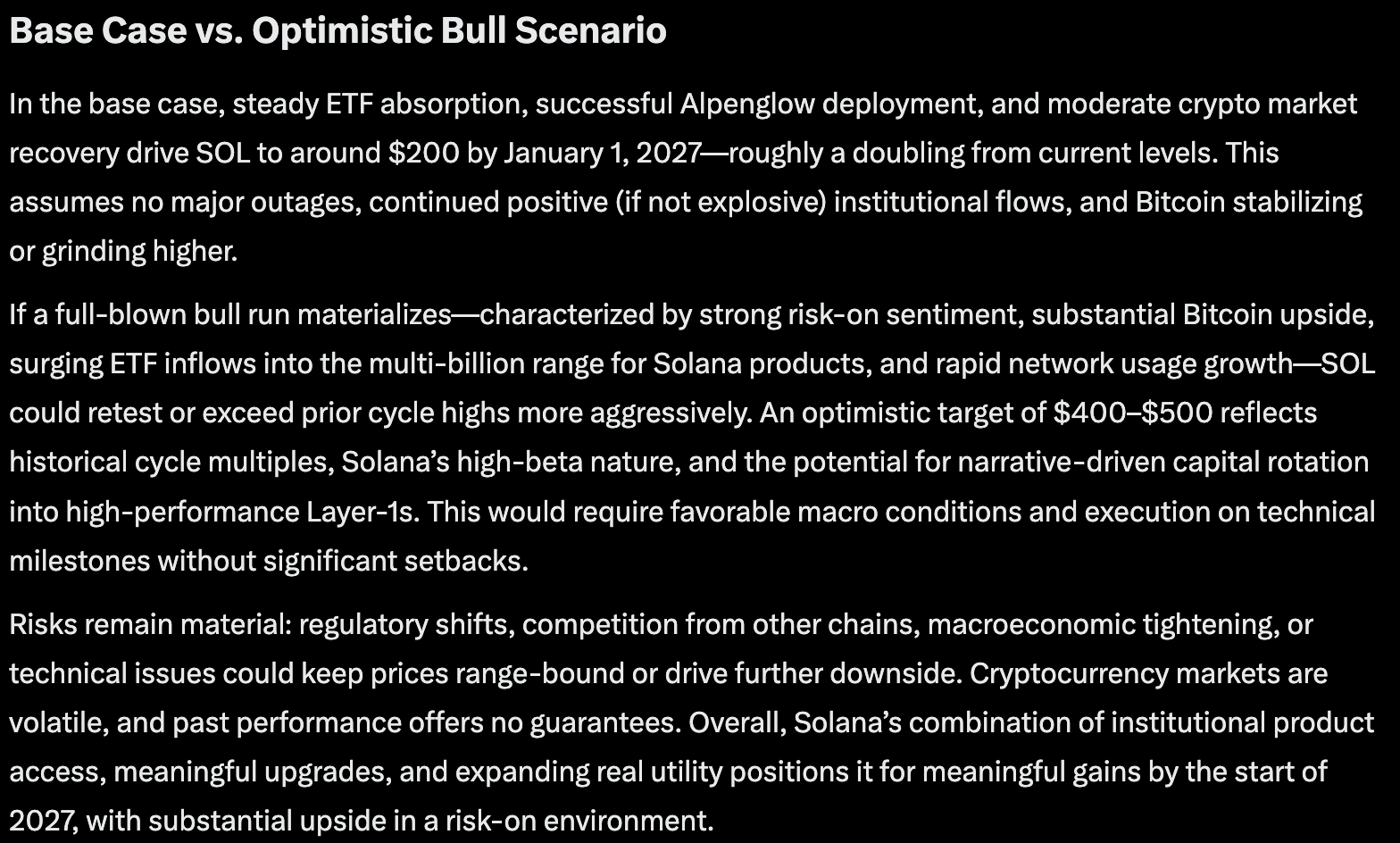
The full Microsoft Copilot AI prediction for SOL by the end of 2026 is reproduced below. (SOURCE: Microsoft Copilot)
ETF Flows Provide a Structural Bid
U.S. spot Solana ETFs, which launched in late October 2025, have accumulated roughly $1.3–1.34 billion in cumulative net inflows, with total assets under management near $1.4–1.5 billion. Bitwise's BSOL has dominated the category, capturing the majority of flows and recently crossing $1 billion in AUM.
August 2026 saw some of the strongest weekly inflows of the year, with more than $150 million entering Solana products in a single week, even as Bitcoin and Ethereum ETFs occasionally recorded outflows. That divergence is significant: for much of the ETF era, altcoin products have tended to track the flows of the larger Bitcoin and Ethereum funds, so sustained standalone demand for Solana vehicles would mark a shift in how institutional capital treats the asset.
These vehicles give traditional investors regulated exposure to SOL and generate ongoing demand for the underlying asset, particularly among products that offer staking yields. Copilot's analysis notes that continued or accelerating flows into 2027 would steadily absorb supply and support higher prices, echoing the early impact of Bitcoin ETFs — albeit on a smaller scale given Solana's market position. (SOURCE: CoinGlass)
Technical Picture and Market Structure
On the charts, SOL has broken above multi-month downtrend lines and key resistance near $98–$103, a zone that is now acting as support. Analysts' near-term targets sit at $117–$120, with further upside toward $150 if momentum holds.
The broader structure points to a base-building phase following the post-2025 correction. Holding above $90–$100 keeps the medium-term bias constructive; sustained closes above $150–$180 would open a path toward the $200 region by year-end.
Crypto markets remain highly correlated with Bitcoin, and some institutional forecasts — Bernstein among them — project a potential recovery toward $125,000 for BTC by late 2026 and higher in 2027. A supportive macro backdrop, such as easing rates or liquidity expansion, would amplify Solana's moves given its higher beta. That higher beta cuts both ways: the same sensitivity that lifts SOL more than BTC in risk-on phases also deepens its drawdowns when sentiment turns, which is consistent with the roughly two-thirds decline from its January 2025 peak.
Solana opened at $103.03 on Coinbase today, reached $104.36, and traded as low as $98.30, dipping below its former breakout area intraday:
For $SOL , I'm treating $100-$103 as the immediate reclaim zone, recovering it on a daily basis would weaken the breakdown attempt while… pic.twitter.com/iFyTBDfpqb
— 𝗘𝗹𝗹𝗮 (@Ellaweb_3) September 2, 2026 (X post)
Major Catalysts on the Horizon for Solana
Network upgrades stand out as the key drivers in the outlook. Alpenglow, Solana's consensus overhaul targeting roughly 150-millisecond finality (down from around 12–13 seconds), is expected on mainnet around October 2026. The upgrade was first proposed in May 2025 by Solana core developer Anza and, if delivered as specified, would address one of the most persistent criticisms of the network — finality lag — while reducing the types of reorg-related risks that have complicated high-frequency trading applications.
Combined with growing adoption of the Firedancer client, an independent validator client developed by Jump Crypto that adds client diversity and resilience, these upgrades strengthen Solana's suitability for high-frequency applications, institutional use, and real-world assets.
Real-world asset (RWA) tokenization on Solana has already surpassed $4 billion, stablecoin activity continues to expand, and the network leads certain on-chain metrics such as tokenized equities trading volume. Broader adoption in DePIN, AI agent payments, and consumer applications could further differentiate Solana from competitors.
Analyst views vary widely. Standard Chartered has lowered its near-term target to around $135 (from earlier figures near $250) while projecting higher levels further out, including $400 into 2027 in some notes. The spread between Copilot's base case and Standard Chartered's near-term figure illustrates how much the outlook depends on assumptions about ETF flow persistence and macro conditions rather than on any single data point.
The Bull Market Price Outlook
In Copilot's base case, steady ETF absorption, successful Alpenglow deployment, and a moderate crypto market recovery drive SOL to around $200 by January 1, 2027 — roughly a doubling from current levels. This scenario assumes no major outages, continued positive (if not explosive) institutional flows, and Bitcoin stabilizing or grinding higher. The no-major-outage condition is not incidental: Solana suffered repeated network outages in 2022 and 2023 and a notable February 2024 outage, and prolonged downtime episodes have historically weighed on institutional confidence in the network.
If a full-blown bull run materializes — strong risk-on sentiment, substantial Bitcoin upside, Solana ETF inflows surging into the multi-billion range, and rapid network usage growth — SOL could retest or exceed prior cycle highs more aggressively. An optimistic target of $400–$500 reflects historical cycle multiples, Solana's high-beta nature, and the potential for narrative-driven capital rotation into high-performance Layer-1s. Achieving it would require favorable macro conditions and execution on technical milestones without significant setbacks.
Overall, the Copilot analysis concludes that Solana's combination of institutional product access, meaningful upgrades, and expanding real utility positions it for meaningful gains by the start of 2027, with substantial upside in a risk-on environment.
Solana Is Showing What Faster Infrastructure Can Do — Bitcoin Hyper Wants to Bring That Advantage to BTC
Solana's latest thesis is no longer purely about speculation, according to the article. Faster finality, more usable blockspace, and tighter supply are building an infrastructure case for why more capital could migrate onto the network. (SOURCE: Bitcoin Hyper)
Bitcoin Hyper (HYPER) applies that same execution-first logic to Bitcoin. The project uses the Solana Virtual Machine to bring high-speed transactions, ultra-low fees, and smart contract functionality into a Bitcoin Layer 2 environment. Its Canonical Bridge is designed to move BTC into that ecosystem, while HYPER powers gas, staking, and governance across the network.
The stated opportunity is straightforward: Bitcoin already has the capital and security, but lacks the fast, programmable execution layer that has helped Solana expand into trading, DeFi, and tokenized assets. Bitcoin Hyper's presale has raised more than $33 million, with buyers able to stake HYPER for yields of up to 36% APY ahead of a planned 2026 launch.

