China Halts Solana Shanghai Event Over Advertising Violations as SOL Tests $90
Key Takeaways
- •The People's Bank of China confirmed that authorities halted the Solana Accelerate China 2026 event in Shanghai over alleged cryptocurrency advertising violations, including an outdoor campaign near Citigroup Tower.
- •Officials classified Solana's brand promotion as regulated virtual-currency activity and plan to investigate the domestic businesses and individuals involved, though no parties have been identified or fined.
- •Solana Foundation President Lily Liu initially attributed the postponement to crowd-management issues after registrations rose fourfold overnight, while the central bank later recast the halt as a regulatory violation.
- •A People's Bank of China official said authorities regard SOL as a virtual currency and cited Solana's role in supporting the issuance and trading of other digital assets, including USDT.
- •SOL dropped more than 6% to trade near $90 on Nov. 6, pressured by $1.18 million in Solana ETF net withdrawals on Thursday, declining futures open interest, and technical support near $87.21.
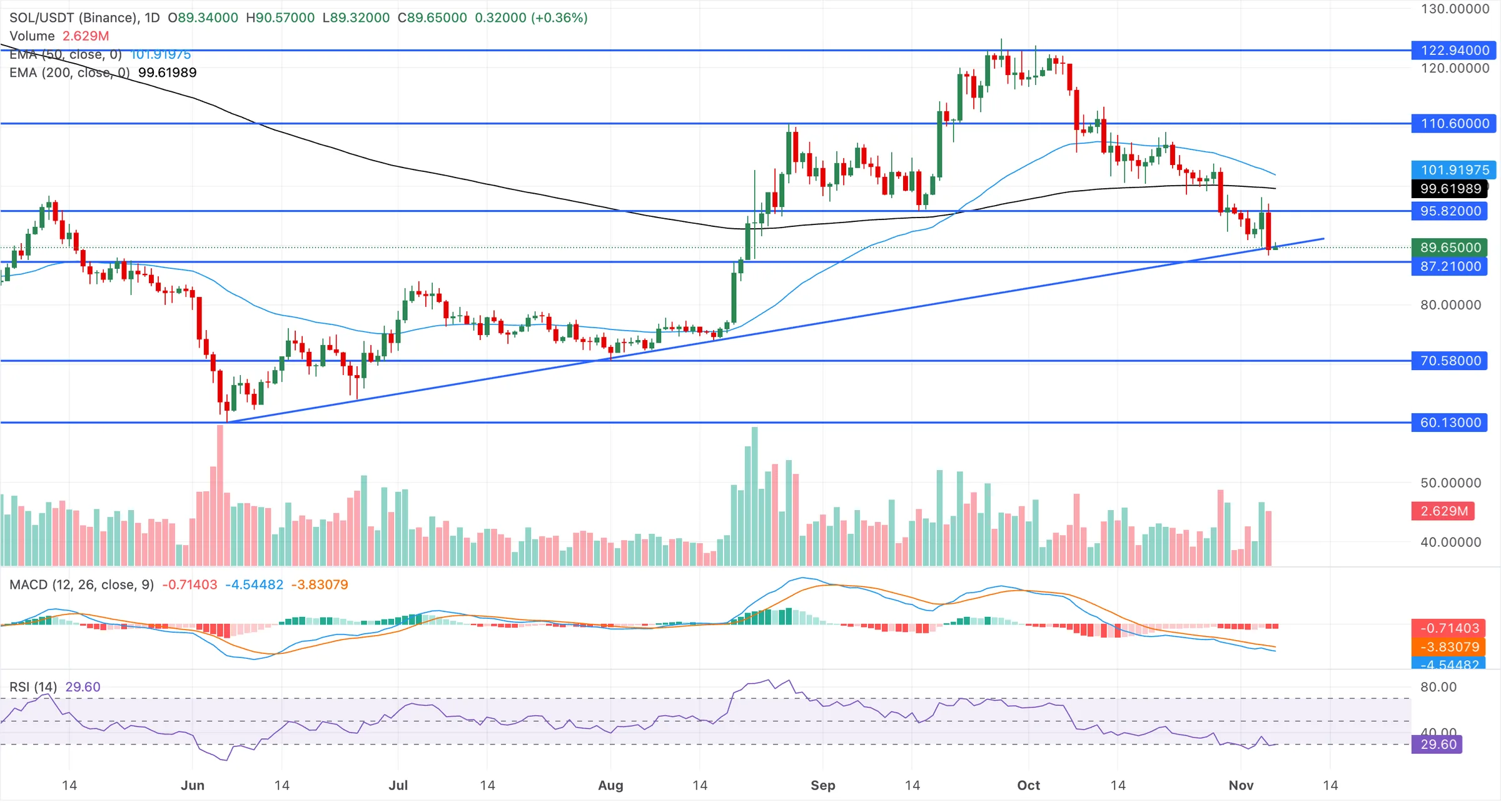
Solana's price fell below $90 on Nov. 6 after China's central bank confirmed that authorities halted a Shanghai promotional event over alleged cryptocurrency advertising violations. SOL also faced pressure from $1.18 million in net withdrawals from Solana exchange-traded funds on Thursday and declining futures exposure.
China Halts Solana Accelerate China 2026 Event
The People's Bank of China said Solana worked with local organizations to promote its brand in Shanghai. One campaign placed a large advertisement outside Citigroup Tower in Lujiazui, the city's financial district. Officials classified the advertisements as cryptocurrency marketing under China's restrictions on virtual-currency activities. The classification matters because it extends those restrictions beyond trading platforms to brand promotion itself, treating even an outdoor advertising campaign as regulated virtual-currency activity.
The central bank coordinated with financial regulators, police and market supervision departments to halt the Solana Accelerate China 2026 gathering, which had been scheduled for Oct. 16. Authorities said they plan to investigate the domestic businesses and individuals involved in the campaign. Officials have not identified the parties under investigation or announced any fines. The scope of that inquiry is the case's main open question.
The Solana Foundation had scheduled events in Shanghai, Hangzhou, Shenzhen and Beijing from Oct. 16 through Oct. 22. The program covered blockchain infrastructure, artificial intelligence, payments and related technologies. Visitors encountered entry restrictions at the Shanghai venue, and organizers suspended the gathering.
Solana Foundation President Lily Liu initially attributed the postponement to crowd-management issues. In an Oct. 16 post, Liu said registrations had increased fourfold overnight and exceeded the capacity that organizers had registered with authorities. She said the team would postpone the meeting to comply with local requirements.
Binance co-founder Changpeng Zhao questioned whether the organizers had understood China's policies and referred to an earlier disruption involving a Solana event in Shenzhen. The central bank's subsequent statement attributed the Shanghai intervention to prohibited cryptocurrency advertising. The gap between the two accounts matters: Liu's explanation described a logistical problem, while the central bank's statement recasts the halt as a regulatory violation under the country's virtual-currency rules.
China Signals Broader Cryptocurrency Enforcement
A People's Bank of China official said authorities regard SOL as a virtual currency. The official also cited Solana's role in supporting the issuance and trading of other digital assets, including USDT. Chinese regulators therefore consider domestic promotion of the network a breach of the country's cryptocurrency rules.
In February 2026, the central bank and seven other agencies reaffirmed restrictions on cryptocurrency trading, token issuance and related financial services. Their notice also addressed domestic businesses that assist overseas platforms serving customers in mainland China. Unauthorized yuan-linked stablecoins and certain tokenized assets received additional scrutiny. The Shanghai halt offers a concrete illustration of that framework in practice, showing that promotional activity organized with local partners falls within its scope alongside trading and issuance.
China has restricted cryptocurrency activity for years. In 2013, regulators ruled against Bitcoin's use as legal currency. In 2021, they classified cryptocurrency trading services as illegal financial activities. The central bank now says enforcement will focus on domestic dealers and local affiliates of overseas cryptocurrency platforms. For overseas projects, that stated focus makes the selection of local marketing partners in the mainland a compliance question rather than a routine logistics decision.
SOL Approaches Technical Support Near $90
SOL traded near $90 on Friday after losing more than 6% over the previous 24 hours. The token approached an ascending trendline near $89.83 that connects lows from June. The next horizontal support level was identified at $87.21 if buyers fail to defend the trendline.
Market data also indicated weaker positioning. CoinGlass recorded a decline in SOL futures open interest from 62.71 million tokens on Monday to 59.45 million. Thursday's liquidations totaled $42.87 million, including $39.37 million in long positions. Open interest is tracked as a measure of total leveraged exposure, while liquidation figures show where forced position closings concentrated. CoinGlass data is available at
Solana ETFs recorded $1.18 million in net withdrawals on Thursday, following $71.47 million in outflows during the previous week. The daily Relative Strength Index stood at 29, while the moving average convergence divergence indicator remained below its signal line. ETF flows are watched as a gauge of institutional demand for spot exposure. ETF flow data is available at
A sustained decline below $87.21 could bring the August support area near $70.58 into view. Conversely, a recovery above the trendline would put the 200-day exponential moving average at $99.62 in focus. The 50-day average near $101.92 represents another nearby resistance level.
The original report was published by The Market Periodical: https://themarketperiodical.com/2026/11/06/china-targets-solana-over-shanghai-ads-as-sol-crypto-tests-critical-90-support/

