Solana ETFs Outpaced XRP Funds 300% in Daily Net Inflows, Report Shows
Key Takeaways
- •On September 28, U.S. Solana ETFs recorded $12.70 million in net inflows compared with $3. million for XRP products, a ratio of roughly 3.2 to 1.
- •Over the trailing 30-day window, Solana ETFs attracted $278.20 million in net inflows versus $127.05 million for XRP ETFs, more than double the XRP total.
- •Despite the recent gap, XRP funds lead on a cumulative basis with $1.80 billion in total net inflows since launch, ahead of Solana's $1.62 billion.
- •The comparison spans nine Solana ETFs and five XRP ETFs, and both categories operate well below the inflow volumes of U.S. spot Bitcoin ETFs.
- •Canary Capital's XRPC holds about 22% of the $1.68 billion XRP fund category, while Solana's category net assets total $1.93 billion across nine products.
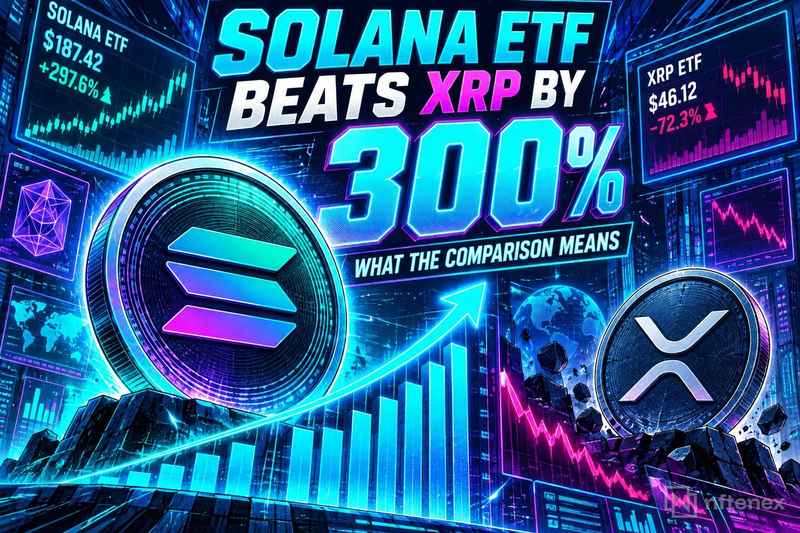
Solana ETF products pulled in roughly 3.2 times more daily net inflows than XRP funds on September 28, according to a report by U.Today, with the gap widening to more than double across the trailing 30-day window. The divergence points to meaningfully different institutional demand profiles for the two assets in the current market cycle.
Solana ETF's Reported 300% Edge Over XRP
Per the U.Today report, U.S. Solana funds attracted $12.70 million in net inflows on September 28, compared with $3.96 million for XRP products on the same day. That single-day comparison is where the "300%" framing originates: Solana's figure was approximately 3.2 times XRP's, translating to a roughly 220% premium — close enough to the 300% framing when rounded upward.
The same report put 30-day net inflows at $278.20 million for Solana ETFs versus $127.05 million for XRP ETFs. The underlying daily flow tables from Farside, the primary tracker typically cited for these figures, were inaccessible during research due to Cloudflare restrictions. The figures therefore carry a single-source caveat: they are reported by U.Today and have not been independently reconciled to the underlying fund-level data.
The comparison is a category-level one, not a single-fund matchup. According to the report, there were nine Solana ETFs versus five XRP ETFs in the comparison set, meaning Solana's total inflow pool was spread across more products. Percentage comparisons can also look amplified when the base values are small, as both categories remain well below the inflow volumes seen in U.S. spot Bitcoin ETFs, which launched in January 2024 and operate at a far larger asset scale.
Why the SOL-versus-XRP ETF Gap Matters
ETF flow data reflects the behavior of institutional allocators and registered investment advisors who route capital through regulated wrappers rather than spot exchanges. Net inflows — the difference between capital entering and leaving a fund on a given day — are a standard gauge of that activity, and they are the metric published daily by trackers such as Farside. A sustained gap in category-level inflows suggests that, at this moment in the cycle, advisors are building Solana positions through funds at a faster rate than XRP positions. That is a demand signal about product activity, not a forecast for token price performance.
One useful contrast is at the fund level. Canary Capital's XRPC, one of the XRP trust products listed on Nasdaq, reported net assets of $374,228,613 as of September 29, 2026. The report cited total XRP category assets of $1.68 billion, meaning XRPC alone represents roughly 22% of the XRP wrapper market. Solana's total category net assets were reported at $1.93 billion across nine products. Neither cumulative asset figure automatically confirms which category will attract more flows going forward.
On a cumulative basis, U.Today's report actually shows XRP ahead: $1.80 billion in total net inflows since launch versus $1.62 billion for Solana. The recent daily and 30-day figures represent a reversal of that longer-term trend, which adds context to the "unexpected" framing in the original report's headline. Solana ETFs have demonstrated an ability to outpace larger rivals in short windows before, a pattern that matters to allocators watching momentum.
SOL, the native token of the Solana blockchain, was trading at $118.07 at the time of research, with a 24-hour decline of 0.66% and a market capitalization near $69.4 billion, per CoinGecko data. The broader crypto Fear & Greed Index stood at 71, classified as Greed, suggesting the flow data is arriving in a broadly risk-on environment rather than a capitulation period.
What to Watch Next for Solana and XRP ETF Products
The next reporting cycle will determine whether September 28's inflow gap was a one-day anomaly or part of a continuing trend. Traders and advisors following the comparison should track daily and weekly category-level flow totals as they are published, along with any changes in total assets under management for both the Solana and XRP fund rosters.
Regulatory and issuer developments remain a separate variable. Canary's XRPC disclosure notes the trust is not a commodity pool or a registered investment company under the Investment Company Act of 1940, the U.S. federal statute that sets registration and disclosure requirements for investment companies — a structural distinction that affects how advisors can allocate to it. Any SEC guidance that changes the regulatory treatment of crypto trusts would affect both categories. Solana ETFs recently extended an inflow streak spanning multiple weeks, and whether that momentum carries into October is the more actionable near-term question.
Investors watching the XRP side should distinguish between Canary's XRPC and any other XRP products in the category, since a single large redemption at one fund can distort the category total. The broader market context, including Solana's role in the recent multi-asset rally, provides the backdrop against which these product-level flow differences should be interpreted.
Disclaimer: This article is for informational purposes only and does not constitute financial or investment advice. Cryptocurrency and digital asset markets carry significant risk. Always do your own research before making decisions.

