Solana's Alpenglow Consensus Upgrade Reaches Public Testnet as SOL Tests $120
Key Takeaways
- •Alpenglow, Solana's most significant consensus overhaul, has been deployed to public testnet with the goal of reducing transaction finality from roughly 13 seconds to about 0.15 seconds using the new Votor protocol that replaces TowerBFT.
- •Validators must run Agave version 4.3 to participate, and after four months of dedicated-network testing, the public testnet phase will determine whether the broader validator set can migrate and sustain one- and two-round settlement under live load.
- •SOL trades near $118 after gaining roughly 23% over the past week, and spot-linked investment products reportedly drew more than $28 million in inflows as the token broke above $110.
- •Solana's decentralized exchanges handled about 208 million onchain swaps in the week ending September 13, exceeding the NYSE's roughly 190 million trades for the first time, though the comparison measures trade counts rather than dollar volume.
- •The four-hour RSI near 71 indicates stretched momentum that raises the odds of short-term profit-taking, with a daily close above $120 opening a path toward $125–$130 and rejection potentially returning SOL to $115–$116.
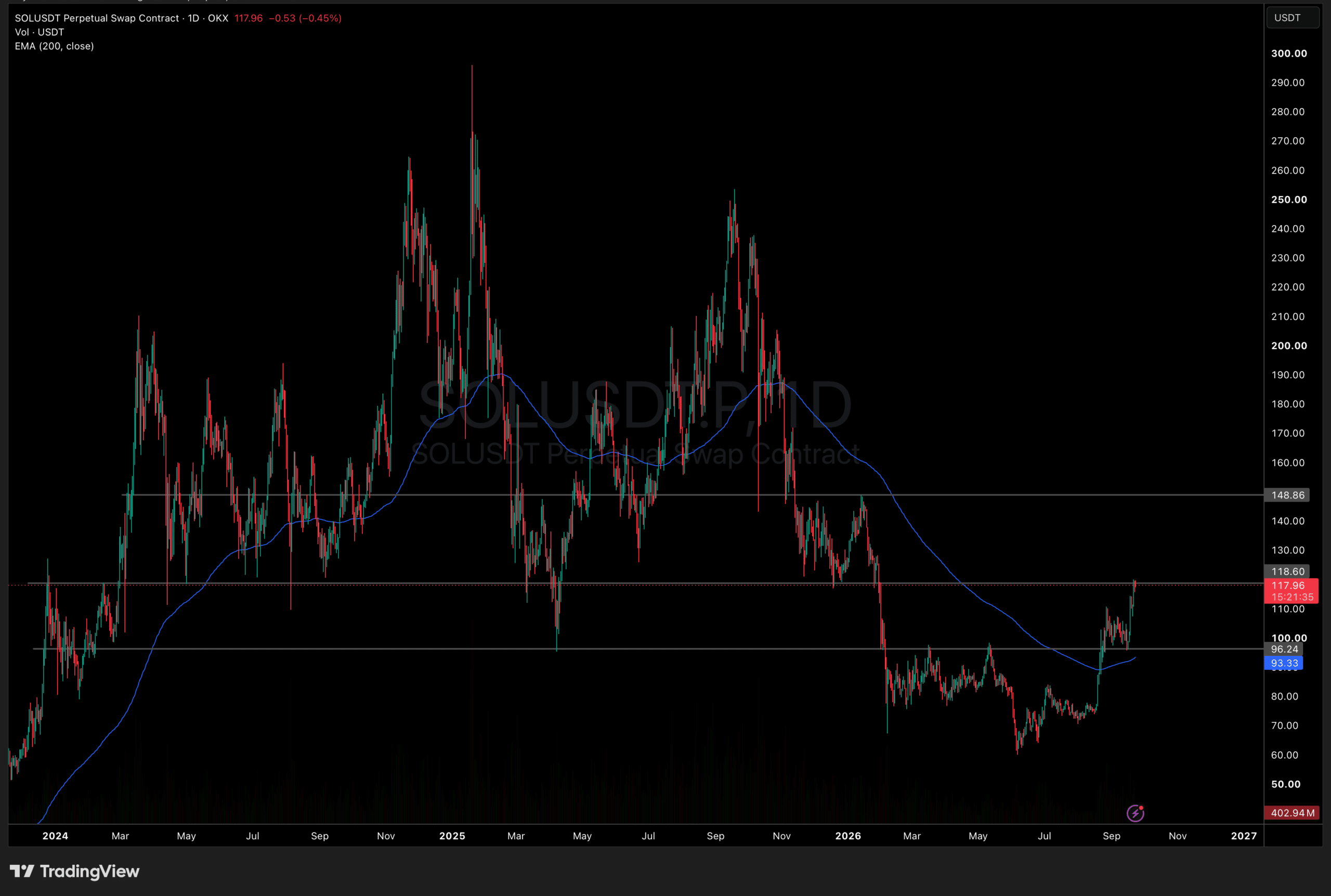
Solana is making news on two fronts at once: SOL trades around $118, up about 1.3% on the day, while developers have moved the network's most significant consensus overhaul into public testing — an upgrade designed to make transactions final in less time than the blink of an eye.
Alpenglow Reaches Public Testnet
Developers have deployed Alpenglow to Solana's public testnet. The upgrade aims to cut finality — the point at which a transaction can no longer be reversed — from about 13 seconds to roughly 0.15 seconds. That window matters in practice: the sooner a block is final, the sooner trading, payments, and other applications can treat a transaction as settled rather than merely submitted.
The change is a new consensus protocol called Votor, which replaces the current TowerBFT system. Instead of stacking votes across 32 slots, validators vote directly with one another and settle blocks in one or two rounds. Anza, the team behind Solana's Agave client, confirmed that validators need version 4.3 to take part.
The move follows four months of testing on a dedicated network. The public testnet phase is the real stress test: it will show whether the wider validator set can migrate without breaking anything. With the version 4.3 requirement in place, the signals to watch from here are how quickly validators adopt the release and whether one- and two-round settlement holds up under live load.
BREAKING: Alpenglow, @Solana's biggest consensus upgrade in history, is moving into its testnet phase this week. Source: @anza_xyz pic.twitter.com/cYKHrqDUP7
— SolanaFloor (@SolanaFloor) September 22, 2026Source: SolanaFloor on X
Can Solana Price Hit $125 This Week?
The upgrade lands in a market that is already moving. SOL has gained roughly 23% over the past week and now sits directly beneath a zone that has capped price before.
On the daily chart, SOL is testing $118.60, a former support level that turned into resistance after the February breakdown, with the psychological $120 mark just above. The token has also reclaimed its 200-day EMA near $93 for the first time in months, a shift that often signals a change in trend.
Demand appears to be real. Spot-linked products reportedly drew more than $28 million in inflows as SOL broke above $110 earlier this week — a gauge of demand arriving through investment products rather than exchange buying alone. However, the four-hour RSI near 71 shows momentum that is strong but also stretched; readings above 70 are conventionally treated as overbought, which raises the odds of short-term profit-taking.
Three scenarios stand out:
- A daily close above $120 opens a path to $125–$130. The next major level on the chart sits near $149.
- SOL chops between $115 and $120 while the market digests the rally.
- Rejection at resistance sends SOL back to $115–$116, with deeper support around $96 and the 200-day EMA below that.
Solana Processes More Weekly Trades Than the NYSE
Price is not the only thing surging. For the first time, the number of weekly spot trades on Solana's decentralized exchanges has passed the New York Stock Exchange, according to The Kobeissi Letter, which cites Blockworks data.
BREAKING: The number of weekly spot DEX trades on Solana has officially surpassed the NYSE for the first time in history. This metric includes the number of individual onchain token swaps executed on decentralized exchanges built on Solana. In the week ending September 13th,… pic.twitter.com/kTbpO17gZj
— The Kobeissi Letter (@KobeissiLetter) September 22, 2026Source: The Kobeissi Letter on X
In the week ending September 13, Solana handled about 208 million onchain token swaps, compared with roughly 190 million trades on the NYSE. The gap with Nasdaq also narrowed to about 47 million trades, the smallest on record.
Jupiter, Solana's largest trading platform, drove much of that growth. It has processed more than 80 million trades so far this, up 38% from last month. Overall, weekly spot DEX trades on Solana have climbed about 185% from their July lows.
One caveat: this comparison counts the number of trades, not dollar volume, and a typical Solana swap is much smaller than a typical NYSE trade. Even so, it shows how much real trading activity is moving onchain — and why Alpenglow's faster finality matters: an environment handling hundreds of millions of weekly swaps has a direct stake in how quickly those transactions reach settlement.
LiquidChain ($LIQUID): One Layer for Bitcoin, Ethereum, and Solana Liquidity
LiquidChain is a Layer 3 infrastructure project that combines liquidity from Bitcoin, Ethereum, and Solana into a single execution environment. Its pitch to developers is simple: deploy once and access all three ecosystems, instead of building and maintaining separate integrations for each.
The protocol is built on three core features:
- Unified Liquidity Layer: Pools liquidity across the three chains into one accessible source.
- Single-Step Execution: Completes cross-chain actions in one transaction instead of several.
- Verifiable Settlement: Lets users confirm transactions settled as intended.
The $LIQUID presale has raised $971,680.17 so far, with tokens priced at $0.014958. The project positions the sale as an early-stage entry point for traders who view cross-chain liquidity as an emerging infrastructure narrative, before any exchange listing sets a market price. The presale platform accepts multiple funding options, including ETH, BNB, SOL, USDT, USDC, and BTC, alongside direct bank card purchases for those buying with fiat. Staking is enabled at the time of purchase, offering the currently advertised 1,178% APY.
As with any early-stage token sale, prospective participants should review LiquidChain's documentation, tokenomics, and team directly, and only commit capital they can afford to lose.
This article is based on reporting originally published by 99Bitcoins.

