SoftBank Seeks Up to $100 Billion From Gulf Investors for AI Buyout Fund
Key Takeaways
- •SoftBank CEO Masayoshi Son is up to $100 billion from Gulf investors for a fund that would buy operating companies and use AI to improve their performance, though the fundraising remains unconfirmed.
- •The proposed fund would shift SoftBank's strategy from backing AI technology developers toward implementing AI inside established, revenue-generating businesses.
- •SoftBank's total investment in OpenAI has reached $64.6 billion for a stake of nearly 13%, following a final $10 billion payment made on October 1.
- •The yield on SoftBank's dollar debt due in 2031 rose to about 8.2% in September from 6.7% in January, meaning lenders now demand higher returns to hold its debt.
- •Bain & Company estimates the AI industry must reach $6 trillion in annual revenue by 2031, leaving a gap of roughly $4.2 trillion beyond what existing applications are expected to generate.
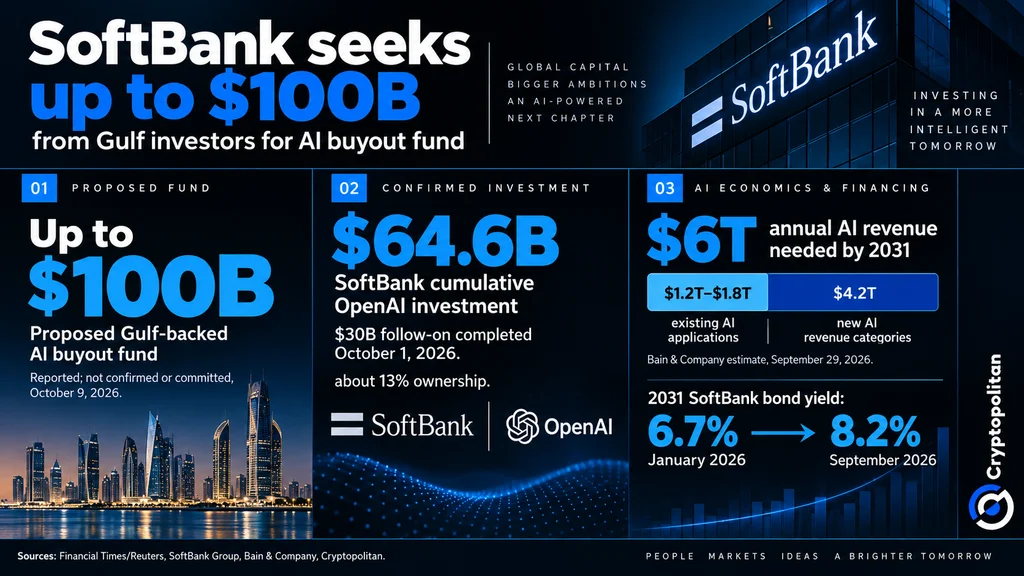
SoftBank Group Chief Executive Masayoshi Son is seeking to raise as much as $100 billion from Gulf investors for a fund that would acquire businesses and enhance their performance using artificial intelligence.
If the fund comes to fruition, it would shift SoftBank away from backing companies that develop AI technology and toward implementing the technology inside established companies. The fundraising has not been confirmed.
A fund to buy businesses, not just back model makers
Son has reportedly held discussions with senior figures in the United Arab Emirates, according to Reuters. The news agency could not independently verify the meetings, and SoftBank did not respond to a request for comment.
The proposed fund would acquire operating companies and apply AI to enhance their performance — a different approach from SoftBank's past investments in AI models, chips, and data centers. The emphasis would shift toward monetizing businesses that already serve customers. In practical terms, the technology would be judged by what it does for the operations of companies with existing revenue, rather than by the fortunes of the developers building the underlying models.
For now, the $100 billion figure remains a target, with no confirmed commitments from investors. Any confirmed deal would need to come through an official SoftBank announcement or on-the-record investor commitments.
$64.6 billion already tied to OpenAI
SoftBank's existing AI-related obligations are considerable. In an announcement on October 1, the company disclosed that it had made its final $10 billion payment under a total $30 billion investment in OpenAI, bringing its total investment in the company to $64.6 billion and giving it an ownership stake of almost 13%.
The payment was financed through senior notes denominated in foreign currencies. SoftBank also cancelled $10 billion in unused bridge-loan capacity on September 30 after repaying all of the loans it had taken.
As reported earlier by Cryptopolitan, SoftBank has raised roughly $11 billion through dollar and euro bonds. The yield on its dollar debt due in 2031 stood at about 8.2% in September, up from 6.7% in January — meaning lenders now demand a noticeably higher return to hold SoftBank's debt than they did at the start of the year. Those rising borrowing costs are one reason drawing in outside investors has taken on added importance.
The $6 trillion question
The pressing question is whether and how AI can generate enough revenue to cover the spending involved.
According to Bain & Company, the industry must reach $6 trillion in annual revenue by 2031 to accommodate expected demand for computing. Existing applications might generate between $1.2 trillion and $1.8 trillion, leaving a gap of about $4.2 trillion that must come from new sources of revenue. On Bain's figures, even the upper end of that range would leave roughly 70% of the required revenue still to be created.
“The economics of AI infrastructure demand trillions in new revenue beyond productivity gains,” said David Crawford of Bain & Company.
There is also growing concern over how AI funding is being raised. UBS has pointed to the growing links between AI-related borrowing, while the Bank for International Settlements, which serves as a bank for central banks, has raised doubts about whether the development of AI will produce substantial economic gains.
For SoftBank, the new fund would need to convert the progress made in AI into actual profits. A structure built around companies that already generate revenue would put that test in unusually direct terms.
Why the Gulf, and why Washington is watching
Gulf investors can provide substantial capital, but their technology partnerships also face geopolitical constraints. The Middle East Institute has examined how US export restrictions, chip access, and data-center security shape the region's AI ambitions. Because those rules govern which advanced chips and infrastructure can reach the region, they would also shape what an AI-focused buyout fund there could actually execute.
A SoftBank-Gulf fund could deepen those ties while extending AI investment into established businesses. Whether it reaches $100 billion will depend on investor commitments that have yet to materialize.

