Soft Payrolls Cleared One Risk. Week 42 CPI Has to Clear the Other
Key Takeaways
- •U.S. September payrolls increased by only 29,000 with the unemployment rate holding at 4.2%, while revisions left July and August a combined 60,000 jobs weaker than initially reported.
- •October 7 FOMC minutes showed most participants viewing another rate hike as likely appropriate by year-end, with staff estimating August total PCE inflation around 3.8% and core at 3.4%.
- •August real consumer spending rose 0.6% despite flat real disposable income, and gasoline plus shelter drove the August CPI gains that September data must offset to validate the soft-labor signal.
- •China's August CPI rose 0.8% year over year on falling food prices, but PPI climbed 3.8% and energy, electronics, and gold jewelry prices stayed elevated, keeping global disinflation incomplete.
- •A durable soft-landing read requires synchronized cooling across U.S. CPI, China prices, Japan CGPI, and euro-area factory data into the October 28–30 G3 central bank meetings.
Quick Answer
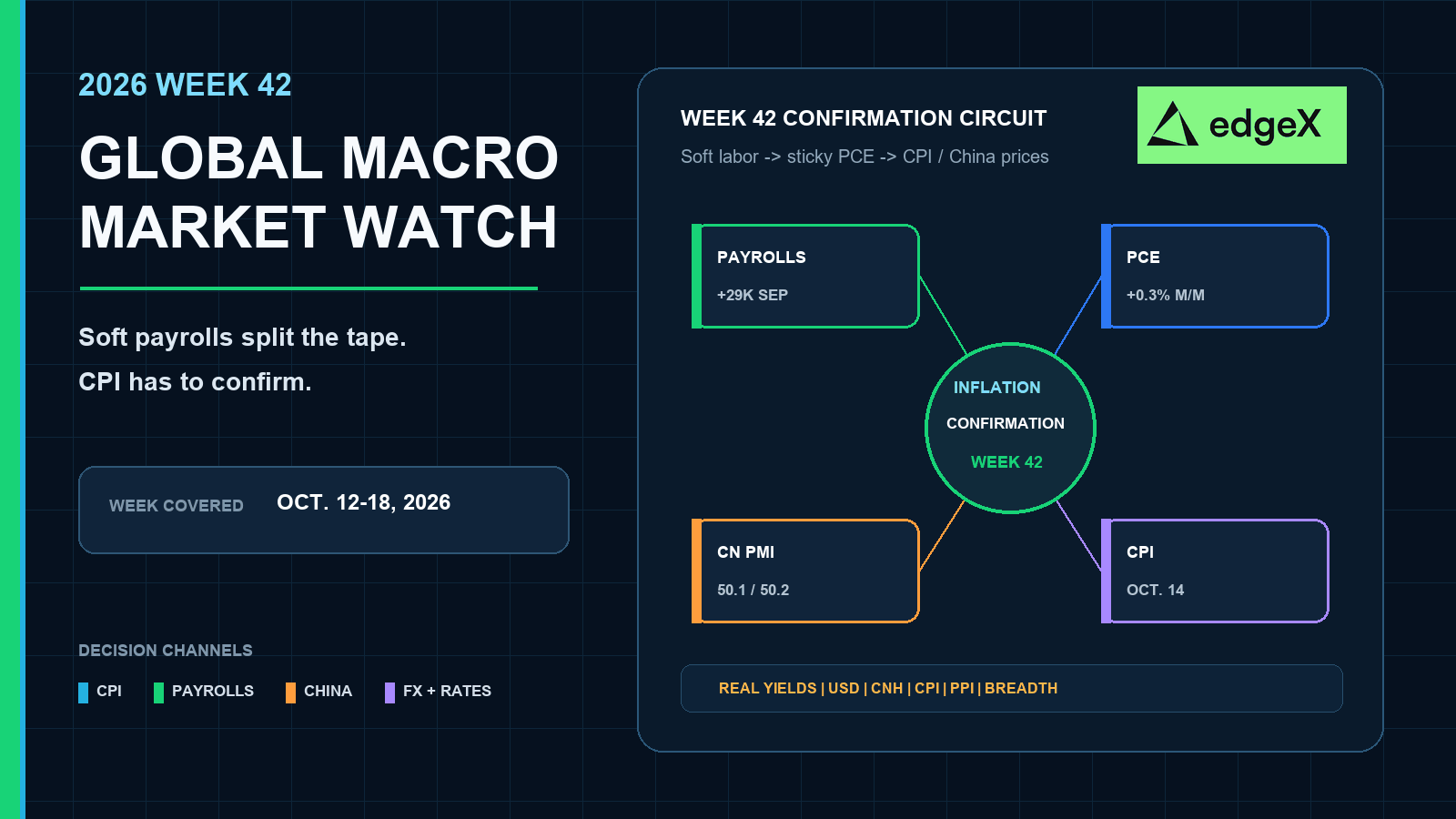
Trade Week 42 as a confirmation test into the October 28–30 G3 cluster. Soft U.S. payrolls already cut the hiring scare. They did not settle the path. The week passes only if September CPI fades August’s gasoline-and-shelter mix and China, Japan, and Europe pipeline prices stop rebuilding rate pressure. If those prints stay hot, soft labor will not keep another hike off the table.
Why Week 42 Is a Confirmation Week
Week 40 answered the labor question markets wanted answered. Hiring slowed. Wage growth cooled. Revisions cut the prior two months. Futures pricing knocked near-term hike odds lower. That was relief, not resolution.
The unfinished half is prices. August demand stayed firm. The Fed’s preferred inflation gauge stayed sticky. The October 7 minutes, released in Week 41, still left another year-end hike on the table. Week 42 sits between that written record and the late-October G3 decision cluster. Its job is confirmation: does soft labor survive sticky prices, or does the price channel put the second hike back in play?
Trade the conflict. A soft payroll print can reprice front-end yields for a session. A durable path shift needs September CPI, China CPI/PPI, Japan CGPI, U.S. retail and PPI, and Europe’s factory tape to move together.
Week 42 Global Macro Calendar
| Date | Region | Scheduled Event | Why Markets Care |
|---|---|---|---|
| October 13 | Japan | Corporate Goods Price Index | Scheduled Japan pipeline-price update before the late-October BOJ meeting. |
| October 14 | United States | CPI, September 2026 | Main U.S. inflation release before the October 28 FOMC decision. |
| October 14 | China | CPI and PPI, September 2026 | Scheduled China consumer- and factory-gate inflation update. |
| October 15 | United States | Retail sales and PPI, September 2026 | Same-week U.S. demand and pipeline-price check after CPI. |
| October 15 | Euro area | Industrial production, August 2026 | Europe factory-volume print into the late-October ECB meeting. |
| October 16 | Euro area | CPI final, September 2026 | Europe consumer-price confirmation into the October 28–29 ECB meeting. |
| October 28–30 | United States / Euro area / Japan | FOMC; ECB; BOJ MPM | Next live G3 policy cluster after the confirmation week. |
Soft Labor Cleared the Hiring Scare
The September Employment Situation cooled the labor scare without needing a collapse story. Payrolls rose only 29,000. The unemployment rate held at 4.2%. Average hourly earnings edged up just 0.1%, or 3.0% year over year. Hours stayed stuck at 34.4, with manufacturing overtime unchanged at 3.0. That mix says hiring and pay pressure eased together.
Breadth mattered more than one soft headline
The better read is where the jobs still came from. Health care kept adding work, but at 17,000 it ran well below its 33,000 average over the prior year. Financial activities stayed in reverse and are now down 129,000 since the May 2025 peak. Soft labor here is not a one-sector accident. The old job engines slowed, and one rate-sensitive category kept shedding.
Revisions and lagged openings still cut both ways
The revisions mattered as much as the monthly print. July flipped from a small gain to a 10,000 decline, and August was cut to 133,000, leaving the prior two months 60,000 weaker than first reported. August JOLTS, released September 29, still showed openings little changed at 7.1 million. That is an August vacancy snapshot published inside Week 40, not proof that September openings already cracked. Soft payrolls lowered the hiring scare. They did not settle the vacancy channel before Week 42 CPI.
Sticky Spending Kept the Inflation Channel Open
The labor tape cooled. Household demand did not. BEA’s August Personal Income and Outlays release showed real disposable income flat while real PCE still rose 0.6%. Households spent harder than inflation-adjusted incomes grew. That is why soft payrolls alone could not close the inflation debate.
The composition of that spending is the useful part. Goods led the monthly rise, and the biggest category lifts came from gasoline and other energy goods, food services and accommodations, and motor vehicles and parts. Services still rose, but the tape was not a quiet services-only grind. Energy and goods demand stayed live enough to keep price risk on the board. The same September 30 BEA slate also left second-quarter real GDP at a 2.2% annualized gain in the third estimate. Useful backdrop. Not the Week 42 lead.
August CPI set the bar September CPI must clear
The August CPI release is still the baseline Week 42 has to confirm or fade. Gasoline alone accounted for more than one-third of the monthly all-items rise. Shelter reaccelerated to 0.3% after a 0.1% July gain. Communication, lodging away from home, and airline fares also jumped, while medical care and motor-vehicle insurance cooled. If September CPI fades that gasoline-and-shelter mix, soft labor gets room to stick. If it does not, the sticky demand channel stays live into October 28.
Minutes Kept Another Hike on the Table
The October 7 FOMC minutes from the September 15–16 meeting are Week 41 adjacency, not a finished Week 41 review. They still change the Week 42 setup. Participants saw inflation risks tilted to the upside and labor-market risks broadly balanced. All of them backed the move to 3.75%–4.00%. A couple had raised their estimate of the neutral funds rate. Several said current policy looked not restrictive, or only mildly restrictive. Most then judged that another increase would likely be appropriate by year-end, while stressing they would stay open to incoming data.
Staff language kept the same pressure on. The staff estimated August total PCE inflation around 3.8% and core around 3.4%, pointing to past tariff increases, energy and geopolitical costs, and AI-related consumer-goods prices. Futures pricing cut near-term hike odds after the soft payrolls print. Treat that only as market pricing color. The written minutes still left another year-end hike as the path most participants thought would likely be appropriate. Soft labor helps only if Week 42’s inflation prints give officials a reason to rewrite that bias.
China, Japan, and Europe Filter the Same Split
China is not offering clean global disinflation into October 14. NBS August CPI rose 0.8% year over year, but the split mattered more than the headline. Food fell 1.4%, with pork down 11.8%. Energy rose 4.1%, and gasoline jumped 9.3%. China Daily’s wrap also showed tablets, computers, and mobile phones still rising at double-digit rates, with gold jewelry up 33.6%. Soft groceries do not cancel AI-linked and energy-linked consumer prices.
Factory-gate prices tell the same story from the other side. NBS August PPI rose 3.8% year over year. Means of production were up 5.0%. Consumer goods were still down 0.5%. Purchasing prices rose 5.8%. Upstream pressure stayed firmer than finished consumer goods. That is a pipeline filter for metals, CNH, and Asia cyclicals, not a broad household reflation signal.
Activity rebounded only at the surface
September official PMI put manufacturing back at 50.1 and non-manufacturing at 50.2. Construction rose to 50.3, the highest reading this year. New orders stayed weak at 46.5, and real estate remained below 50. August industrial profits slowed to 4.2% after 11.2% in July, even as electronics profits jumped about 110% and high-tech manufacturing rose 54.7% over the first eight months. AI and upstream strength are carrying the tape. Household demand is not.
Japan and Europe keep the same filter open. Japan’s August CGPI fell 0.2% on the month but stayed up 7.6% year over year. Export prices were still up 11.1% year over year on a contract-currency basis, and import prices were up 16.7%, even after a 1.0% monthly drop. Europe’s Week 41 adjacency was no cleaner. Retail trade rose only 0.1% after a 0.6% drop, or 0.8% year over year, and Germany’s 1.3% monthly rebound still left sales down 0.4% year over year. Industrial producer prices jumped 1.9% month over month, almost entirely through energy. Excluding energy, producer prices rose just 0.2%. Soft U.S. payrolls do not cancel hot Asia and Europe pipeline prices if those channels still feed FX, metals, and front-end yields.
Week 40 Review: Soft Jobs Met Sticky Prices
Week 40, September 28–October 4, was the latest completed weekly window at the October 8 cutoff. The week opened in Asia. China’s industrial-profits package showed the annual total still growing, but August slowed sharply and left the upside concentrated in electronics and high-tech manufacturing rather than broad household demand.
The middle of the week stacked the U.S. confirmation problem. August JOLTS kept openings little changed, reminding markets that the vacancy channel had not yet cracked in the lagged data. The next day, BEA’s August income-and-outlays package showed real spending still rising while real incomes were flat, with energy, food services, and vehicles doing a lot of the work. China’s official PMI only just crossed back above 50 the same day, and new orders stayed soft.
October 2 closed the week with the soft payrolls print. Hiring slowed, wage growth cooled, and the prior two months were revised lower. Futures markets cut near-term hike odds on that labor relief. The completed Week 40 record still left a harder message for Week 42: labor cooled, spending and prices did not, and the October 7 minutes later kept another year-end hike on the table. Soft payrolls lowered one risk. They raised the bar for September CPI and the global pipeline prints that follow.
Cross-Asset Decision Map
| Week 42 Mix | Crypto | Stocks | Commodities | FX and Rates |
|---|---|---|---|---|
| Soft U.S. CPI after soft payrolls, with cooler China/Japan pipeline prices | Lower real-yield pressure can support BTC and ETH if leverage stays contained. | Duration and high-beta can catch a bid; AI leaders still need earnings, not just path relief. | Gold can firm if real yields fall; industrial metals need China demand confirmation. | Front-end yields ease; USD softens selectively into late October. |
| Hot U.S. core CPI while China PPI and Europe producer prices stay firm | Higher real yields and tighter liquidity hit leveraged crypto first. | Long-duration underperforms; quality and cash-flow names hold up better. | Gold faces a yield headwind; energy and industrial metals stay two-sided. | Real yields and USD firm; hike odds into October 28 rebuild. |
| Soft labor sustained, but China CPI/PPI re-accelerate on energy and electronics | Asia risk-off can still pressure high-beta crypto even if U.S. yields stabilize. | China-sensitive multinationals and materials lag U.S. domestics. | Copper and related metals weaken if absorption stays weak; oil stays geopolitical. | CNH softens; commodity currencies diverge from pure USD path trades. |
| Cool CPI with weak U.S. retail and soft euro-area industrial production | Rate relief helps only if growth-scare deleveraging does not dominate. | Earnings revisions matter more than the first CPI print; defensives can lead. | Gold can outperform industrial commodities. | Curves can bull-steepen; policy-path uncertainty stays elevated across USD and JPY. |
What Would Confirm the Week 42 Signal?
The base case is confirmation noise, not a clean one-way trend. A durable soft-landing read needs September CPI to fade August’s gasoline-and-shelter push, China CPI/PPI to keep food soft without another energy-and-electronics surge, Japan CGPI to stop the year-over-year pipeline rate from re-accelerating, and euro-area industrial production to show that hot producer prices are not arriving with a factory collapse. Soft U.S. retail would support the labor-cooling story only if PPI does not reopen the pipeline channel the same day.
China needs its own checklist. Read October 14 CPI and PPI against the August food-versus-energy split, the September PMI new-orders gap, and the profits slowdown that still left electronics extremely strong. Stable China prices with firmer new orders support containment around a softer U.S. labor tape. Another PPI or energy-led CPI push keeps Asia selective even if U.S. payrolls stay soft. Week 42 confirmation should show up in the joint move of CPI, China prices, Japan CGPI, front-end yields, the dollar, CNH, EUR, JPY, and industrial metals. A U.S.-only CPI reaction that dies before Asia’s open is less durable than a synchronized global adjustment into the October 28–30 G3 cluster.
Trade with an Edge
In fast-moving markets, execution matters just as much as direction. That's why more traders are turning to decentralized venues like edgeX for perpetuals and spot trading.
Unlike traditional centralized platforms, edgeX is built around self-custody, meaning you keep control of your assets and authorize fund movements yourself. For active traders, that offers a meaningful advantage: market access without handing custody to an exchange.
edgeX also combines the core benefits of DeFi with a trading experience designed for serious execution. The platform emphasizes deep liquidity, high-speed order matching, and low-slippage performance, helping traders stay responsive during volatile conditions. With support for high leverage, it gives experienced market participants more flexibility in how they express macro views and manage risk.
Beyond execution, decentralized trading infrastructure can offer structural advantages: greater transparency, on-chain verification, and reduced dependence on centralized intermediaries. For traders who want performance without giving up control, that model is increasingly compelling.
edgeX is built for that balance: bringing together a professional trading experience with the core principles of decentralized markets.
Traders looking to explore a more capital-efficient, self-custodial way to trade can take a closer look at edgeX.
Frequently Asked Questions
What is the biggest event in Global Macro Week 42?
The highest-impact catalyst is U.S. September CPI on October 14. Markets will still score that print against the same-week China CPI/PPI release, Japan CGPI on October 13, U.S. retail sales and PPI on October 15, and euro-area industrial production, not as a U.S.-only inflation day.
Why review Week 40 instead of Week 41?
Production closed on October 8, while Week 41 was still in progress. The October 7 FOMC minutes and Europe’s early-October retail and producer-price prints are treated as Week 41 adjacency. Week 40, September 28–October 4, was the latest completed weekly window and is labeled explicitly.
Why do soft payrolls not settle the Fed path alone?
September payrolls cooled hiring and wages, but August real spending still rose while real incomes were flat, and the October 7 minutes still said most participants saw another hike as likely appropriate by year-end. Soft labor lowers growth risk. Sticky prices keep the second-hike channel open until Week 42’s inflation prints say otherwise.
How should China be read in Week 42?
Use the August split as the baseline: soft food and pork against firmer energy, electronics, and factory-gate prices, with September PMI only just back above 50 and new orders still weak. October 14 CPI and PPI update that split. Broad cooling supports global digestion. Another energy-or-AI-led push keeps CNH, metals, and Asia cyclicals selective.
What would make the Week 42 signal durable into late October?
A durable signal needs U.S. CPI, China prices, Japan CGPI, and Europe’s factory tape to line up with front-end yields, the dollar, CNH, EUR, JPY, and industrial metals. One soft U.S. CPI print that fails against hot Asia or Europe pipeline prices is less durable than a synchronized confirmation into the October 28–30 G3 cluster.

