Sodium-Ion Batteries: The Emerging Lithium Alternative Gaining Ground in Energy Storage
Key Takeaways
- •Sodium batteries use only aluminum current collectors rather than the aluminum and copper combination required by lithium cells, providing a theoretical cost advantage.
- •Three main sodium battery chemistries exist—NFM, NCO, and NFPP—each suited to distinct applications from light e-mobility to grid-scale stationary storage.
- •NFPP batteries deliver superior cycle life and thermal tolerances with nearly zero fire risk, and require less HVAC infrastructure than comparable lithium iron phosphate systems.
- •U.S. companies such as Alsym, Unigrid, and Peak Energy are developing domestic sodium battery manufacturing capacity, aided by federal tax credits under the 2022 Inflation Reduction Act.
- •Global sodium battery production exceeded 3 GWh last year, signaling the technology has moved beyond laboratory development into commercial-scale deployment.
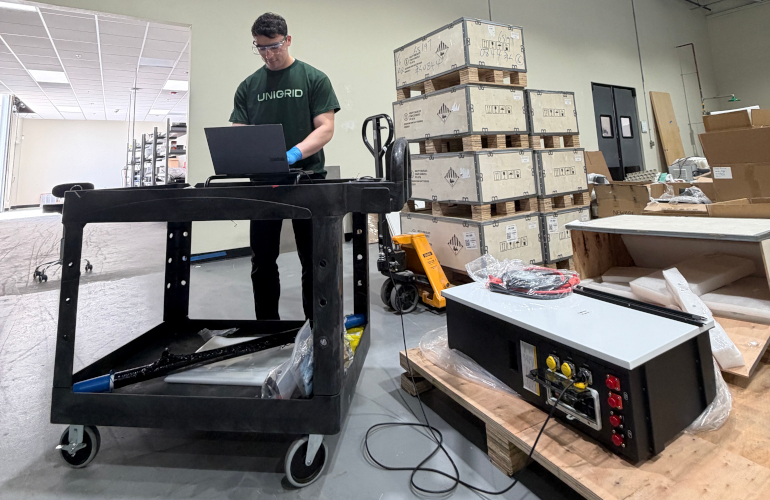
Sodium-based batteries are not new to the energy storage market, but interest in the technology began surging in the early 2020s as the industry sought alternatives to lithium. Lithium prices spiked sharply during that period, and with the majority of global lithium refining concentrated in China, governments and manufacturers worldwide grew motivated to diversify battery chemistries. Sodium is the sixth most abundant element on Earth, and sodium-ion batteries function and can be manufactured in ways similar to conventional lithium designs, making their adoption more straightforward than other advanced technologies such as flow batteries. However, just as multiple lithium chemistries exist, different types of sodium batteries are suited to different use cases.
What Is a Sodium Battery?
Sodium-based batteries rely on abundant sodium to generate nontoxic power. They are not flammable or explosive—provided no other reactive materials are introduced into the chemistry—and can operate across a wide temperature range. Sodium battery cells can also be fully discharged to zero charge without sustaining damage.
During charging, sodium ions move from the cathode to the anode; during discharging, they travel back from the anode to the cathode. The manufacturing process closely mirrors that of lithium batteries: the cathode and anode are coated with a slurry, the cell pouch is filled with electrolytes, and the module is sealed. Sodium cell manufacturers are adopting form factors similar to lithium cells to facilitate easy adoption.
A key distinction lies in the current collector design. Sodium batteries typically use only aluminum, whereas lithium batteries use both aluminum and copper. Relying solely on aluminum theoretically gives sodium batteries a cost advantage. Additionally, because sodium batteries operate across a wide temperature range and carry minimal fire risk, they do not require the heating, cooling, and fire suppression systems found in lithium battery energy storage systems (BESS). This allows large-scale sodium energy storage systems to have a significantly smaller physical footprint than their lithium counterparts. For stationary grid-scale storage, where weight and volume are less constraining than in electric vehicles, sodium's lower energy density relative to lithium is less of a drawback.
Different Types of Sodium Batteries
Several variants of sodium batteries exist, but the three most common are NFM, NCO, and NFPP.
Sodium Nickel Iron Manganese (NFM) is most frequently compared to lithium cobalt oxide (LCO) and is used in light e-mobility applications such as scooters and e-bikes. Like LCO batteries found in portable electronics such as phones, NFM batteries can pose safety hazards and may catch fire. They are not considered appropriate for large-scale applications.
Sodium Chromium Oxide (NCO) is often compared to lithium nickel manganese cobalt (NMC). NCO offers high energy density but a relatively short cycle life. These layered metal oxide batteries can enter thermal runaway and generate oxygen as they burn, though the likelihood is considerably lower than what has been observed with lithium batteries.
Sodium Iron-Phosphate Pyrophosphate (NFPP) is typically compared to lithium iron phosphate (LFP). NFPP batteries deliver better cycle life and thermal tolerances with nearly zero fire risk. U.S.-based manufacturer Alsym incorporates a non-flammable electrolyte into its NFPP+ design to further eliminate fire risk. Compared to LFP, NFPP designs have lower energy density but require less HVAC infrastructure and fewer BESS add-ons.
Where Are Sodium Batteries Being Manufactured and Installed?
As with virtually every battery product, China currently dominates production. Sodium battery manufacturing can be integrated into existing LFP production lines with relative ease, and many established Chinese lithium brands have already repurposed idle or excess capacity at their plants to produce sodium designs.
In the United States, a handful of sodium-ion research and development efforts are underway. The battery's abundant chemistry base and absence of critical materials mean the U.S. could rapidly onshore manufacturing of sodium-ion energy storage systems. Federal incentives under the 2022 Inflation Reduction Act, which include tax credits for domestically produced battery cells and critical mineral sourcing, have further encouraged investment in non-lithium chemistries that reduce reliance on imported materials.
Boston-based Alsym has been developing NFPP cell designs, and large-scale energy storage developer ESS recently announced it would use Alsym technology in its upcoming sodium-ion battery launch.
"Our first launch is going to be with NFPP because that's a good technology. It follows the same characteristics that ESS has followed since its birth — no risk of fires and it's safe," said Randy Selesky, ESS chief commercial officer.
UC San Diego spin-off Unigrid is developing NCO cells and announced a partnership with manufacturer Syntropic Power to produce sodium-ion batteries in the United States. The two companies are targeting the residential market because it is ready for lithium alternatives, said Unigrid co-founder and CEO Darren Tan.
"We already have water storage at home, we have food storage. I think it's very conceivable in the next two decades that everyone may have energy storage at home, as long as the energy storage is as affordable, as safe and as reliable as a refrigerator," Tan said. "This is an opportunity for sodium-ion."
Peak Energy plans to open a facility in Sacramento in 2027 with 4 GWh of annual manufacturing capacity, producing 3.1-MWh NFPP systems. The company currently uses imported cells, but executives are already securing other components, said Peak chief scientist Brandon Kelly.
"You can make hard carbon, which is the anode, from almost anything. Right now, we use coconuts. We're going to do some peach pits and other random stuff. It makes for funny supply chain conversations," Kelly said. "But you can make it out of coal, you can make it out of petroleum byproducts, which are things we're good at here in the States. Even though it's not something that is scaled today, it's something that will be quite easy for us to do [in the United States] relative to lithium."
U.S. companies would not be building manufacturing infrastructure without demand for the new battery technology. Although current installed capacity remains low, each company representative told Solar Power World that the industry stands at the beginning of significant growth. The broader grid-scale energy storage market is expanding as renewable energy deployment increases and utilities seek longer-duration solutions to balance intermittent generation.
"Last year, there was over 3 GWh of sodium produced," Kelly said. "There's a lot of people that feel it's more of a lab technology, but the reality is it's commercial-quality cells that already hit on their performance in that large format that you can get at the gigawatt-hour scale. It's ready for prime time."
