SKUU Now Listed on edgeX: What GraniteShares 2x Long SK Hynix Means for AI Memory Traders
Key Takeaways
- •edgeX has listed the SKUU/USDC perpetual contract, enabling 24/7 trading of a derivative linked to the GraniteShares 2x Long SK Hynix exchange-traded product on its self-custodial platform.
- •SKUU targets twice the daily return of SK hynix stock, but its daily reset mechanism means performance over extended periods can diverge substantially from simple double exposure due to path dependence and volatility drag.
- •SK hynix holds a structural advantage in the AI memory market as a leading supplier of high-bandwidth memory, with strong positioning in HBM qualification among major AI accelerator customers.
- •Trading SKUU on edgeX involves three distinct layers of risk: SK hynix's business fundamentals, the daily-reset leverage dynamics of the reference product, and perpetual contract mechanics including funding rates and liquidation thresholds.
- •International traders on edgeX should account for KRW/USD currency fluctuations, as SK hynix's primary listing trades on the Korea Exchange in South Korean won, adding another dimension to the position's risk profile.
Quick Answer
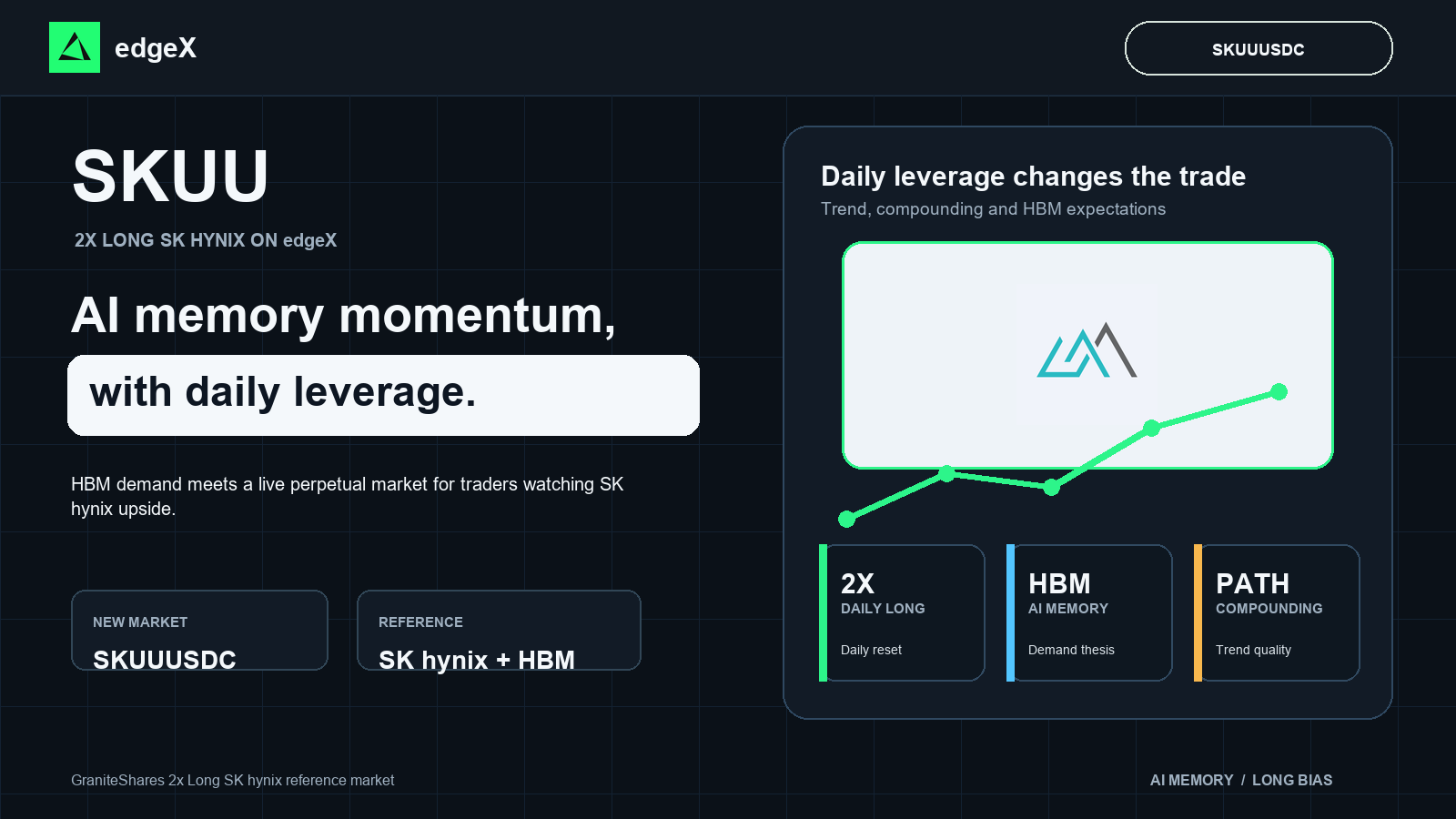
SKUU is a GraniteShares daily leveraged product linked to SK hynix, a core supplier in the AI memory sector. edgeX has listed the SKUU/USDC perpetual contract for eligible traders seeking continuous derivative exposure to this long SK hynix thematic. The key lies in the structure: the reference product targets 2x daily exposure, while the edgeX market introduces perpetual funding rates, liquidity, index, and liquidation mechanisms.
Trade the SKUU/USDC perpetual contract on edgeX.
https://x.com/edgeX_exchange/status/2087429533532336251
SKUU Arrives as AI Memory Trading Grows More Leverage-Sensitive
edgeX has listed SKUU on its V2 TradFi perpetual market — the GraniteShares 2x Long SK Hynix product. This listing provides traders with a continuous trading venue to express bullish views on the SK hynix theme, but the instrument must be understood on its own terms. It is not regular SK hynix stock, nor is it a simple two-times version of long-term returns.
The underlying narrative has strong logic. SK hynix is one of the primary suppliers of DRAM and high-bandwidth memory used in AI servers. HBM demand has reshaped the memory cycle by making capacity, packaging, qualification, and supply discipline central to the economics. As a result, investors view SK hynix not only as a semiconductor company but also as a way to access the capital expenditure race behind artificial intelligence.
What Is SKUU?
SKUU seeks twice the daily performance of SK hynix stock. "Daily" is the key term. The product resets its exposure every trading day, so its returns over a week or a month can differ significantly from twice the cumulative return of the underlying stock. Volatility, the sequence of gains and losses, financing costs, and product fees all play a role.
Why the Daily Reset Matters
If SK hynix rises steadily, daily compounding can work in favor of the long leveraged product. If the stock price swings sharply, the reset mechanism can have an adverse effect. A simple example illustrates this: a 10% gain followed by a 10% decline leaves the stock down 1%. A daily two-times product gaining 20% then declining 20% would end up down 4%. This difference stems from path dependence, not tracking error.
The edgeX perpetual contract adds a second layer of calculation. Traders are not buying SKUU itself; they hold a derivative position referencing SKUU as the underlying market. Even if the underlying ETP performs as expected, funding rates, liquidation thresholds, and the perpetual contract's index rules affect the final outcome.
The SK hynix Investment Thesis Behind the Product
SK hynix's core opportunity stems from HBM, advanced DRAM, and server demand. AI accelerators require substantial high-bandwidth memory located close to the processor. As model training and inference scale up, the memory content, packaging complexity, and qualification requirements of each system can increase the value of reliable supply.
This is not a one-way demand story. The memory industry remains cyclical. Customers may delay orders, competitors may add capacity, and shifts in the product mix between HBM, conventional DRAM, and NAND can alter margins. The bullish thesis depends on whether SK hynix can translate scarce, technically demanding memory into durable pricing power, rather than merely experiencing a short-lived shortage.
What Traders Should Watch
| Driver | Bullish Signal | Risk Signal |
|---|---|---|
| HBM demand | More customer qualifications and solid AI server orders | Slowing deployments or delayed capacity commitments |
| Pricing | Tight supply and improving contract prices | Inventory build-up or aggressive competitor supply |
| Product mix | Increasing share of HBM and server DRAM | Shift toward lower-margin products |
| Capital expenditure | Capacity expansion aligned with visible demand | Overinvestment leading to subsequent oversupply |
| SKUU mechanics | Smooth trends support daily compounding | Choppy trading increases path drag |
The most important distinction is between company fundamentals and product performance. SK hynix can deliver strong results, but if the path is highly volatile, the return of a daily leveraged product may still disappoint. Conversely, a brief rally can make the product appear effective even if the long-term memory thesis has not improved.
Latest Developments and Market Interpretation
The current narrative around SK hynix is shaped by AI infrastructure investment, HBM supply negotiations, and a broader re-rating of Korean semiconductor stocks. The market rewards evidence that HBM demand is real, qualified, and profitable; at the same time, it punishes quickly when there are signs of customer over-ordering or supply catching up faster than expected.
For SKUU, news momentum is particularly important because leveraged products tend to attract short-cycle positions. Traders should distinguish between durable changes in earnings expectations and reactions triggered by a single customer announcement, a single analyst estimate revision, or a gap move in the underlying stock. Derivative trading venues allow the market to continue operating outside of local stock market trading hours, but they do not eliminate the need to understand the underlying asset's actual trading hours and how the contract handles gaps.
Risks That Could Undermine the Long-Term Thesis
The first risk is a reversal in the memory cycle. Even with HBM's structural importance, prices can come under pressure as supply, customer absorption, or macro conditions change. The second is concentration: a few large AI customers can influence demand timing and bargaining power. The third is execution, including yields, packaging capacity, and qualification timelines.
The fourth risk is specific to SKUU itself. Daily-reset leverage erodes value in choppy, sideways markets. The fifth relates to edgeX derivatives: funding rates, liquidation, and index behavior can all alter outcomes. These risks compound rather than offset one another.
Conclusion
SKUU offers a more concentrated way to trade the bullish SK hynix and AI memory narrative, but it does so through a leveraged daily product referenced via the perpetual market. The opportunity is strongest when the underlying trend is clear, HBM economics are improving, and position sizing accounts for volatility. Conversely, it is most vulnerable when markets are choppy and traders treat daily 2x exposure as a certain long-term multiplier.
The new edgeX market provides 24/7 access to this theme. The responsibility remains with the trader: understand the reference product, monitor the memory cycle, and verify real-time contract terms before taking action.
Understanding the Long Trade on Three Levels
Anyone trading SKUU is effectively making three interconnected judgments. First is SK hynix itself: can the company maintain its HBM leadership, execute product transitions, and convert demand into cash flow? Second is the GraniteShares product, where the daily path of the reference underlying determines whether leveraged exposure produces constructive compounding. Finally, the edgeX perpetual contract, where funding rates, liquidity, and liquidation risk determine whether the position can survive long enough for the thesis to play out.
Treating these questions as one is dangerous. A positive company thesis can still meet a poor entry price, and a strong weekly stock return can mask intraday paths unfavorable to a daily-reset product. Even if SKUU moves in the expected direction, excessive leverage or unfavorable funding rates can erode the final perpetual outcome.
Trend Quality Matters More Than the Surface Multiple
The most favorable environment for a daily long product is sustained upside with controlled volatility. Consecutive positive trading days allow exposure to reset on a higher base. An environment where prices first surge and then reverse just as sharply is unfavorable, even if the news flow remains bullish. Traders should therefore watch realized volatility alongside direction.
This distinction is especially important around earnings, customer qualification announcements, and industry conferences. These events can cause semiconductor stocks to swing violently. Traders entering before a catalyst are betting on gap size and direction, not just on the long-term HBM market.
HBM Leadership Is an Execution Test
HBM is difficult to manufacture because it combines advanced memory dies, stacking, packaging, and stringent customer qualification. Scarce qualified supply supports the bullish thesis. But it also means that yields, packaging capacity, or transition delays can impact revenue even when end demand is strong.
Orders Do Not Equal Confirmed Profit
Investors should distinguish between announced demand and shipment volumes, and between shipment volumes and margins. Long-term customer discussions can improve visibility, but product mix, contract terms, and manufacturing costs determine income statement results. If competition intensifies or switching costs rise, suppliers may ship more while earning less per unit.
Capital expenditure also carries uncertainty. Investment can solidify leadership and unlock output, but capacity built on overly optimistic forecasts can intensify the next downturn. The strongest evidence is synchronized progress: customer qualifications, output improvements, inventory discipline, and cash flow generation advancing in tandem.
SKUU Scenario Framework
In the bullish scenario, AI infrastructure budgets remain firm, HBM content per accelerator increases, and SK hynix continues to keep qualified supply tight. The reference stock trends upward in a relatively orderly manner, allowing daily leverage to compound positively. The edgeX position still requires manageable funding rates and conservative position sizing.
In the base case, HBM demand remains healthy but is partially offset by conventional memory volatility, product transition costs, or valuations that already reflect favorable news. SK hynix may trade in a wide range. For SKUU, this environment can be frustrating because daily leverage amplifies volatility without guaranteeing progress.
In the bearish scenario, slower customer absorption, weaker pricing, or new qualified supply pressures earnings expectations. The leveraged long reference product can decline rapidly, and liquidation risk can make the perpetual contract more sensitive than an unleveraged stock position. The truly relevant question is not whether AI still matters, but whether current expectations are too high for the next reporting period.
Practical Checklist Before Trading
First, check the real-time reference market. Confirm whether the Korean underlying stock and the GraniteShares product are open, closed, or moving on stale reference data. Then review edgeX funding rates, spreads, depth, and index composition. The value of continuous trading is greatest when traders understand which part of the price reflects new information and which part is pricing in the next traditional market open.
Position sizing should reflect the layered leverage. The "2x" label describes the daily target of the reference product; it does not mean maximum perpetual leverage should be added on top. Smaller positions preserve the ability to reassess after a gap, while oversized positions may be liquidated before the company thesis is validated.
Watch the Gap Between Stock and Product
A useful habit is to compare the underlying stock movement with the leveraged product's own performance after each catalyst. If the stock moves cleanly and smoothly, the long product generally has room to work. If the stock exhibits sawtooth patterns, the product may lose efficiency even if the direction is correct. Many first-time traders underestimate precisely this gap.
SK hynix is also situated within the broader Korean semiconductor conversation. This means US AI sentiment, local memory pricing, currency fluctuations, and customer commentary may arrive simultaneously. The edgeX market can help traders react quickly when narratives shift overnight, but the trade still depends on whether the next move is a durable re-rating or merely a fast sentiment swing.
What Would Make the Bullish Structure Stronger
The strongest SKUU structure would feature three aligned signals simultaneously. First, SK hynix needs evidence of durable HBM demand: customer qualifications, solid supply agreements, product mix improvements, or management commentary indicating pricing remains firm. Second, the stock price action needs to appear orderly rather than purely speculative. For a daily leveraged product, steady upside with controlled volatility is more useful than large gaps followed by repeated reversals. Third, the edgeX contract needs sufficient depth and reasonable funding rates so that the perpetual layer does not overwhelm the company thesis.
The Warning Sign Is Rallies Without Earnings Follow-Through
The most vulnerable version of this trade is a rally driven solely by the AI label. If SK hynix rises on strong semiconductor sentiment but subsequent operating data shows weakening pricing, shipment delays, or rising costs, then SKUU may face both valuation disappointment and daily compounding drag simultaneously. A better bullish thesis should therefore start from memory economics and then assess whether the product structure suits the expected path.
Trading the SKUU/USDC Perpetual on edgeX
Access to traditional financial markets no longer has to stop when traditional exchanges close. edgeX provides traders with around-the-clock access to perpetual contracts on select stocks and exchange-traded products through a self-custodial platform. Users retain control of their assets and authorize fund transfers themselves, while the platform is designed for fast execution and transparent on-chain settlement.
24/7 Access to Listed TradFi Markets
The newly listed SKUU/USDC perpetual contract allows traders to express bullish or bearish views on the reference market without waiting for the next traditional trading session to open. Perpetual contracts are derivatives and do not represent ownership of the underlying security. Traders should check the live contract page for current leverage, funding rates, fees, liquidity, index methodology, contract specifications, and regional availability.
Self-Custody and Market Infrastructure
edgeX combines decentralized settlement with an order book trading experience. The platform claims to offer institutional-grade liquidity, high-speed matching, self-custody, and account registration without KYC. Product availability and performance claims may change, so traders should verify current terms directly on edgeX before trading.
Leverage Changes the Risk Profile
Leverage amplifies both gains and losses. Funding payments, liquidation, spreads, slippage, reference price differences, and market gaps can all affect outcomes. Even with the correct directional view, losses can occur if position sizing or timing are poorly managed.
FAQ
How Is SKUU Different From Holding SK hynix Stock?
Holding SK hynix stock provides direct equity exposure. SKUU is a daily leveraged reference product, and the edgeX market is a perpetual derivative linked to that product. Therefore, the trade depends on SK hynix fundamentals, daily compounding, and perpetual market mechanics.
Why Is a Steady HBM Rally Better for SKUU Than a Volatile Rally?
Daily leverage performs best when the reference stock trends consistently upward. Repeatedly reversing rallies create path drag, meaning SKUU's outcome may not match what traders expect from the surface stock price movement.
What Could Weaken the SKUU Thesis?
The thesis weakens if HBM demand slows, contract pricing softens, customer orders are delayed, product transitions hurt margins, or SK hynix's rally is too choppy for daily leverage to compound efficiently.
What Should Traders Verify Before Opening a SKUU/USDC Perpetual Position?
Check the live edgeX market page for funding rates, fees, leverage, liquidity, index methodology, contract specifications, and regional availability, then compare those terms with the trading hours of the underlying SK hynix and GraniteShares products.
Does an edgeX Perpetual Contract Represent Ownership of the Underlying Asset?
No. It is a derivative contract and does not confer voting rights, dividends, or claims on the underlying issuer's assets.
What Should Traders Verify Before Opening a Position?
Check the live edgeX market page for current funding rates, fees, leverage, liquidity, index methodology, contract specifications, and regional availability.

