SKDD Is Listed on edgeX: How GraniteShares 2x Short SK Hynix Expresses a Bearish Memory View
Key Takeaways
- •edgeX has listed the SKDD/USDC perpetual market, providing 24/7 derivative access to the GraniteShares 2x Short SK Hynix exchange-traded product.
- •SKDD is designed to deliver approximately twice the inverse daily return of SK hynix stock, gaining value when the reference share declines and losing value when it rises.
- •Daily inverse compounding causes multi-session results to diverge significantly from a simple negative multiple, making the product better suited for short-term tactical positions than long-term hedges.
- •SK hynix's deep exposure to DRAM, HBM, and AI-server investment cycles creates both strong earnings potential and vulnerability to memory-market downturns.
- •The edgeX perpetual does not confer ownership of the underlying security and carries additional risks from funding costs, leverage, and liquidation mechanics.
Quick Answer
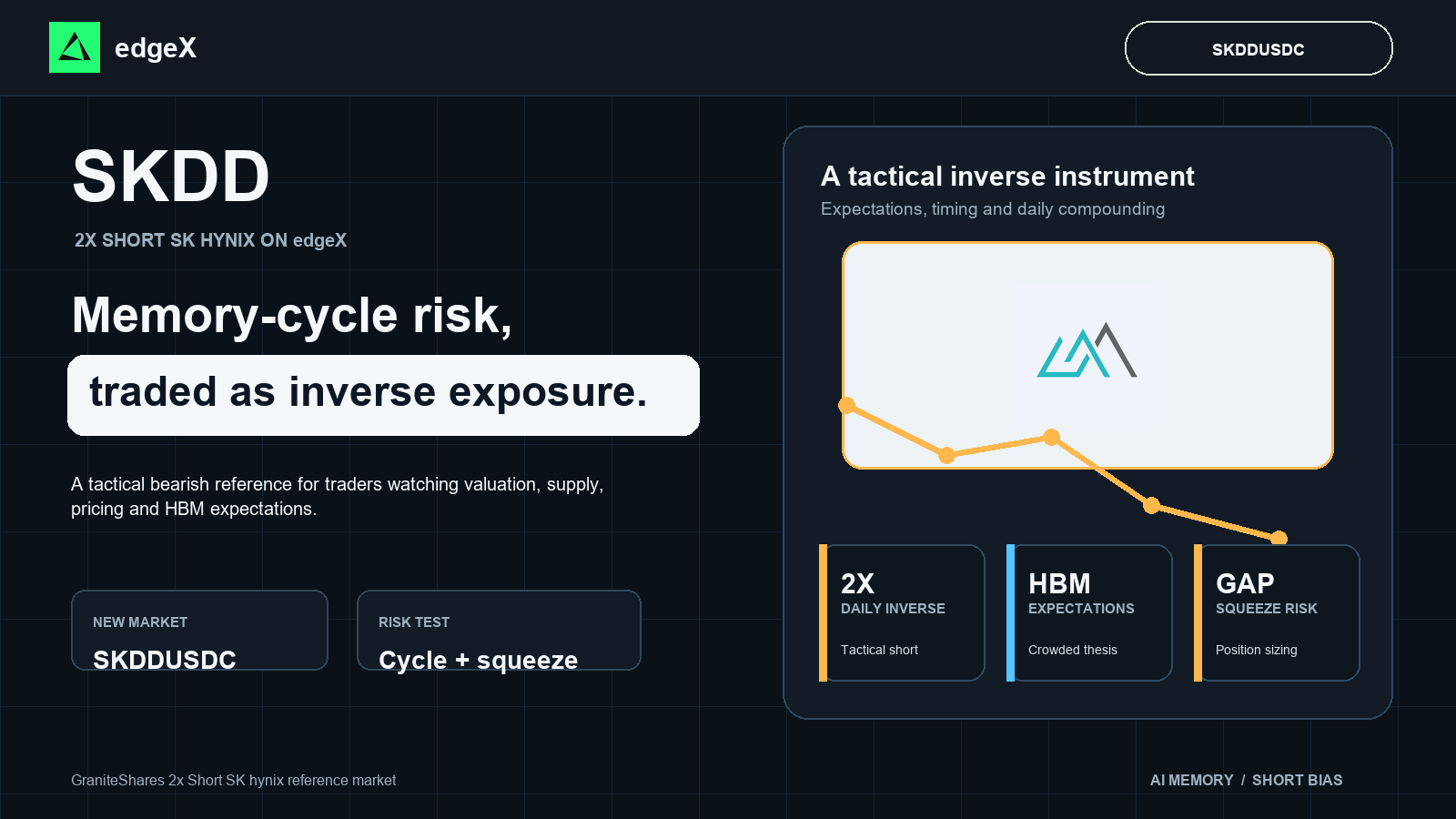
SKDD is a GraniteShares daily inverse leveraged product linked to SK hynix. edgeX lists a SKDD/USDC perpetual for eligible traders who want continuous derivative access to a bearish or hedging view on the SK hynix-linked reference. It is not a direct short sale of SK hynix shares, and the trade depends on timing, daily inverse compounding, funding and liquidation risk.
Trade the SKDD/USDC perpetual on edgeX.
https://x.com/edgeX_exchange/status/2087429533532336251
SKDD Brings a Leveraged Bearish SK hynix View to edgeX
edgeX has listed SKDD, the GraniteShares 2x Short SK hynix product, on its V2 TradFi perpetual markets. The instrument is designed for traders who expect the SK hynix share price to fall over a daily measurement period. It is not a conventional short sale, not a direct equity position, and not a simple two-times inverse return over any chosen holding period.
The bearish case sits against one of the strongest semiconductor narratives in the market. SK hynix is deeply exposed to DRAM, HBM and AI-server investment. That exposure can create exceptional earnings momentum when memory is scarce, but it can also leave the stock vulnerable when customers digest inventory, competitors add capacity or pricing expectations turn.
What Is SKDD?
SKDD seeks two times the inverse daily performance of SK hynix stock. If the reference share falls during a day, the product is designed to rise by approximately twice that daily move before fees and tracking effects. If the share rises, the product can lose value quickly. Its exposure resets daily, so the path taken by the stock matters as much as the starting and ending prices.
Inverse Daily Exposure Is Not a Long-Term Hedge by Default
Daily inverse products are most intuitive when used for a defined short-term view. Over several sessions, compounding can create outcomes that differ sharply from a simple negative multiple. A 10% fall followed by a 10% rebound leaves the stock down 1%, but a daily two-times inverse product would gain 20% and then lose 20%, leaving it down 4% before costs.
That path dependency is especially relevant for a volatile semiconductor share. A trader can correctly identify a late-cycle risk and still lose money if the stock swings before the expected decline arrives. The edgeX perpetual introduces additional variables, including funding, liquidation and the contract's reference-price methodology.
Why SK hynix Can Become a Bearish Trade
SK hynix's HBM leadership is a strength, but strengths can become crowded expectations. The market may already price strong AI-server demand, high HBM utilization, favorable contract pricing and disciplined capital spending. When expectations are high, a merely good update can disappoint.
Memory also remains cyclical. Customers can reduce orders after building inventory, conventional DRAM pricing can weaken, or supply additions can arrive just as demand growth slows. HBM qualification cycles can support scarcity, but they do not eliminate manufacturing, packaging, yield and customer-concentration risks.
The Downside Signals to Watch
| Signal | Why bears care | What could invalidate the short view |
|---|---|---|
| HBM orders | Slower AI-server deployment reduces urgency | New qualifications and firm customer commitments |
| Memory pricing | Falling contract prices pressure earnings estimates | Tight supply and sustained pricing power |
| Inventory | Build-ups can precede a cycle turn | Healthy sell-through and disciplined customer stocks |
| Competition | More HBM capacity can reduce scarcity | Technical lead and constrained qualified supply |
| SKDD mechanics | Choppy markets create compounding drag | A clean, persistent decline in the reference share |
The key is to distinguish a thesis change from a timing problem. A weaker data point may trigger a brief selloff without changing the medium-term AI-memory outlook. Conversely, a rising stock does not disprove the bear case if the move reflects broad market beta rather than stronger SK hynix fundamentals. Short exposure requires a plan for both.
The Broader Korean Semiconductor Context
SK hynix trades within a market that reacts to global AI capital spending, U.S. technology policy, Korean export data, currency moves and competitor results. A strong Nasdaq session or a weaker Korean won can overwhelm company-specific signals. The stock can also move before local investors have full access to overnight developments, creating gaps at the next open.
For SKDD users, this means the reference product's daily return may not map neatly onto a continuous 24/7 derivative quote. The perpetual can remain tradable while the underlying exchange is closed, but the next official reference update may incorporate a gap. Traders should check how the live contract handles index updates, funding and liquidation before relying on the product for overnight protection.
The Difference Between a Short Thesis and a Short Position
A short thesis says the market's expectations are too high or the cycle is weakening. A short position is a timed, financed exposure with a liquidation boundary. SKDD is designed around daily inverse exposure, while the edgeX contract adds perpetual-market mechanics. Those layers can make the position much more sensitive than a reader may expect from the words “short SK hynix.”
Position Size Matters More Than Precision
The most useful risk control is often smaller exposure, not a more dramatic forecast. A trader who expects a correction but leaves room for a 10% countertrend move has a different probability of surviving than one who uses maximum leverage. Funding costs can also turn a correct but slow thesis into a losing trade.
The product is therefore better suited to a clearly defined tactical view than to an unmonitored portfolio hedge. Before entering, decide what evidence would confirm the thesis, what would invalidate it, and how long the position can remain open if the market moves sideways.
What Could Break the Bearish Case
The most obvious invalidation is continued HBM scarcity combined with stronger-than-expected AI investment. If customers keep accelerating deployments and SK hynix converts that demand into profitable pricing, the stock can remain strong even when valuation looks demanding. A new product or qualification milestone can also reset expectations quickly.
There is a second, less obvious risk: the market may anticipate weakness too early. A crowded short trade can rally sharply on a small positive surprise, forcing covering and worsening the move. SKDD can be particularly sensitive to this dynamic because daily inverse exposure and derivative liquidation can amplify a short squeeze.
Trade SKDD Perpetuals on edgeX
The SKDDUSDC perpetual market on edgeX gives eligible traders a venue for expressing a bearish view on the SK hynix-linked product around the clock. It does not provide a short sale of SK hynix shares or ownership of the GraniteShares ETP. Verify current leverage, funding, fees, index methodology, liquidity and contract terms directly on the live market page.
edgeX offers self-custodial access to selected TradFi perpetuals, allowing users to authorize fund movements from their own wallets. The platform's 24/7 structure can be useful when news arrives outside Korean or U.S. market hours, but continuous access also makes risk management more important. A perpetual can be liquidated before a trader's longer-term bearish view has time to work.
The Bottom Line
SKDD is a tactical instrument for traders who believe the SK hynix narrative is vulnerable to a memory-cycle turn, excessive expectations, or a broader risk-off move. Its daily inverse objective makes path and timing central. The edgeX perpetual adds another layer of leverage and market-structure risk.
The best use of the listing is precise rather than automatic: define the event or data that supports the short view, size for volatility, monitor funding and liquidation, and remember that a daily inverse product is not a permanent hedge.
Reading the Bear Case Across Three Layers
SKDD combines a company view, an inverse daily product and a perpetual position. The company question is whether SK hynix earnings expectations are vulnerable. Product mechanics then decide whether daily inverse compounding can translate that weakness efficiently. On top of both sits the perpetual layer, where funding, liquidity and liquidation risk can change the outcome. A trader needs all three layers to cooperate.
That is why SKDD is not simply “SK hynix goes down.” A slow decline interrupted by violent rallies can be difficult for an inverse daily product. A correct cycle forecast can arrive after the position has paid substantial funding. A headline-driven squeeze can liquidate a perpetual even if the stock later falls.
A crowded bull case can create opportunity and danger
The appeal of a short often comes from expectations. If the market assumes unbroken HBM demand, firm pricing and flawless execution, a modest disappointment can have a large effect. Yet crowded optimism can persist longer than a bearish trader expects, particularly when AI capital spending continues to surprise upward.
Short exposure therefore requires evidence, not discomfort with a high valuation. Useful evidence includes weakening customer orders, inventory accumulation, lower contract pricing, delayed qualification or rising capacity without matching demand. A stock appearing expensive is not enough by itself.
How Memory Downturns Usually Reach Earnings
Memory cycles can turn when supply growth exceeds bit demand, when customers reduce inventory or when macro weakness lowers device and server shipments. Pricing often changes before reported revenue fully reflects the shift. Analysts then revise margin and cash-flow assumptions, which can move the equity more than the first revenue decline.
HBM can delay a cycle without abolishing it
HBM has different economics from commodity memory because qualification and packaging constrain supply. That can make the current cycle more durable. It does not eliminate customer concentration, technological substitution or eventual capacity growth. The bearish case becomes stronger when HBM resilience can no longer offset weakness elsewhere in DRAM or NAND.
Investors should also watch capital spending. A supplier may expand to meet contracted demand, but heavy spending raises depreciation and creates future capacity. If demand estimates fall after commitments are made, the earnings effect can last beyond one quarter.
A Scenario Framework for SKDD
In the bearish scenario, AI-server orders slow, conventional memory weakens and the market reduces its assumptions for HBM pricing. SK hynix shares decline in a persistent trend. That is the environment in which daily inverse exposure is most likely to behave intuitively, although funding and perpetual leverage remain separate risks.
In the base scenario, strong HBM demand offsets softer commodity memory. Earnings expectations stabilize and the stock trades in a volatile range. SKDD can lose value through path dependency even if the share finishes only modestly higher or lower.
In the bullish invalidation scenario, SK hynix wins additional qualifications, supply remains constrained and AI infrastructure budgets accelerate. Earnings estimates rise and the stock gaps upward. Daily inverse exposure can suffer an outsized loss, while a leveraged perpetual position may face liquidation before the next reassessment.
Practical Checkpoints Before Trading
First identify the intended horizon. A position around an earnings release, memory-price update or customer event is different from an open-ended belief that the cycle will eventually turn. Then define invalidation in observable terms: a new contract, stronger pricing, better margins or a break in the stock trend.
Check whether the reference markets are open. Overnight perpetual prices can incorporate expectations that are confirmed or rejected at the next Korean or U.S. session. Review the edgeX index, funding and depth before assuming the displayed price will map directly to the next underlying print.
Finally, size for a squeeze. Inverse products can move sharply against the trader, and additional perpetual leverage compounds the sensitivity. The position should be small enough that one positive company headline does not decide the entire trade.
What Would Make the Bearish Setup Stronger
The strongest SKDD setup would begin with evidence that expectations have moved ahead of fundamentals. That evidence could be weaker HBM order language, softer conventional-memory pricing, customer inventory digestion, a delayed qualification cycle, or rising supply that threatens the scarcity premium. The short case is more convincing when several of those signals appear together, because SK hynix can often offset weakness in one memory category with strength in another.
The warning sign is a short based only on valuation
Valuation can matter, but it is rarely enough by itself. A stock tied to a powerful AI spending cycle can stay expensive while earnings estimates keep rising. SKDD becomes more dangerous when the bear thesis is only that the share has already gone up too much. The cleaner trade needs an operating trigger, a defined holding period and enough room for the stock to rally before the expected weakness appears.
Trade SKDD/USDC Perpetuals on edgeX
TradFi access no longer has to stop when traditional exchanges close. edgeX gives traders around-the-clock access to selected stock and exchange-traded-product perpetuals through a self-custodial venue. Users retain control of their assets and authorize fund movements themselves, while the platform is built for fast execution and transparent on-chain settlement.
24/7 Access to Listed TradFi Markets
The newly listed SKDD/USDC perpetual lets traders express a long or short view on the referenced market without waiting for the next traditional-session open. A perpetual is a derivative, not ownership of the underlying security. Traders should check the live contract page for current leverage, funding, fees, liquidity, index methodology, contract specifications and regional availability.
Self-Custody and Market Infrastructure
edgeX combines decentralized settlement with an order-book trading experience. The platform describes institutional-grade liquidity, high-speed matching, self-custody and no KYC onboarding. Product availability and performance claims can change, so traders should verify current terms directly on edgeX before trading.
Leverage Changes the Risk Profile
Leverage can magnify both gains and losses. Funding payments, liquidation, spread, slippage, reference-price differences and market gaps can all affect results. A view can be directionally correct and still lose money if position size or timing is poorly managed.
Frequently Asked Questions
Why is SKDD not automatically a long-term hedge?
SKDD targets inverse daily performance, not a fixed inverse return over weeks or months. Volatility and compounding can erode value, so it needs an active time horizon and clear invalidation levels.
Which memory-cycle signals support a bearish SK hynix view?
Bearish evidence includes weaker HBM order momentum, softer DRAM or NAND pricing, customer inventory digestion, delayed qualification, rising competitive supply and margin guidance that no longer supports the market price.
What can trigger a short squeeze in SKDD?
A new HBM customer win, stronger AI-server spending, better memory pricing or a broad semiconductor rally can push SK hynix higher quickly. That move can hurt SKDD and may be amplified by perpetual liquidation risk.
How should traders distinguish a timing problem from a broken thesis?
A timing problem means the bearish data has not arrived yet. A broken thesis means the evidence has moved the other way, such as stronger pricing, tighter supply or better guidance. The second requires reassessment, not just patience.
Does the edgeX perpetual represent ownership of the underlying?
No. It is a derivative contract. It does not provide voting rights, dividends, or a claim on the underlying issuer's assets.
What should traders verify before opening a position?
Check the live edgeX market page for current funding, fees, leverage, liquidity, index methodology, contract specifications, and regional availability.

