SK Hynix Stock After Q2 2026 Earnings: Record AI Memory Profit Meets a Harder Market
Key Takeaways
- •SK Hynix posted record second-quarter 2026 revenue, operating profit and net profit, with revenue up 257% year over year.
- •The company’s revenue of 79.319 trillion won came in below market expectations of about 84 trillion won, while operating profit also missed consensus cited before the release.
- •AP reported that the Kospi fell more than 8% on July 29 amid a broader selloff in AI-related shares, with SK Hynix and Samsung Electronics leading the decline.
- •The stock drop reflected investor concern about future margins, capacity and how long high-bandwidth memory pricing power can last, not a collapse in demand.
- •The article says the company remains a major beneficiary of AI memory demand, but the market is now demanding continued proof of earnings strength quarter by quarter.
Why SK Hynix Earnings Mattered So Much This Week
SK Hynix entered its Q2 2026 earnings day carrying one of the most intense narratives in global equities: the idea that memory, once treated as a brutally cyclical commodity business, had become one of the scarce bottlenecks of the AI infrastructure boom. Nvidia GPUs may get the spotlight, but those accelerators need high-bandwidth memory to work at scale. That has turned SK Hynix from a memory-cycle recovery stock into one of the market's purest AI supply-chain trades.
That is why the reaction looked so strange at first glance. A company can post record results and still see its stock fall if investors were positioned for something even stronger. That is what happened here. The earnings report confirmed that AI memory demand remains real. The stock reaction showed that the market had already moved beyond proof of demand and into a stricter debate about estimates, margins, capacity, and how long HBM pricing power can last.
The timing made the move sharper. South Korean equities were already under stress from a broader selloff in AI-linked shares. AP reported that the Kospi fell more than 8% on July 29 as investors dumped AI-related stocks, with SK Hynix and Samsung Electronics leading the decline. In that environment, even record earnings were not enough to protect a crowded winner.
The Q2 Numbers: Record Results, Tougher Expectations
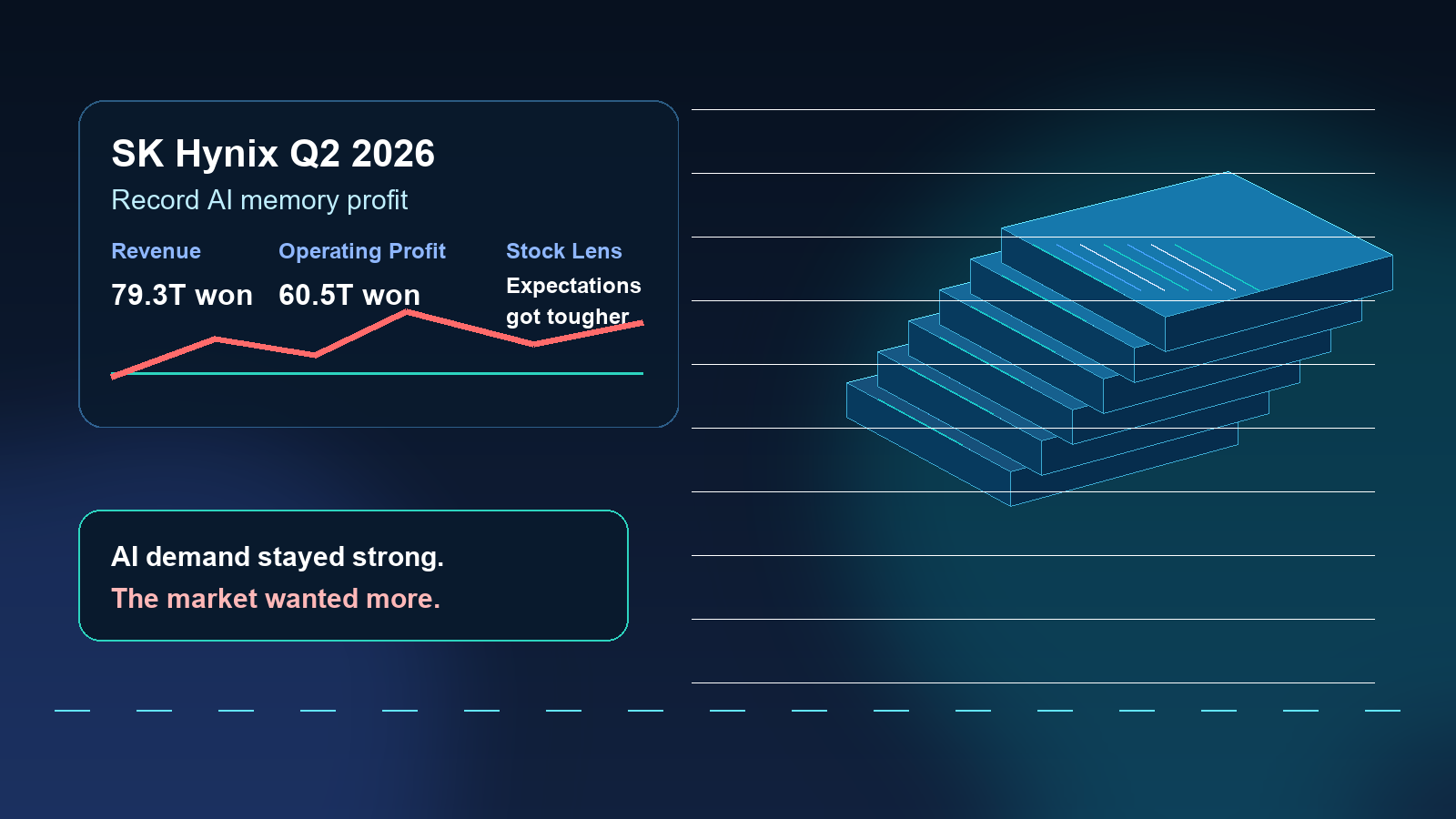
SK Hynix’s reported numbers were remarkable by ordinary standards. The Wall Street Journal reported that the company posted revenue of 79.319 trillion won, operating profit of 60.543 trillion won, and net profit of 93.923 trillion won for the second quarter. Barron’s also noted that quarterly revenue was up 257% year over year, although it came in below expectations of roughly 84 trillion won.
That gap explains much of the stock reaction. Before the release, Yonhap cited a consensus estimate for 84.1 trillion won in sales and 64.1 trillion won in operating profit. In other words, SK Hynix did not disappoint because the business was weak. It disappointed because expectations had moved so far ahead of normal earnings logic.
| Metric | Q2 2026 Reported / Market Context | Investor Read |
|---|---|---|
| Revenue | 79.319 trillion won | Record scale, but below elevated consensus expectations |
| Operating profit | 60.543 trillion won | Record profit, but below the pre-report consensus cited by Yonhap |
| Net profit | 93.923 trillion won | Extraordinary bottom-line result, helped by non-operating gains as reported by market coverage |
| Stock reaction | Sharp selloff in Seoul and U.S.-linked trading | Investors were positioned for near-perfect results |
| Market backdrop | Kospi and AI-linked chip stocks under pressure | Earnings reaction amplified by broader de-risking |
The table matters because it separates two ideas that often get collapsed after earnings: company performance and stock performance. SK Hynix’s company performance remained exceptional. SK Hynix stock, however, had to absorb whether that performance was enough compared with what investors had already paid for.
That distinction is especially important for a memory company. In older DRAM cycles, investors often focused on whether supply was tightening, whether inventory was falling, and whether pricing was turning. In the AI-memory cycle, those questions still matter, but the market is also asking whether premium HBM economics can change the company's earnings quality. If HBM makes revenue less cyclical and margins more resilient, SK Hynix deserves a different discussion from the memory stocks of the past. If HBM simply creates a more profitable but still capacity-sensitive cycle, the valuation debate becomes much more cautious.
What Investors Are Really Debating Now
The central debate is not whether SK Hynix is benefiting from AI. It clearly is. The harder question is whether the current profit level is an early stage of a longer structural reset, or whether the stock is already discounting a near-peak version of the cycle.
HBM leadership is still the bull case
The bullish case remains straightforward. SK Hynix has been one of the clearest beneficiaries of high-bandwidth memory demand, and the AI server buildout continues to pull premium memory into data centers. If AI infrastructure spending keeps expanding, HBM can support higher average selling prices, better mix, and stronger margins than a conventional memory upcycle.
That is why a simple “earnings miss” label can be misleading. The company is not reporting stress. It is reporting record profitability. Investors who remain constructive on SK Hynix will argue that the stock is being punished for missing an aggressive consensus, not for any collapse in end demand.
The bear case is about expectation risk
The bearish case is more subtle. It does not require AI demand to vanish. It only requires the market to decide that future upside is less certain than the valuation implied. If investors start worrying about HBM oversupply, customer concentration, aggressive capacity expansion, or China-linked competition in broader DRAM, the stock can fall even while earnings remain high.
That is the danger of a crowded AI trade. Once a stock becomes a symbol of a major investment theme, its earnings hurdle rises. Good numbers become ordinary. Great numbers need to be accompanied by better guidance, cleaner capital-allocation signals, or evidence that pricing power can last longer than feared.
Why the Korean Market Reaction Was So Severe
SK Hynix’s selloff did not happen in isolation. AP reported that SK Hynix shares sank 12.6% while Samsung Electronics dropped 8%, pulling the Kospi sharply lower. Reuters coverage carried by Investing.com had already described pressure on Korean chip stocks from China competition fears and the retreat from AI-related names.
That combination matters for investors. SK Hynix is not only a company-specific earnings story; it is a major weight in Korea's equity-market psychology. When it rallies, it can lift the market’s technology narrative. When it falls, it can force investors to question the entire AI-memory premium embedded in Korean equities.
There is also a timing issue. The latest available Investing.com historical data showed SK Hynix closing at 1,550,000 won on July 28, down 14.65% on the day. Because the stock was moving quickly around the earnings release and July 29 market reaction, investors should verify the latest real-time quote through KRX, a broker, or live market-data pages before using any price as a trading input.
The Korean-market angle also changes how traders read the earnings surprise. A U.S. chip stock can sometimes lean on global passive flows, dollar liquidity, and Nasdaq risk appetite. SK Hynix has that global AI exposure, but its primary listing still trades inside the rhythm of the Korean market. Foreign flows, index futures, won movement, and Samsung-related read-throughs can all affect how quickly investors rotate in or out. That means the post-earnings move is not just a judgment on one quarter. It is also a test of whether Korea's AI-stock leadership can withstand a broader valuation reset.
The Stock Narrative: From AI Scarcity to AI Proof
The SK Hynix story has moved through three phases. First came survival, when memory companies were recovering from the prior downturn. Then came scarcity, when HBM capacity became one of the clearest constraints on AI hardware supply. Now comes proof: proof that demand can remain strong, proof that margins can hold, and proof that management can invest without creating the next oversupply cycle.
That third phase is harder for stocks. Scarcity narratives can expand multiples quickly because investors are buying a future bottleneck. Proof narratives are more demanding because investors start asking for quarter-by-quarter confirmation. The Q2 report gave the market strong evidence, but not enough to stop de-risking.
This is where the stock can become more volatile even as the company becomes more profitable. Investors are no longer debating whether SK Hynix has relevance in AI. They are debating the slope of the next several quarters. A slightly lower revenue number, a more cautious margin comment, or a hint of future supply normalization can matter more than it would have mattered earlier in the recovery. When a stock has already become an AI favorite, the market often treats the absence of upside surprise as its own kind of negative signal.
For long-term investors, this may create a more useful setup than the earlier euphoria. A stock that only goes up on AI enthusiasm can become fragile. A stock that is forced to reprice around real earnings, real margin assumptions, and real supply risk becomes easier to analyze. The selloff does not automatically make SK Hynix cheap, but it does make the debate more grounded.
What to Watch After Q2
The next stage of the SK Hynix stock story will likely turn on four checkpoints. The first is HBM demand visibility: whether major AI customers continue to lock in supply, and whether those commitments translate into durable margins. The second is conventional DRAM pricing, because a broader memory recovery can either support the HBM story or expose dependence on one premium segment.
The third is capital spending. Investors want enough investment to defend leadership, but not so much that the industry recreates the oversupply problem that has hurt memory stocks in past cycles. The fourth is Korean market liquidity. If the Kospi remains under pressure, SK Hynix may struggle even if company-level fundamentals stay strong.
That is the real lesson from this earnings day. SK Hynix is still one of the most important AI memory names in the world. But after a huge rally, the stock needs more than record numbers. It needs a narrative that can survive a market that has become more skeptical, more valuation-sensitive, and less willing to reward AI exposure without fresh evidence.
Trade SK Hynix Stock 24/7 with Perpetual Futures on edgeX
edgeX allows traders to take positions on SK Hynix stock 24/7 via the SKHYNIXUSDC perpetual futures pair - no brokerage account, no KRX market hours, and no centralized custodian required.
SK Hynix trades on the Korea Exchange (KRX) during set market hours, but the semiconductor cycle doesn’t pause at 3:20 PM Seoul time. edgeX’s SKHYNIXUSDC perpetual futures pair lets you act on SK Hynix price movements around the clock, any day of the week. Whether a memory demand report drops on a Sunday night or an earnings surprise hits during Asian off-hours, you're not locked out.
The edgeX decentralized exchange combines CEX-level execution with DeFi self-custody. The withdrawal flow reflects that design. A withdrawal request on edgeX is confirmed through your own wallet and released without requiring platform approval - no operational queue, no discretionary delay. Settlement runs on the EDGE chain, anchored to Ethereum via Arbitrum, with smart contracts that have undergone third-party security audits. For traders seeking SK Hynix price exposure without ceding control of their capital, the SKHYNIXUSDC perpetual futures pair offers a structurally different arrangement.
Ready to trade SK Hynix on your schedule? Start trading the SKHYNIXUSDC perpetual futures pair with up to 10x leverage at edgeX exchange.
Frequently Asked Questions
Did SK Hynix have a bad Q2 2026 earnings report?
No. The report was very strong in absolute terms. The issue was that market expectations were even higher, and the stock had already priced in an aggressive AI-memory profit story.
Why did SK Hynix stock fall after record earnings?
The stock fell because reported revenue and operating profit were below elevated consensus expectations, while Korean and global semiconductor shares were already under pressure from AI-capex and competition concerns.
Is SK Hynix still an AI memory leader?
Yes. SK Hynix remains one of the key beneficiaries of high-bandwidth memory demand. The investment debate is about valuation, durability, and supply discipline, not whether AI memory demand exists.
What should investors watch next?
Investors should watch HBM supply agreements, DRAM pricing, capital spending, customer concentration, Korean market liquidity, and whether AI infrastructure spending remains strong enough to support premium memory margins.
Can investors trade SK Hynix directly on edgeX?
No. edgeX does not provide spot equity ownership of SK Hynix shares. It offers SKHYNIXUSDC perpetual futures for price exposure, which is structurally different from owning KRX-listed common stock.

