SK hynix Open to Further US Investment, Sees Memory Chip Shortage Through 2030
Key Takeaways
- •SK hynix said it is open to additional investment in the United States, but no new decision has been made.
- •The company expects the global memory chip shortage to continue through the end of 2030.
- •Its Indiana advanced packaging project was announced in 2024 with about $3.87 billion in planned investment and is targeted for production in 2028.
- •Kwak said AI demand is pushing the memory business toward more customized chips and may reduce the severity of past boom-and-bust cycles.
- •SK hynix said a possible U.S. IPO for Solidigm remains under review, and no decision has been made on its stake in Kioxia.
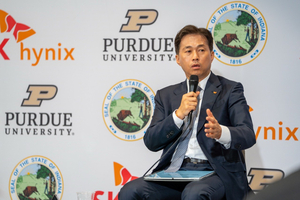
SK hynix remains open to additional semiconductor investment in the United States, while the South Korean chipmaker expects a global memory chip shortage to persist through the end of 2030, CEO Kwak Noh-jung said Thursday.
The outlook matters beyond one company: SK hynix is the world’s second-largest memory chipmaker and a leading supplier of the high bandwidth memory (HBM) chips used in AI accelerators, making its capacity plans a closely watched signal for a supply chain that runs from data centers to consumer electronics.
“We are always open (for more investment), but nothing has been decided,” Kwak told reporters after a groundbreaking ceremony for the company’s advanced packaging plant in West Lafayette, Indiana.
The Indiana project, announced in 2024 with roughly $3.87 billion in planned investment, is designed to bring advanced packaging for HBM and related R&D onto US soil, with production targeted for 2028.
The CEO said SK hynix is surveying potential sites worldwide that could support its development and testing requirements, with power supply, water availability and government incentives among the key considerations.
“If there is a location that can provide sufficient infrastructure and resources, we are open to anywhere,” he said, adding that he hoped the company could bring “more good news” for the US AI industry in the future.
Kwak noted that SK hynix’s investment plans have grown modestly from its initial agreement with the US government, primarily because demand has strengthened.
AI Reshapes the Memory Business
According to Kwak, the rise of AI is transforming the memory chip business from one centered on standardized products to one increasingly built around partially or fully customized chips — a shift expected to make the industry’s traditional boom-and-bust cycles less severe.
The stakes are familiar to anyone who has followed the sector: the industry’s latest downturn ran from 2022 into 2023, when oversupply pushed major memory makers deep into the red before AI demand ended the slump.
“The memory chip industry underwent multiple downturns over the past decades, when the memory business was based 100 percent on commodity chips,” Kwak said. “Now, our products are either partly customized or completely customized.”
Closer coordination with customers, he added, would give chipmakers greater visibility into future demand.
Kwak said SK hynix sees no clear sign of a downturn in the coming years. Even if one were to emerge, he expects demand to ease gradually rather than collapse as it has in past memory cycles.
“After 2030, we expect supply-demand to become more balanced, with the overall AI industry continuing to grow,” he said.
Looking Beyond Memory
SK hynix is also looking beyond memory as AI increasingly blurs the boundaries between memory, logic and advanced packaging. The CEO pointed to the latest HBM4 — the next generation of high bandwidth memory, which SK hynix has said it is ready to mass-produce — as an early example, with logic circuitry incorporated into its base die.
The company’s newly established AI Co., Kwak said, will serve as an investment vehicle for startups and companies that could support its next businesses, including those offering coordination with its existing memory operations.
On Solidigm, SK hynix’s NAND subsidiary — built from the NAND and solid-state drive business it acquired from Intel — Kwak said a potential US initial public offering remains under review. “We have not decided to withdraw the plan,” he said.
No decision has been made on SK hynix’s stake in Japan’s Kioxia, Kwak said, though he indicated the company is exploring ways to deepen its role in Japan’s chip industry. SK hynix became the largest shareholder in the Japanese NAND flash maker earlier in August, after Toshiba reduced its stake through a series of market sales — a move that pushed an SK hynix-backed investment vehicle into the top spot. SK hynix’s interest in Kioxia dates to 2018, when it joined the Bain Capital-led consortium that acquired the company.
“Just as we want to contribute to the AI industry in the US, we also want to contribute to Japan’s semiconductor industry,” he said. “We are carefully looking at how we can grow the market together.”
Source: Korea Herald Business

