SK hynix Reopens Bonus Debate With Proposal to Pay Profit-Sharing in Stock
Key Takeaways
- •SK hynix management proposes paying well over half of annual profit-sharing awards in company shares subject to a lock-up period, replacing the current optional conversion system.
- •The existing ten-year agreement dedicates ten percent of annual operating profit to the bonus pool, a structure that has influenced comparable demands at Samsung Electronics and other major Korean companies.
- •The union contends the stock-based proposal undermines last year's deal and exposes employees to share-price volatility, with representatives warning of further action if no revised offer is presented.
- •SK hynix reported a 557.2 percent year-over-year surge in second-quarter operating profit to 60.54 trillion won, even as its share price experienced sharp swings including a 55.7 percent plunge from its June peak.
- •Samsung Electronics reached a May labor agreement establishing a new semiconductor bonus paid entirely in treasury shares, a model that is now reverberating back to SK hynix's negotiations.
SK hynix, the South Korean chipmaker whose profit-linked bonus formula set off a wave of similar demands across major domestic industries, is now exploring whether mandatory stock compensation could become the next benchmark for labor agreements.
The company and its union are scheduled to hold a fifth round of wage negotiations on Tuesday at SK hynix's campus in Cheongju, North Chungcheong Province. According to minutes from the previous session released by the union, management has maintained a proposal to pay well over half of the annual profit-sharing (PS) award in company shares, with a lock-up period restricting their sale for a set time.
The negotiations enter a new chapter in a debate that SK hynix itself helped ignite. Under a 2025 agreement, the company dedicates 10 percent of its annual operating profit to the PS pool. That deal eliminated a previous ceiling of 1,000 percent of base salary and locked in the formula for a 10-year term. Under the current structure, 80 percent of the pool is disbursed for the relevant year, with the remaining 20 percent deferred over two years.
The formula quickly became an industry reference point. Workers at Samsung Electronics pushed for a fixed profit-linked bonus, and comparable demands surfaced at major automotive and shipbuilding firms. The ripple effect is characteristic of South Korea's labor landscape, where wage and benefit outcomes at top conglomerates frequently influence negotiations across sectors.
Now SK hynix wants to reshape how the award is delivered. In the union-released minutes, management argued that a "sustainable" system—one capable of securing broader stakeholder support—is necessary. The company also reiterated a proposal to temporarily adjust wages if it posts a loss, though the specific mechanism has not been disclosed.
The union countered that the proposals would undercut last year's agreement and shift "the risk of share-price fluctuations" onto employees. Union representatives have warned of further action if management fails to present a revised offer at Tuesday's session.
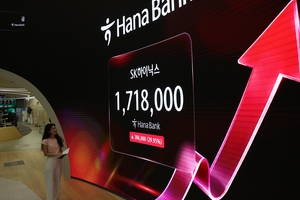
Recent market volatility has underscored that risk. SK hynix shares plunged 55.7 percent from an intraday record of 2.987 million won ($2,000) on June 25 to 1.322 million won on Thursday, before surging by the 29.95 percent daily limit to 1.718 million won on Friday.
Under the existing plan, employees may already elect to convert between 10 percent and 50 percent of their PS into shares, receiving a 15 percent cash premium after a one-year holding period. The new proposal would make stock the mandatory format for most of the award.
The financial implications have grown amid record earnings. SK hynix reported Wednesday that second-quarter operating profit reached 60.54 trillion won, a 557.2 percent increase year over year. The company is a leading global supplier of memory chips, including high-bandwidth memory used in artificial intelligence infrastructure, making its compensation arrangements a focal point for both investors tracking labor costs and workers across the semiconductor sector.
A parallel development at Samsung Electronics illustrates the chain reaction. Samsung's May labor agreement—reached after demands shaped by SK hynix's formula—established a separate semiconductor bonus paid entirely in treasury shares. That stock-based model is now reverberating back to SK hynix: while Samsung built stock payment into a newly created bonus, SK hynix is seeking to modify the payout terms of an existing 10-year agreement.

