SK Group Chairman Chey Tae-won Faces 944 Billion Won Divorce Settlement; Share-Backed Loans, Dividends, and SK Siltron Stake Sale Seen as Likely Funding Sources
Key Takeaways
- •The Seoul High Court mandated that Chey Tae-won pay 944 billion won in cash, preserving his shareholding and direct control over SK Group.
- •Chey's 17.9 percent stake in SK Inc. is considered essential to his group-wide control, making a reduction unlikely despite the financial burden.
- •Analysts anticipate Chey will finance the settlement through share-backed loans, increased dividends from affiliates, and monetization of his personal SK Siltron stake.
- •SK Telecom shares rose on expectations of enhanced dividend payouts, even as other SK Group affiliates declined alongside a broader market sell-off.
- •Chey's 29.4 percent personal stake in unlisted semiconductor wafer producer SK Siltron, currently under negotiation for sale to Doosan, is valued at over 5 trillion won.
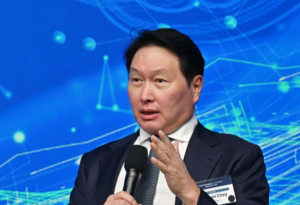
SK Group Chairman Chey Tae-won's nearly 1 trillion won ($685 million) divorce settlement has turned investor focus toward SK Group shares, as markets evaluate how the chairman will finance the record payment while retaining control of the energy-to-chip conglomerate.
On Friday, the Seoul High Court ordered Chey to pay 944 billion won in cash to his former wife, Roh Soh-yeong, in South Korea's largest-ever divorce settlement, bringing a yearslong legal battle to a close.
Because the court mandated a cash payment rather than a transfer of shares, Chey's grip on SK Group remains directly unaffected. However, raising nearly 1 trillion won still represents a significant financial obligation, intensifying speculation about how he will leverage his shareholdings.
Chey holds a 17.9 percent stake in SK Inc., the group's holding company, currently valued at approximately 8.52 trillion won. Market observers consider it unlikely that he will reduce this stake, given that it forms the foundation of his control over SK Group. South Korea's major family-controlled conglomerates, known as chaebol, typically rely on layered holding structures that allow founders and their relatives to exercise group-wide control through relatively small direct stakes, making any reduction of those positions especially sensitive.
SK Inc. sits at the top of the group's ownership structure, holding a 32.21 percent stake in intermediate holding company SK Square, which in turn owns a 20.5 percent stake in flagship chipmaker SK hynix. SK hynix is a global leader in memory chips and a key supplier of high-bandwidth memory (HBM) used in artificial intelligence accelerators, making its ownership structure strategically significant at a time when AI-driven semiconductor demand is reshaping competitive dynamics across the industry.
Rather than selling shares, market analysts broadly anticipate that Chey will draw on a combination of share-backed loans, increased dividend income, and monetization of unlisted assets.
Share-Backed Loans
Expanding share-backed borrowing is widely viewed as the most probable option. Chey has previously utilized stock-backed loans, and the substantial rise in SK Inc.'s share price has markedly enhanced his borrowing capacity by increasing the collateral value of his holdings.
Higher Dividends
Another avenue would be boosting cash inflows through increased dividends. Under this scenario, profitable subsidiaries such as SK Telecom would raise dividend payouts to SK Inc., which would in turn increase Chey's personal dividend income. SK Inc. holds a 30.6 percent stake in SK Telecom, the country's largest telecommunications firm by market share.
While SK Group shares plunged on Friday alongside the benchmark Kospi's 5.72 percent decline, SK Telecom shares closed 0.5 percent higher, reflecting investor expectations of an improved dividend payout. The stock surged as much as 5 percent during intraday trading.
Following the appellate court's 2024 divorce ruling, local brokerage Hana Securities projected that SK Telecom would likely enhance shareholder returns, enabling more dividends from the group's cash-generating affiliates to flow directly to Chey. Hana Securities named SK Telecom its top pick in the sector.
SK Siltron Stake Monetization
Market speculation has also focused on the potential monetization of Chey's personal stake in unlisted SK Siltron. Chey owns a 29.4 percent interest in the semiconductor wafer manufacturer, valued at over 5 trillion won.
In a deal currently under negotiation with Doosan, the buyer is expected to acquire SK Inc.'s 70.6 percent stake in SK Siltron while separately purchasing Chey's 29.4 percent personal stake. Since these shares are a personal asset unrelated to group management control, selling them would likely be the least burdensome route for Chey to raise the funds needed for the settlement. SK Siltron is South Korea's only domestic producer of semiconductor wafers, a critical input in chip manufacturing that has drawn growing strategic interest as countries push to strengthen local semiconductor supply chains.
Market Impact
Shares of SK Group's key affiliates declined sharply on Friday amid a broad Kospi sell-off. SK Inc. fell 3.82 percent, while SK hynix and SK Square dropped 8.34 percent and 9.17 percent, respectively.

