Silver and Gold Stocks Surge 20+ Percent on the Week Amid Broad Precious Metals Rally
Key Takeaways
- •Gold surged to a close of $4,341.30 per ounce, gaining $101.40 on the day, after the U.S. economy unexpectedly lost 23,000 non-farm jobs in July against a Dow Jones consensus forecast of an 83,000 gain.
- •Precious metal mining equities significantly outperformed the underlying metals, with the HUI Gold BUGS Index rising 7.39 percent and the Silver Sentiment Index gaining 6.62 percent on Friday.
- •China's central bank extended its gold-buying streak to 21 consecutive months, adding approximately 20 tonnes in July — its largest monthly reserve increase since October 2023.
- •The gold-silver ratio compressed to 68.4:1, down from 69.1:1 the prior day, reflecting silver's faster appreciation relative to gold.
- •Rising spread differentials in both gold and silver futures contracts may signal tightening availability for near-term physical delivery of the metals.
Silver and Gold Stocks Surge 20+ Percent on the Week Amid Broad Precious Metals Rally
Ed Steer | SilverSeek
Gold prices rose the moment Shanghai markets opened on Friday morning, holding gains until a modest pullback began around the noon silver fix in London. The metal then surged vertically following the weak U.S. non-farm payroll report at 8:30 a.m. EDT, before commercial traders brought the rally under control within approximately fifteen minutes. Gold was subsequently sold lower in a measured fashion until 1:00 p.m. in COMEX trading in New York, then drifted gradually higher through the 5:00 p.m. EDT close.
CME Group recorded the low and high ticks in gold at $4,257.70 and $4,399.50 in the October contract, and $4,288.00 and $4,432.30 in December — an intraday move of $144.30 in the latter month. The August/October price spread differential at the New York close was $26.40; October/December was $32.60; December/February 2027 was $35.60; and February/April 2027 was $33.80 per ounce.
Gold closed Friday in New York at $4,341.30 spot, up $101.40 on the day and $29.10 off its Kitco-recorded high tick. Combined net volume in October and December was approximately 197,500 contracts, with an additional 16,800 contracts in roll-over/switch volume.
In August contracts, 422 gold and 461 silver contracts were traded. Deliveries this month have been disappointing, with no contracts being added.
Silver
Silver's rally during Far East and early London Globex trading was capped at 9:00 a.m. BST, then sold lower until the non-farm payroll data release. From that point, commercial traders managed silver's price path in a manner similar to gold through the 5:00 p.m. EDT close.
Silver's low and high ticks were $61.42 and $65.48 in the September contract, representing a $4.06 intraday move. The September/December spread differential was 72.3 cents, and December/March 2027 was also 72.3 cents per ounce. Spread differentials in silver have risen notably in recent days, with gold spreads also ticking higher — a pattern that can reflect tightening availability for near-term physical delivery.
Silver closed Friday at $63.46 spot, up $2.06 on the day but $1.52 off its Kitco-recorded high tick. Net volume was relatively light at 44,000 contracts, with approximately 22,500 contracts in roll-over/switch volume — predominantly into December, with the remainder into March 2027.
Platinum and Palladium
Platinum's rally in overseas Globex trading was capped at noon in Zurich, then sold unevenly lower until around the 10:00 a.m. EDT afternoon gold fix in London. It then chopped broadly higher through the 5:00 p.m. EDT close. Platinum closed up $25 from Thursday at $1,743 spot, $35 off its Kitco-recorded high tick.
Palladium formed a double top at approximately 10:30 a.m. and 11:40 a.m. CEST in Zurich, was engineered lower through the 8:20 a.m. COMEX open, and its price spike on the non-farm payroll number was quickly contained. Palladium chopped lower until around the 10:00 a.m. EDT gold fix, then staged a choppy rally that encountered resistance around 3:15 p.m. in thin after-hours trading before being sold sharply lower. Palladium closed at $1,357 spot, up $4 on the day and $32 off its Kitco-recorded high tick.
Gold/Silver Ratio and Dollar Index
Based on Kitco spot closing prices, the gold/silver ratio stood at 68.4:1 on Friday, compared to 69.1:1 on Thursday. The ratio, which measures how many ounces of silver one ounce of gold buys, has compressed significantly from levels above 80:1 seen in earlier years, reflecting silver's faster appreciation.
The dollar index closed Thursday at 99.93, then opened one basis point higher when trading commenced at 7:45 p.m. EDT Thursday evening (7:45 a.m. China Standard Time Friday). The index traded in a quiet range until the non-farm payroll release at 8:30 a.m. EDT. After the data, the dollar index finished Friday at 99.54, down 39 basis points from Thursday's close. A weaker dollar typically supports dollar-denominated commodity prices by making them cheaper for holders of other currencies.
Treasury Yields
The U.S. 10-year Treasury yield closed at 4.6600%, down 0.0100 (-0.21%), as of the 1:59:53 p.m. CDT close. The yield dropped sharply at 8:30 a.m. EDT before crawling higher until approximately 11:12 a.m., then traded sideways through the close. For the week, the 10-year yield declined by 8.50 basis points.
Mining Stocks
Gold shares gapped higher at the 9:30 a.m. equity market open in New York, hitting highs at the 10:00 a.m. EDT London afternoon gold fix, then drifted lower before recovering through the 4:00 p.m. close. The HUI (NYSE Arca Gold BUGS Index) closed up 7.39 percent. Mining equities carry operating leverage: because production costs are relatively fixed, small increases in metal prices can translate into larger percentage gains in mining company earnings and share prices.
Silver stocks followed a similar path, with highs reached by 9:55 a.m. Nick Laird's Silver Sentiment Index closed higher by 6.62 percent.
The two top-performing silver stocks were Coeur Mining (up 11.12 percent) and SSR Mining (up 10.46 percent). Peñoles was the weakest performer, closing up only 3.85 percent.
Key performance metrics for Friday:
- Silver: +3.35%; Silver Sentiment Index: +6.62%; Sprott PSLV: +3.22%
- Gold: +2.39%; HUI: +7.39%; Sprott PHYS: +2.08%
The HUI outperformed the Silver Sentiment Index on both relative and absolute bases, despite silver outperforming gold by a wide margin.
The Shanghai/U.S. price premium in silver was 12.30 percent on Friday.
Weekly and Year-to-Date Performance
The weekly chart showed broad gains across precious metals and their equities, with precious metal equities rising significantly relative to underlying metals. The year-to-date chart showed precious metal equities in positive territory despite the metals themselves remaining negative for the year, with silver shares notably outperforming the metal itself.
Despite silver briefly breaking the $120 barrier and London silver supplies nearly running dry last October, the gold/silver ratio remains at 68.4:1. The historical ratio of approximately 15:1 would imply silver at $290 based on Friday's gold close, while the 7:1 ratio at which silver comes out of the ground relative to gold would imply approximately $620 per ounce.
COMEX Daily Delivery Report — August, Day 7
116 gold and 450 silver contracts were posted for delivery within COMEX-approved depositories on Tuesday.
In gold, BNP Paribas issued 115 contracts from its client account. The three largest of eight long/stoppers were JPMorgan (56 contracts, client account), Wells Fargo Securities (25 contracts), and RBC Capital Markets (13 contracts).
In silver, BNP Paribas was the sole issuer from its client account. The two largest of five long/stoppers were Wells Fargo Securities (274 contracts, house account) and JPMorgan (145 contracts).
Month-to-date, 15,416 gold and 1,375 silver contracts have been issued/reissued and stopped in August. On First Notice Day, 15,653 gold and 1,248 silver contracts remained open. Deliveries have been underwhelming, with only a small number of contracts added since then.
CME Preliminary Report — Friday Session
Gold open interest in August fell by 848 contracts, leaving 918 open, minus the 116 contracts for Tuesday delivery. This resulted in a net addition of 152 gold contracts to the August delivery month.
Silver open interest in August increased by 151 contracts, leaving 622 open, minus the 450 contracts for Tuesday delivery — meaning 151 silver contracts were added.
Total gold open interest rose by a net 8,715 COMEX contracts (primarily December), while total silver open interest increased by 1,699 contracts.
ETF and Fund Activity
GLD added 90,598 troy ounces of gold, and GLDM added 17,262 troy ounces. There was no reported change in SLV.
In other global gold and silver ETFs and mutual funds, net of COMEX, GLD, GLDM, and SLV activity, 154,158 troy ounces of gold and 1,110,861 troy ounces of silver were added — almost entirely from 1,098,869 troy ounces added to iShares/SSLN.
SLV borrow rates started at 0.27% and ended at 0.43%, with 10.0 million shares available to short. GLD borrow rates remained at 0.44%, with 6.6 million shares available.
U.S. Mint Sales — July
The U.S. Mint sold 7,000 troy ounces of gold eagles, 8,000 one-ounce 24K gold buffaloes, and 425,000 silver eagles.
COMEX Warehouse Activity — Thursday
In gold, 11,785 troy ounces were received (all at Loomis International), and 158,041 troy ounces were shipped out — including 114,148 from Manfra, Tordella & Brookes, Inc. and 43,893 from HSBC USA. Paper activity included 80,882 troy ounces adjusted out of the Eligible category at Asahi, and 14,467.950 troy ounces (450 kilobars) transferred from Registered to Eligible at JPMorgan.
In silver, nothing was received and 304,166 troy ounces were shipped out — including 300,128 from Loomis International and 4,038 from Delaware. There was no paper activity.
Shanghai Futures Exchange
The SHFE reported a net addition of 44,593 troy ounces (1.387 metric tonnes) of silver, leaving inventories at 40.550 million troy ounces (1,261.244 metric tonnes).
U.S. Gold and Silver Trade Data — June
The U.S. imported 13.225 tonnes (425,196 troy ounces) of gold and exported 66.349 tonnes (2.133 million troy ounces). In silver, imports were 569.204 tonnes (18.300 million troy ounces) and exports were 201.33 tonnes (6.473 million troy ounces).
China added 19.9 tonnes (639,800 troy ounces) of gold to its official reserves in July, bringing totals to 2,366 tonnes (76.07 million troy ounces). Most long-time market observers believe actual reserves may be 10 times this amount.
Global Depository and ETF Holdings
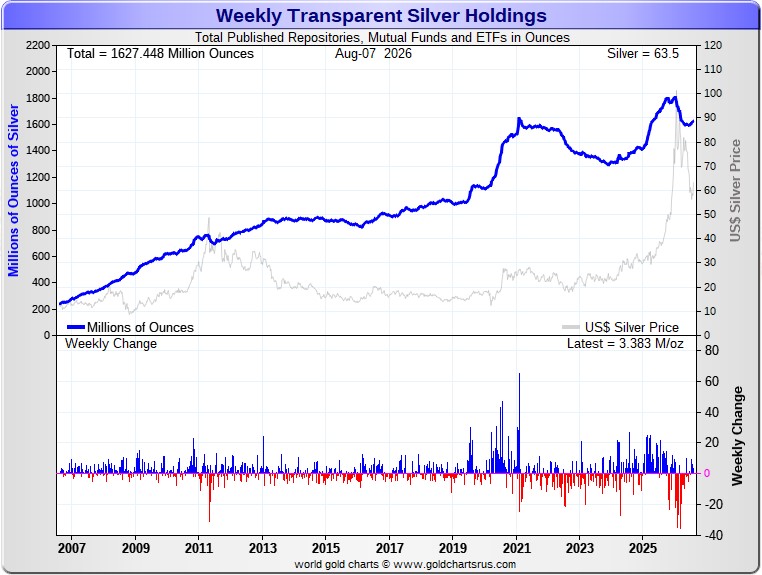
During the past week, a net 107,000 troy ounces of gold and 3.383 million troy ounces of silver were added to all known depositories, ETFs, and mutual funds.
Over the last four weeks, a net 1.027 million troy ounces of gold were added globally, marking three consecutive weeks of net gold deposits. The largest inflows were 700,996 troy ounces into Tether — the issuer of USDT, the world's largest stablecoin by market capitalization, which has been accumulating physical gold as a reserve asset — 583,457 into SLV, and 254,743 across five iShares ETFs. The largest outflows were 394,610 troy ounces from the COMEX and 130,115 from iShares/IAU.
A net 20.195 million troy ounces of silver were added over the same four-week period, including 10.235 million into SLV, 5.505 million into the COMEX, and 1.750 million into WisdomTree. The largest outflow was 967,000 troy ounces from Sprott's Central Fund of Canada.
Silver held in all known depositories, ETFs, and mutual funds remains below its late January 2026 all-time high. Net additions have occurred in seven of the last eight weeks.
Major Silver Depositories
- SLV: 487.8 million troy ounces (largest), up 1.1 million net this week
- COMEX: 334.3 million troy ounces, up 1.5 million net (adjusted to approximately 231.3 million after deducting 103 million held in trust for SLV by JPMorgan)
- PSLV (Sprott): 215.4 million troy ounces, unchanged for the second consecutive week
JPMorgan's adjusted silver warehouse holdings stand at approximately 35 million troy ounces, versus the 137.9 million reported. The bank has parted with approximately 76 million ounces over the past nine months.
SLV Short Position
The latest short report (for positions as of July 15) showed SLV's short position rose 1.17% to 31.13 million shares, representing 5.81% of total shares outstanding. No physical silver backs these shorted shares, contrary to SLV prospectus requirements. BlackRock warned over a decade ago that there might not be enough metal for shorts to cover.
The next short report (for positions as of July 31) is due August 11 on The Wall Street Journal's website.
Bank of America reportedly holds a large OTC short position in silver, with JPMorgan and associated parties on the long side. Ted Butler discussed this in an April 2021 article, "A New Piece of the Puzzle."
Commitment of Traders Report — Silver
For positions as of Tuesday's close, the Commercial net short position in silver rose by 1,613 COMEX contracts (8.065 million troy ounces). Commercials purchased 611 long contracts and added 2,224 short contracts.
In the Disaggregated COT Report, Managed Money added 2,792 net long contracts and Nonreportable/small traders added 1,550. Other Reportables reduced their net long position by 2,729 contracts.
The Commercial net short position in silver stands at 40,422 contracts (202.110 million troy ounces).
- Big 4: net short 31,919 contracts, up 437
- Big 5-8: net short 15,792 contracts, up 852 (sixth consecutive weekly increase)
- Big 8 total: net short 47,711 contracts, up 1,289
- Ted Butler's "raptors" (25 small commercials): reduced net long position by 324 contracts to 7,289 contracts net long
The Big 8 are net short 42.6% of total open interest in silver, down from 43.5% the prior week, largely due to a 5% increase in total silver open interest.
Managed Money traders remain net long 11,974 COMEX silver contracts — unusual for this price level, as they would typically be net short or market neutral.
Commitment of Traders Report — Gold
The Commercial net short position in gold increased by 14,182 COMEX contracts (1.418 million troy ounces), through the sale of 3,628 long contracts and addition of 10,554 short contracts.
In the Disaggregated COT Report, Managed Money added 10,971 net long contracts and Other Reportables added 4,593. Nonreportable/small traders reduced their net long position by 1,382.
The Commercial net short position in gold stands at 226,491 contracts (22.649 million troy ounces).
- Big 4: net short 140,074 contracts, up 7,386
- Big 5-8: net short 63,907 contracts, up 4,679
- Big 8 total: net short 203,981 contracts, up 12,065 — now 42,083 contracts above their record low of 161,898 (May 26)
- Raptors (38 small commercials): increased net short position by 2,117 contracts, now net short 22,510 contracts
The Big 8 are short 54.9% of total open interest in gold, up from 49.9%. Including the 38 raptors, the commercial net short position is 61.0% of total open interest, up from 55.2%. Excluding market-neutral spread trades, it rises to approximately 65%.
COT — Other Metals
Palladium: Managed Money decreased net short position by 715 contracts to 5,458 net short — the only category net short palladium. Total open interest is 18,574 contracts, near the lowest since 2022.
Platinum: Managed Money increased net long position by 4,434 contracts to 10,960 net long. Producer/Merchant category net short 11,155 contracts; Swap Dealers net short 7,287.
Copper: Managed Money increased net long position by 10,750 contracts to 75,758 (1.894 billion pounds). Producer/Merchant category net short 92,844 contracts (2.321 billion pounds); Swap Dealers net long 6,675 contracts. The bifurcation between these two commercial categories has persisted for over 10 years.
Days to Cover
Per Nick Laird's chart (positions as of August 4):
Silver: Big 4 short approximately 69 days of world production; Big 5-8 short 34 additional days; Big 8 total 103 days (approximately 3.4 months of world production, or 238.555 million troy ounces / 47,711 contracts).
Gold: Big 4 short approximately 43 days; Big 5-8 short 20 additional days; Big 8 total 63 days of world production.
Bank Participation Report — August
Gold: 5 U.S. banks net short 86,236 contracts (up 3,838 from July), their largest position since February. 24 non-U.S. banks net short 97,331 contracts (up 1,691), also their largest since January. Combined, 29 banks were net short 49.4% of total gold open interest, up from 47.9%.
Silver: 5 U.S. banks net short 6,357 contracts (down 1,244 from July). Gross short position fell to 13,511 contracts from 16,128 in July. 15 non-U.S. banks net short 26,473 contracts (up 452). Combined, 20 banks were net short 29.3% of total silver open interest, down from 32.1% due to increased open interest.
Platinum: 5 U.S. banks net short 6,794 contracts (up 340). 14 non-U.S. banks net short 13,490 contracts (down 577). Combined, 19 banks net short 36.3% of total open interest, down from 38.2%.
Palladium: 5 U.S. banks net long 71 contracts. 12 non-U.S. banks net short 817 contracts. 17 banks combined net short 4.0% of total open interest. The Big 8 shorts (non-bank) are net short 41.1% of total palladium open interest.
The next Bank Participation Report is due September 4.
Critical Reads
U.S. Economy Unexpectedly Lost 23,000 Jobs in July
The Bureau of Labor Statistics reported Friday that non-farm payrolls fell by a seasonally adjusted 23,000 in July, compared with a downwardly revised 20,000 decline for June. The Dow Jones consensus forecast had projected a gain of 83,000. The unemployment rate slipped to 4.1% as the labor force participation rate fell to 61.4%, its lowest in more than five years. May's count was revised down to 63,000, bringing the 12-month average to 34,000. The severe miss — every estimate in the consensus projected job growth — strengthened market expectations for Federal Reserve rate cuts, which reduce the opportunity cost of holding non-yielding assets such as gold and silver.
Nicole Bachaud, labor economist at ZipRecruiter, stated: "The July employment report solidified that the labor market is not out of the woods quite yet."
The Zero Hedge coverage was headlined "July Jobs Shock: U.S. Lost 23K Workers, Below Lowest Estimate, As Unemployment Rate Drops to 4.1%."
Consumer Credit Jumps More Than Expected in June
The Fed's G.19 report showed U.S. consumer credit posted a $14.17 billion bounce in June, fully reversing May's $1.1 billion decline and exceeding the $11.9 billion median estimate. Revolving credit rose $6.7 billion, bringing total outstanding credit card debt to $1.351 trillion, just $1 billion below the October 2024 all-time high. Non-revolving credit rose $7.4 billion, lifting total student and auto loans to a record $3.816 trillion.
Bessent's Gambit — Doug Noland
Doug Noland wrote: "I do not see compelling data that would warrant downgrading overheating risks. Instead, financial conditions remain exceptionally loose, and inflationary pressures are ever more deeply ingrained."
Noland noted that the VIX closed the week at 14.9 (low since January 9), the S&P 500 posted a record close, and 10-year Treasury yields dipped only three basis points on the surprising job losses to close at 4.65%. The rates market priced 28 basis points of rate cuts for the year, down from 37 the prior Friday.
Regarding Treasury Secretary Scott Bessent's approach, Noland wrote: "Bessent is willing to take extraordinary measures to prevent potentially unmanageable market instability." He noted that Bessent invoked Mario Draghi's "whatever it takes" phrasing from the 2012 European bond crisis. Noland assessed that Fed Chair Kevin Warsh's rhetoric on scaling back the Fed's balance sheet "can pretty much be dismissed," and that the administration is "hellbent on avoiding" a disorderly unwind of carry-trade and basis-trade leverage.
Dollar's Global Dominance Slipping
Economist Barry Eichengreen wrote in a Financial Times column that by selling euros instead of dollars to support the yen — and by encouraging Japan to use a Fed facility rather than directly selling Treasuries — the Trump administration signaled it is "no longer comfortable with U.S. allies selling Treasurys to support their own currencies," potentially denting the appeal of Treasuries as a reserve asset.
Eichengreen wrote: "The bottom line is that Washington, fearing the consequences for U.S. financial markets, is reluctant to see foreign central banks use their dollar reserves. This is telling us that the dollar is not the attractive reserve currency it once was."
China's Exports Beat Estimates in July
China's exports grew 23.9% year-over-year in July in U.S. dollar terms, topping the Reuters consensus forecast of 22.2%. Imports rose 27.5%, slightly below the 27.9% estimate. Integrated circuit exports surged 117% year-over-year in July, with year-to-date chip export values nearly doubling. Mechanical and electrical products accounted for over 60% of total shipments, driven by electric vehicles, lithium batteries, and wind power equipment.
China Moving Gold from London to Hong Kong
Bloomberg reported that the People's Bank of China has been building gold inventories in Hong Kong over recent months, accelerating a longer-term trend of relocating reserves from London. The relocation is set to continue, supporting Hong Kong's push to become a major bullion-trading hub.
China's Gold Reserves Rise by Most Since October 2023
The PBOC extended its gold-buying streak to 21 consecutive months, with reserves rising to 76.08 million fine troy ounces at end-July from 75.44 million. The 640,000-ounce increase (approximately 20 metric tons) was the largest monthly addition since October 2023. Purchase pace has increased each month since March, when the central bank added 160,000 ounces.
The Wrap
Both gold and silver posted significant gains, though commercial traders intervened to cap excessive rallies. Silver was stopped pennies before hitting $66 bid in the spot market. Silver is now back above its 50-day moving average for the first time since mid-May.
Total gold open interest rose only approximately 8,700 contracts and silver by 1,700 contracts in Friday's preliminary report — small amounts relative to the price moves. October has returned as a scheduled delivery month in gold after a 60+ year absence.
Platinum and palladium remained on short price leashes since breaking above their 50-day moving averages on Tuesday. Copper shed 12.5 cents to close at $6.56/pound. Natural gas gained 3 cents to $2.67/1,000 cubic feet. WTIC closed at $77.07/barrel, down 22 cents.
An X post circulating Thursday stated in part: "The FT said that Washington is reluctant to see foreign central banks use their dollar reserves, and reserve diversification is apt to gather steam... if Treasuries can't be sold in a crisis without worsening the crisis, they are no longer fit for purpose as FX reserves... Every reserve manager had to watch a G7 creditor nation ask for permission to use its own savings. Ridiculous. Btw, the asset that doesn't require permission is at $4,224 this evening. Act accordingly."
That asset — gold — closed at $4,341 spot on Friday, up $117.
A separate X post by SightBringer (@The_Prophet) offered an extended analysis of what the author termed the conversion of the U.S. financial system into a "sovereign absorption mechanism," arguing that fiscal and monetary policy distinctions are collapsing, and that "the real policy objective is not sound money. It is controlled degradation." The author described an "operating corridor" in which the currency weakens slowly, bond yields balance demand and debtor solvency, inflation erodes liabilities without triggering revolt, and asset prices preserve collateral without total political illegitimacy.
This analysis echoes British economist Peter Warburton's April 2001 essay, "The Debasement of World Currency: It's Inflation, But Not As We Know It."
The author characterized the current system as a "self-licking ice cream cone" — a self-perpetuating mechanism with no purpose other than self-sustenance — and invoked the chess term Zugzwang to describe the predicament facing both global central banks and the Big 8 shorts in precious metals.
China's announcement of 20 tonnes of gold added to reserves in July reinforces the trend of global movement from paper to hard assets.
The next Bank Participation Report is due September 4. The next SLV short report is due August 11.
Source: SilverSeek

