‘Silver ARMY’ reshapes BTS fandom
Key Takeaways
- •Vicki Ronn said BTS’s lyrics and performances helped her reconnect with her passion for scholarship after discovering the group in 2020.
- •An 89-year-old Las Vegas fan, Dori Jacobson, posted a message in December 2023 urging younger ARMY members to wait for BTS’s return in 2025.
- •All seven BTS members had enlisted for South Korea’s mandatory military service by late 2023, and the group is expected to reunite in 2025.
- •Speakers at the Jeonbuk National University conference said older fans are becoming a larger and more active part of K-pop’s global audience, with commercial importance for South Korea’s cultural exports.
- •The article also noted BTS’s appeal to younger fans in Mongolia and broader examples of K-pop being used to express solidarity in civic settings in East Asia.
Vicki Ronn, a professor of English at Friends University and a BTS fan in her 60s, gave her adult son a vinyl copy of BTS member J-Hope's solo album Jack in the Box, turning him into a devoted fan.
Ronn discovered BTS in 2020 after watching the group perform "On" in front of New York's Grand Central Terminal on NBC's The Tonight Show Starring Jimmy Fallon. During the COVID-19 pandemic, she was drawn in by the group's dynamic stage performance and later fell for its lyrics.
"'Black Swan' is a song about the fear of losing your passion for what you love," Ronn told the Hankook Ilbo at Jeonbuk National University on Sunday. "Listening to it made me reflect on how I had been losing my passion as a scholar."
89-year-old American sparks fandom shift
Ronn was among many who traveled to Korea to attend a BTS conference at Jeonbuk National University. Her presentation focused on aging, participatory culture and the reimagining of women, examining how BTS has changed the lives of older fans abroad and the new social relationships they are building through fan communities.
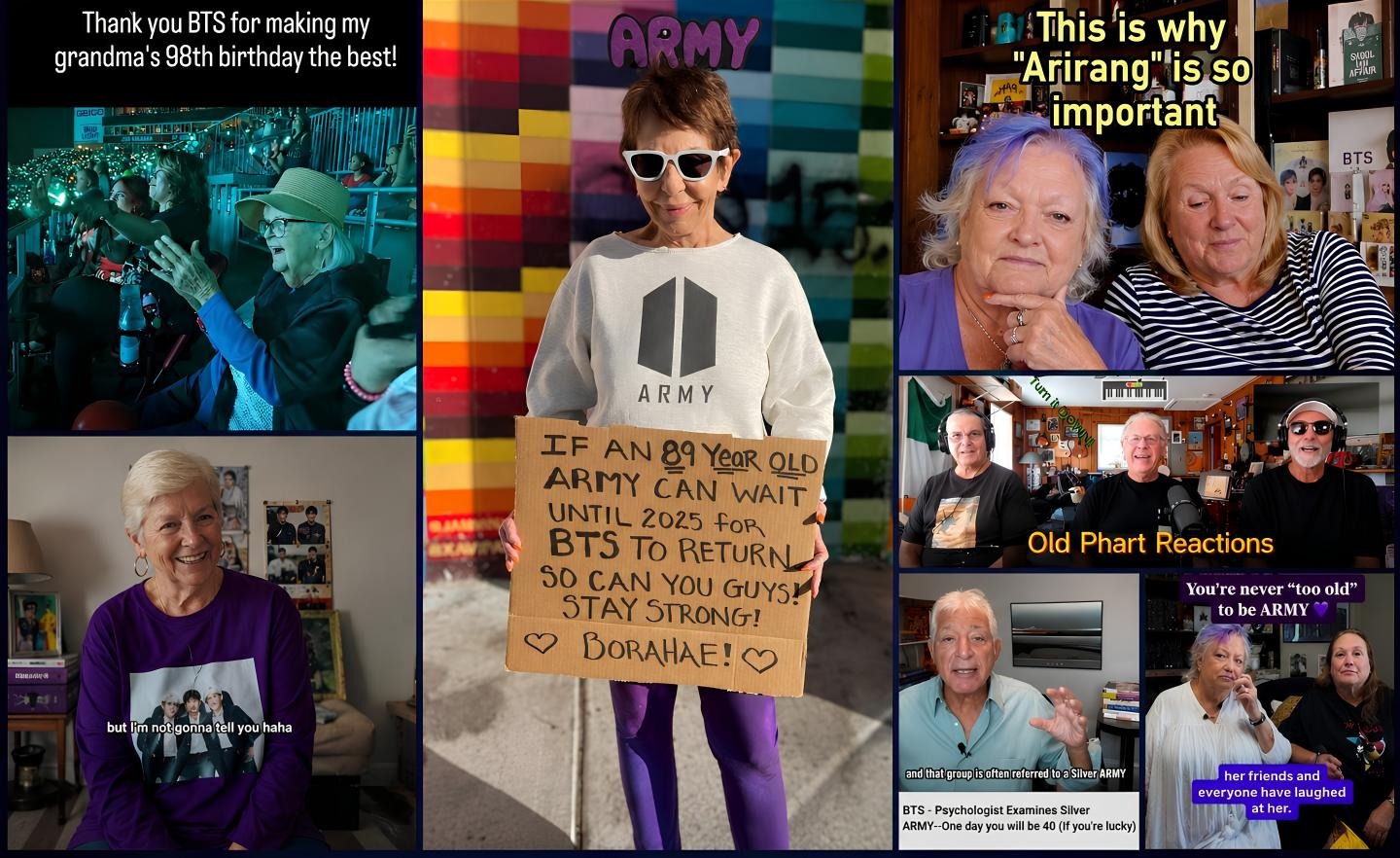
Ronn cited Dori Jacobson as an example of the "Silver ARMY," an informal term for older BTS fans. Jacobson, an 89-year-old resident of Las Vegas, posted a photo of herself holding a sign that read, "IF AN 89 YEAR OLD ARMY CAN WAIT UNTIL 2025 FOR BTS TO RETURN, SO CAN YOU GUYS! STAY STRONG!" She created the post in December 2023 to comfort younger fans grieving the group's hiatus during the members' mandatory military service.
All seven BTS members enlisted for South Korea's mandatory military service by late 2023, with the group expected to reunite as a full ensemble in 2025. The hiatus has tested the durability of one of the world's most active fan communities, and older fans like Jacobson have emerged as a steadying presence.
Jacobson's case shows how older BTS fans are moving beyond passive consumption to become active participants in shaping the fandom. K-pop fan culture, known for passion and solidarity, has taken hold among middle-aged and older adults.
The Silver ARMY phenomenon reflects a broader change in the global K-pop fandom. K-pop is no longer confined to teenagers and people in their 20s. As the consumer base expands to older demographics, fandom culture itself is also changing — a shift that carries commercial weight for South Korea's cultural exports, which the government has tracked as a growing economic sector.
Older fans have become an increasingly important consumer group for K-pop. Grace Kao, a sociology professor at Yale University, attended BTS concerts in Las Vegas on two consecutive days in May. Kao said in an email that she saw many audience members in their 50s and older, adding that the Connecticut ARMY community she belongs to has a similar demographic.
"Middle-aged fans often have the time and disposable income to travel for concerts and view K-pop as a wholesome alternative to Western pop, raising the overall age profile of the fanbase," she said.
Members of the BTS Over 40 ARMY Club pose for a photo. Korea Times photo by Yang Seung-joon
Older fans fill overseas K-pop venues
Ronn said intergenerational connections are the key difference between traditional American pop-culture fandoms and the older BTS fanbase. She argued that K-pop's emergence as a platform for mature American women represents a new frontier for the Korean wave.
"People who experienced the feminist movements of the 1970s and 1980s have found their voices again through BTS," Ronn said.
Her observations have circulated widely in American online communities, where a 98-year-old American woman holding a BTS lightstick at a concert recently became a viral sensation.
Vicki Ronn, right, an English professor at Friends University in the United States, listens to a presentation during the 5th International BTS Conference at Jeonbuk National University Convention Center, Sunday. Courtesy of The 5th BTS: A Global Interdisciplinary Conference
Personal testimonials also frequently appear on social media. A 64-year-old British fan posted that BTS pulled her out of severe depression after a heart attack in 2022. A 68-year-old psychotherapist wrote that BTS gave clients facing terminal diagnoses a renewed motivation to live.
Why mature fans choose BTS over Taylor Swift
That has raised the question of why mature Western audiences choose BTS over a familiar local artist such as Taylor Swift.
"I think Taylor Swift mainly sings about what I felt in my teens or 20s," Ronn said. "Of course, many of my college students are Taylor Swift fans and connect deeply with her lyrics, but BTS's lyrics feel to me like a more universal narrative that crosses generations. They contain a philosophy of life."
U.S. pop star Taylor Swift performs on stage. Captured from Taylor Swift's social media
The professor said the song that moved her most was "Fake Love."
"Women of my generation grew up being told that we had to hide ourselves. There was social pressure to live as a 'false self' rather than show who we really were," she said. "I think that's why women my age find BTS's music more relatable."
K-pop group BTS poses for a photo after performing "Dynamite" at the FIFA World Cup halftime show in New Jersey, July 19. Courtesy of BigHit Music
K-pop fills youth narrative gap in Asia
While BTS has brought renewed energy to older fans around the world, the group also serves as a guiding force for Mongolian youth.
Anujin Mungunkhu, a 17-year-old Mongolian student, explained during the conference why young people in Mongolia listen to BTS. In an interview, she said she coped with anxiety after entering 10th grade by listening to the 2020 track "Life Goes On."
"The song's message is, 'Things may be hard now, but do not worry too much. Life goes on, so let us keep living together.' It comforted me," she said.
Anujin's presentation was part of research by Tsengel Davaasambuu, a professor at the Mongolian State University of Arts and Culture, titled "The BTS Effect and the Physicality of Hallyu: A Socio-Economic Analysis of the Korean wave in Post-Nomadic Mongolia." Davaasambuu said BTS's "Love Yourself" campaign resonated with local youth navigating rapid social change.
"More than half of Mongolia's population is now concentrated in the capital, Ulaanbaatar. This sudden shift to city life has left people used to the relaxed pace of a traditional nomadic society feeling completely disoriented," Davasambuu told the Hankook Ilbo. "For teenagers growing up in the middle of all this massive change, BTS's message to 'believe in yourself' has really struck a chord."
Mongolian student Anujin Mungunkhu, left, and Tsengel Davaasambuu, a professor at the Mongolian State University of Arts and Culture, pose at Jeonbuk National University Convention Center during The 5th BTS: A Global Interdisciplinary Conference, Sunday. Korea Times photo by Yang Seung-joon
K-pop's role extends beyond comforting individuals. In April, Girls' Generation's "Into the New World" was heard outside Japan's National Diet in Tokyo during a rally defending the country's pacifist constitution. The same song has been adopted at civic gatherings elsewhere in East Asia, a pattern scholars have linked to K-pop's emotionally resonant lyrics and its association with collective solidarity.
Demonstrators gather their K-pop lightsticks to take a picture during the "No War" street rally in Osaka, Japan. Captured from X
This article from the Hankook Ilfo, the sister publication of The Korea Times, is translated by a generative AI system and edited by The Korea Times.

