Go Master Shin Jin-seo Defeats KataGo in Historic Two-Stone Handicap Match, Setting Up Decider
Key Takeaways
- •Shin Jin-seo became the first professional Go player to defeat the KataGo AI engine in an official two-stone handicap match.
- •The nine-dan grandmaster won the second game by four and a half points after 299 moves, evening the three-match series at one win each.
- •KataGo had previously dominated numerous professionals receiving the same two-stone handicap, making Shin's victory an exceptionally rare achievement.
- •The two-stone handicap theoretically granted Shin an 18.5-point lead and a 99% estimated winning probability at the start of the game.
- •The decisive third game will be broadcast live on July 21 on Hankyung TV under the same handicap conditions.
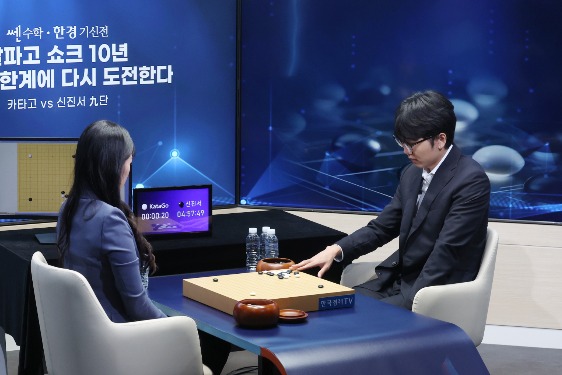
Shin Jin-seo, the world's top-ranked Go player, has become the first professional to defeat the elite AI engine KataGo in an official two-stone handicap match. The nine-dan grandmaster won Sunday's contest by four and a half points after a grueling 299-move battle lasting four hours and 50 minutes, leveling the three-game series at one apiece and forcing a decisive third game on Tuesday.
The breakthrough marked a dramatic turnaround from Friday's opening game, in which KataGo overcame Shin's early advantage during a complex midgame fight and compelled him to resign after 245 moves.
"I thought I had constructed the opening very well, but once the AI began invading along the second line, the pressure was so intense that I could barely breathe," Shin said following Sunday's match. "I thought it would be difficult from there. Still, I stayed calm and pulled myself together."
A Different Game
As in the opener, Shin began Sunday's match with two stones already placed on the board. The handicap theoretically granted him an 18.5-point lead at the outset and an estimated 99% probability of winning. In practice, however, such advantages had done little to protect professionals against KataGo. The self-trained engine — widely regarded as the gold standard of Go AI — had previously dominated numerous practice games against professionals receiving two stones, making Shin's victory an exceptionally rare achievement.
In Friday's first game, Shin's estimated winning probability dropped below 99% after just 70 moves. The position tightened rapidly, and KataGo had seized the upper hand by move 102.
Sunday's game unfolded along a markedly different trajectory. Shin repelled a series of sharp tactical attacks and maintained his 99% estimated winning probability beyond move 150, holding his advantage far longer than in the opener. The balance tightened during a fierce midgame struggle that briefly saw his winning probability fall to 89%. Shin appeared rattled by KataGo's counterattack but navigated a narrow path through the complications. He regained control with a sequence of precise moves in the center and smiled as the outcome became clear.
Historic Context
South Korean Go legend Lee Se-dol famously defeated Google DeepMind's AlphaGo in one game of their five-match series in 2016. AlphaGo ultimately won the series 4-1. Those games were played without any handicap.
Shin's victory came under fundamentally different conditions, with the human player receiving two stones. In Go, handicaps are adjustments designed to level the playing field between players of differing skill levels, offsetting rank differences to produce a closer, more competitive game. That distinction matters because the result is not a like-for-like repeat of the AlphaGo era, but a test of whether the strongest human professionals can still convert a structured advantage against modern engines.
Even so, the result carries considerable symbolic weight. Go engines have advanced rapidly over the past decade, and KataGo had proven virtually unbeatable against professionals under the same two-stone handicap.
"It was only one small battle, but beating AI made it meaningful," Shin said. "I'll give it my best again in the final game, just as I did today."
Match Rules and Stakes
Under the match rules, Shin receives five hours of main time followed by one 30-second countdown period. KataGo has no overall time limit but must make each move within 20 seconds.
Shin is guaranteed 50 million won ($33,560) for each game, or 150 million won for the three-match series, plus a 50 million won bonus for each victory.
Com2uS Tygem Corp., operator of the Tygem online Go platform, constructed a dedicated system for KataGo by linking four Nvidia GeForce RTX 3090 graphics cards in parallel.
The deciding match will be broadcast live on July 21 on The Korea Economic Daily's Hankyung TV (). The match is sponsored by The Korea Economic Daily and Truebook Sinsago, an educational publisher best known for its Ssen math workbooks. With the series tied and the same two-stone conditions in place, the final game will determine whether Shin can turn Sunday's breakthrough into a match victory.
The 26-year-old Shin Jin-seo is the reigning world No. 1 in Go rankings.
