Bitcoin researchers unveil “Shielded Bitcoin” metaprotocol for Zcash-style private transfers
Key Takeaways
- •The Sept. 24 paper by researchers at [[alloc] init] introduces Shielded Bitcoin, a metaprotocol designed to conceal transaction amounts, senders, recipients, and transfer links without requiring a Bitcoin soft fork or consensus changes.
- •The design adapts Zcash-style tools, including encrypted notes, public nullifiers, and zero-knowledge proofs, and publishes its data on Bitcoin mainnet through OP_RETURN rather than launching a separate blockchain.
- •Peg-in and peg-out mechanisms that would move ordinary $BTC into and out of the shielded system are not yet specified, leaving open questions about trustlessness and resistance to transaction linkage.
- •Some metadata, such as transaction timing, fees, and input and output counts, would remain visible, while viewing capabilities could allow selective disclosure of transaction information for auditing or compliance purposes.
- •ZEC climbed above $1,600 this week as weekly shielded transactions reached 62,379, their highest level since 2022, and Bitwise Europe's André Dragosch described Shielded Bitcoin as a potential headwind for privacy coins.
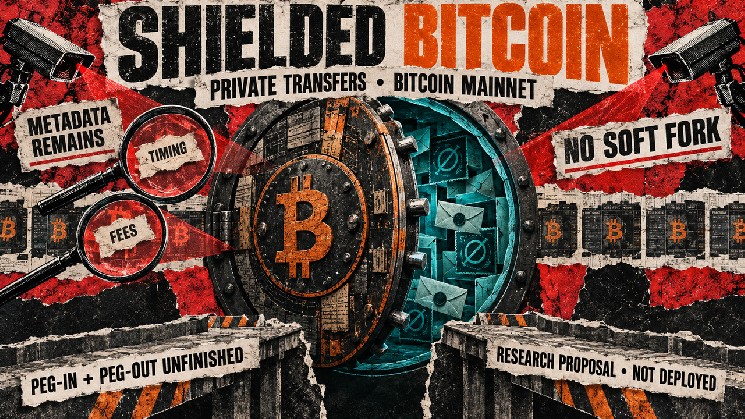
A team of Bitcoin researchers has proposed a design for private transfers directly on the Bitcoin network — one that would require no soft fork and no changes to consensus rules.
The Sept. 24 paper, authored by Clara Shikhelman, Mikhail Komarov, and Aleksei Moskvin of [[alloc] init], introduces Shielded Bitcoin, a metaprotocol built to conceal transaction amounts, senders, recipients, and the links between transfers while publishing its protocol data through Bitcoin mainnet.
The design adapts techniques pioneered by Zcash, including encrypted notes, public nullifiers, and zero-knowledge proofs, but stops short of creating a separate blockchain. Bitcoin itself serves as the publication and ordering layer from which participants reconstruct the private transaction state.
If realized, the approach would extend Bitcoin privacy beyond existing tools such as CoinJoin, PayJoin, and Silent Payments, which can complicate transaction tracing or reduce address reuse yet still leave amounts and other transaction details visible.
Bitcoin would carry the transactions without validating the privacy layer
The proposal sidesteps the wait for a Bitcoin upgrade by moving the privacy logic above the network’s consensus rules.
Users would hold $BTC-denominated value as encrypted notes. To move funds, a sender would publish an envelope containing encrypted outputs, public nullifiers marking previously held notes as spent, and a zero-knowledge proof establishing ownership and value conservation. The amount being transferred and the identities of the counterparties would remain hidden.
Bitcoin miners and nodes would not validate the shielded state themselves. Instead, implementations following the Shielded Bitcoin rules would scan $BTC blocks and replay accepted transfer envelopes in their recorded order, producing a common note tree and a spent-note set.
Bitcoin would therefore supply the timestamped transaction history and ordering needed to reconstruct the system, while the metaprotocol would handle encrypted balances and transfer verification.
In its current implementation profile, the system uses OP_RETURN to publish the encrypted transfer data, though the researchers leave open the possibility of other publication methods.
That architecture marks a departure from Zcash, where the network’s consensus rules enforce shielded transaction validity directly. Shielded Bitcoin would keep $BTC consensus untouched while deriving a separate private state from data anchored to the chain.
Not all metadata would be concealed. Transaction timing, fees, input and output counts, and characteristics of the Bitcoin transaction carrying the encrypted data could still give observers clues.
The paper also includes viewing capabilities that could let users selectively disclose transaction information without surrendering control of their funds, creating a route for auditing or compliance where required.
Sam Callahan, director of strategy and research at Bitcoin treasury company OranjeBTC, said the development fits a broader view that Bitcoin can accumulate functionality without competing with other blockchains feature by feature.
“People still misunderstand Bitcoin’s moat. Bitcoin doesn’t need to win every feature race. Privacy, speed, and functionality can be built over time. The moat is its decentralization, security, and credible monetary policy,” he said. “And on those dimensions, nothing else comes close.”
The design remains incomplete at one critical boundary: moving ordinary $BTC into and out of the shielded system.
Peg-in and peg-out mechanisms sit outside the current specification. Those components would need to lock Bitcoin on mainnet, represent that value inside the private note system, and later release the corresponding $BTC when users exit.
[[alloc] init] expects those flows to rely on its PIPEs v2 work, but the researchers have yet to publish the detailed construction. That leaves open questions around whether entry and exit can be made trustless, private, and resistant to transaction linkage. A distinctive deposit amount, withdrawal amount, or timing pattern could still connect activity at either end of the shielded system.
Other deployment choices also remain unresolved, including the final proof system, publication format, and how light clients can verify shielded state without replaying the full relevant Bitcoin history.
Privacy coins face fresh pressure as Zcash rally tests the thesis
The proposal arrives as privacy-focused cryptocurrencies again attract investor attention, reviving a long-running debate over whether dedicated privacy networks retain an enduring technological advantage over Bitcoin.
André Dragosch, Bitwise Europe Head of Research, described Shielded Bitcoin as a “potential headwind for privacy coins,” reflecting the risk that features once associated with separate networks could increasingly be reproduced around Bitcoin without altering its monetary rules or base-layer consensus.
That argument becomes more consequential for Zcash, where privacy has become central to the token’s recent revaluation. $ZEC climbed above $1,600 this week as shielded activity accelerated and investors returned to the idea that Zcash offers native transactions that can conceal senders, recipients, and amounts.
Usage has moved alongside price. Weekly shielded transactions recently reached 62,379, their highest level since 2022, while nearly 5 million $ZEC were held in shielded pools this month. network also settled more than $23 billion in transfer volume last week, its strongest weekly total since 2021.
Shielded Bitcoin pressures that narrative because it seeks to deliver comparable transaction confidentiality while keeping $BTC as the underlying asset. If the system eventually works as designed, users seeking stronger privacy would have another route besides moving into a dedicated privacy coin.

